Will Global De-Dollarization Change India’s Lending and Bond Market Landscape
|
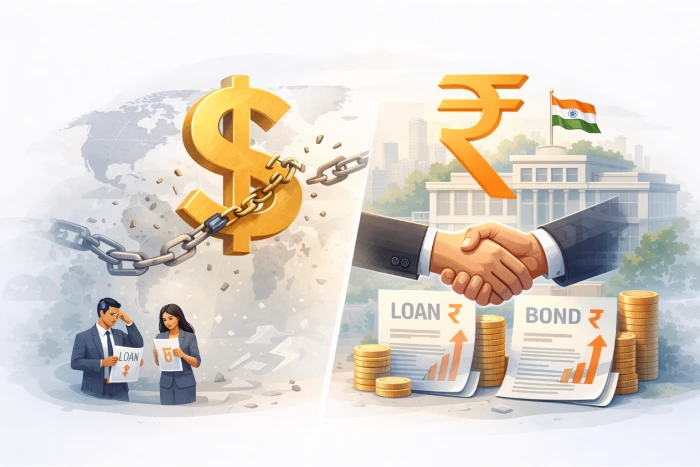
Global de-dollarization is no longer just a geopolitical buzzword. Countries are increasingly exploring trade settlements in local currencies, expanding bilateral swap lines, and reducing reliance on the US dollar. But will global de-dollarization change India’s lending and bond market landscape? The answer is yes, gradually and structurally rather than dramatically overnight. If more trade happens in rupees or alternative currencies, it could influence India’s bond yields, liquidity conditions, interest rates, and external borrowing patterns. For borrowers planning home loans, personal loans, or business loans, understanding these macro shifts helps in making informed long-term decisions.
What Is Global De-Dollarization?
Global de-dollarization refers to the gradual reduction of the US dollar’s dominance in:
International trade settlements
Foreign exchange reserves
Cross-border lending
Commodity pricing
Countries within blocs such as BRICS have discussed increasing trade in local currencies. Central banks are also diversifying reserves into gold and non-dollar assets.
However, the US dollar still accounts for the majority of global trade invoicing and reserve holdings. The shift is incremental, not revolutionary.
Why It Matters for India
India is one of the world’s largest importers of crude oil and capital goods. A large portion of trade is denominated in dollars.
If trade settlement in rupees expands:
Currency risk may reduce
Forex reserve pressure could ease
External borrowing patterns may shift
The Reserve Bank of India has already introduced mechanisms for rupee trade settlement with select countries to reduce dependency on the dollar in specific transactions.
Impact on India’s Bond Market
1. Government Bond Yields
If India settles more trade in rupees and attracts more foreign participation in rupee bonds:
Demand for Indian government securities may increase
Yields could stabilize or soften
Currency volatility impact may reduce
Foreign Portfolio Investors track currency risk closely. Reduced dollar dependency may enhance investor confidence over time.
India’s inclusion in global bond indices has already increased foreign participation in G-Secs. Over the long term, de-dollarization could support rupee bond market depth.
2. Corporate Bond Market Expansion
Indian corporates often borrow through:
Rupee bonds
Dollar-denominated external commercial borrowings
Masala bonds
If dollar dependency reduces:
Corporates may prefer rupee-denominated borrowing
Currency hedging costs may decline
Domestic bond issuance could increase
Rating agencies such as CRISIL have noted that deeper domestic bond markets improve financial system resilience.
Impact on Lending Rates in India
The lending ecosystem depends heavily on liquidity, inflation, and capital flows.
1. Reduced Currency Volatility
If de-dollarization lowers currency volatility:
Imported inflation pressure may reduce
RBI may face less pressure to hike rates defensively
Interest rate cycles could become more domestically driven
However, this assumes stable global trade conditions.
2. Lower External Vulnerability
When the rupee is less exposed to sudden dollar spikes:
Capital outflow risks decline
Bond yields stabilize
Banking system liquidity improves
This can positively impact home loan and business loan rates over time.
At Saarathi.ai, we have observed that macro stability directly influences lender risk appetite. When currency volatility reduces, lenders are more competitive in pricing.
Impact on Indian Borrowers
Home Loan Borrowers
Home loan rates are linked to repo rates and bond yields. If bond markets deepen and yields remain stable:
Long-term mortgage rates may remain competitive
Fixed-rate loans may become more attractive
Housing finance liquidity could improve
You can compare home loan offers on Saarathi.ai to evaluate competitive spreads across lenders.
Personal Loan Borrowers
Unsecured lending depends on funding costs and risk perception. A stable bond market reduces funding volatility for banks and NBFCs.
This can:
Improve credit availability
Stabilize pricing spreads
Encourage faster approvals
You can compare personal loan offers on Saarathi.ai to see transparent interest rate differences across institutions.
MSMEs and Startups
For businesses, de-dollarization can:
Reduce forex risk in trade
Lower hedging costs
Improve predictability of working capital cycles
However, startups dependent on US venture capital may still face funding cycles tied to US monetary policy.
Will the Dollar Lose Its Dominance Soon?
The US dollar remains dominant because:
US financial markets are deep and liquid
US Treasury bonds are considered safe assets
Global trade networks are dollar-centric
Even if trade diversification grows, replacing the dollar fully would take decades.
The policies of the US Federal Reserve still influence global capital flows. If US rates rise sharply, emerging markets including India may face capital outflows regardless of de-dollarization efforts.
RBI’s Strategic Position
The Reserve Bank of India focuses on:
Maintaining price stability
Managing forex reserves
Supporting financial stability
Deepening domestic bond markets
Rupee trade settlement initiatives are part of a long-term diversification strategy rather than an immediate replacement of dollar dominance.
As frequently reported by Economic Times, India’s forex reserves provide a strong buffer against external shocks, which reduces systemic lending risk.
How Digital Lending Fits Into This Shift
As global capital structures evolve, domestic credit efficiency becomes even more important.
At Saarathi.ai, we have seen that AI-driven lender matching improves capital allocation efficiency. When liquidity conditions change, the Saarathi Recommendation Engine analyzes borrower profiles across 110 plus lenders to find optimal matches.
Benefits during macro transitions:
Faster approvals despite rate volatility
Transparent rate comparison
Paperless documentation
Real-time tracking
You can track your application in Saarathi Bazaar and monitor rate changes, documentation, and approval stages seamlessly.
Before applying, you can ask eligibility questions via Saarathi AI expert to avoid unnecessary rejections.
Risks to Watch
De-dollarization is gradual and may create transitional volatility.
Potential risks include:
Trade settlement complexities
Currency liquidity mismatches
Global geopolitical tensions
Fragmentation of capital flows
Borrowers should focus on financial discipline rather than speculative macro positioning.
Practical Strategy for Borrowers in 2026
Maintain strong credit scores above 750
Keep EMI to income ratio below 40 percent
Compare lenders before locking rates
Consider fixed-rate options in uncertain cycles
Build emergency funds covering at least 6 months of EMIs
Macro shifts like de-dollarization influence markets slowly. Individual financial resilience matters more.
FAQs
What is de-dollarization in simple terms?
It is the gradual reduction in global dependence on the US dollar for trade, reserves, and financial transactions.
Will de-dollarization reduce Indian loan interest rates?
Not directly. It may reduce currency volatility over time, which can stabilize bond yields and lending rates.
How does it affect India’s bond market?
Greater rupee trade and deeper domestic markets may increase demand for Indian bonds and improve liquidity.
Should borrowers wait for rates to fall?
Interest rate movements depend on inflation and RBI policy. Borrowers should decide based on personal affordability rather than macro speculation.
Is India fully moving away from the dollar?
No. The shift is gradual and partial. The dollar remains dominant in global finance.
Conclusion
Global de-dollarization is a long-term structural trend, not an immediate disruption. For India, it may gradually strengthen the rupee bond market, reduce currency vulnerability, and improve domestic financial resilience.
However, lending rates will continue to depend primarily on inflation, liquidity, and RBI policy decisions.
For borrowers, the priority should remain strong credit health, smart lender comparison, and disciplined financial planning.
Discover personalized loan options on Saarathi.ai today and navigate changing global financial landscapes with confidence.