What to do financially after losing a job?
|
Losing a job can feel overwhelming. The emotional impact is real. But the financial response you choose in the first 30 days matters even more.
If you are wondering what to do financially after losing a job, the answer is not panic borrowing or withdrawing all investments. It is structured action.
In 2026, with rising EMIs and living costs, quick financial clarity is critical. At Saarathi.ai, we have observed that individuals who act early after job loss protect their credit score, reduce debt stress, and recover faster. This guide walks you through the exact steps to stabilize your finances after job loss in India.
Step 1: Pause and Assess Your Financial Position
Before making any major decisions, calculate three numbers:
Total liquid savings
Total monthly essential expenses
Total EMI obligations
Include:
Rent or home loan EMI
Personal loan EMIs
Car loan EMIs
Insurance premiums
Groceries and utilities
This gives you your survival monthly requirement.
Example:
Monthly Essentials: Rs 60,000
Liquid Savings: Rs 3,00,000
Runway = 5 months
This clarity reduces panic.
Step 2: Activate Your Emergency Fund
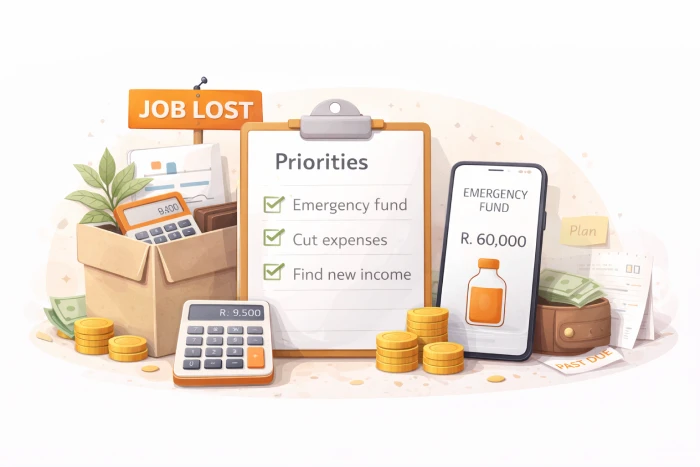
If you built an emergency fund, this is its purpose.
Ideally, you should have 3-6 months of expenses saved. Use it systematically:
Withdraw only what is required monthly
Avoid lump-sum spending
Track every rupee carefully
According to financial literacy guidance from the Reserve Bank of India, maintaining a liquidity buffer prevents unnecessary high-interest borrowing during income disruption.
If you do not have an emergency fund, your next steps become even more critical.
Step 3: Prioritize Essential Expenses Only
Immediately cut:
Dining out
Subscriptions
Non-essential shopping
Travel
Lifestyle upgrades
Focus only on:
Rent or home loan EMI
Utilities
Groceries
Insurance
EMIs
Temporary lifestyle reduction protects long-term financial stability.
Step 4: Protect Your Credit Score
Your credit score is one of your most valuable financial assets.
During job loss:
Do not miss EMIs
Do not skip credit card payments
Avoid minimum due cycles
Avoid multiple loan applications
If EMI pressure feels high, consider restructuring options early instead of defaulting.
At Saarathi.ai, we have observed that borrowers who proactively refinance or restructure before default protect their credit health significantly better.
You can ask eligibility questions via Saarathi AI to understand possible restructuring or refinancing options without harming your credit score.
Step 5: Talk to Your Lender Early
If you anticipate difficulty paying EMIs:
Contact lender immediately
Ask for temporary restructuring
Explore tenure extension
Discuss EMI moratorium if available
According to trends reported by Economic Times during economic slowdowns, proactive communication with lenders improves repayment flexibility.
Silence leads to penalties. Communication leads to options.
Step 6: Evaluate Loan Refinancing
If your EMIs are high:
Consider balance transfer
Look for lower interest rates
Extend tenure to reduce monthly EMI
You can compare personal loan offers on Saarathi.ai to explore better rates across 110+ lenders.
Our AI Recommendation Engine evaluates your repayment capacity and suggests suitable options, helping you avoid unnecessary rejections.
You can track applications transparently in Saarathi Bazaar.
Step 7: Avoid Panic Borrowing
Common mistake after job loss:
Taking high-interest personal loan
Using credit cards heavily
Borrowing for lifestyle continuity
Borrow only if:
Emergency fund is exhausted
Income restart timeline is clear
EMI is comfortably manageable
Debt taken without repayment visibility creates long-term damage.
Step 8: Review Insurance Coverage
Check:
Health insurance active?
Life insurance premium up to date?
Medical emergencies during unemployment can worsen financial stress.
Do not cancel insurance to save small amounts. It exposes you to a larger risk.
Step 9: Consider Partial Income Options
Even temporary income helps extend the runway.
Options:
Freelancing
Consulting
Gig work
Short-term contracts
Monetizing skills
If you reduce monthly expenses and earn partial income, the survival runway extends significantly.
Step 10: Recalculate Disposable Income Once Income Restarts
Once new income begins:
Disposable Income = Net Income - Fixed Obligations - Essentials - Adjusted Annual Costs
Before restoring old lifestyle:
Rebuild emergency fund
Clear high-interest debt
Strengthen savings rate
Avoid lifestyle inflation immediately after re-employment.
What If You Have No Emergency Fund?
If savings are minimal:
Cut expenses aggressively
Speak to lenders immediately
Avoid high-interest debt traps
Seek family support if necessary
Prioritize survival over reputation
Temporary assistance is better than long-term financial damage.
Sample Recovery Plan
Monthly Essentials Including EMIs: Rs 70,000
Savings: Rs 1,40,000
Runway: 2 months
Action Plan:
Cut lifestyle spending by Rs 10,000
Negotiate temporary EMI reduction
Freelance income target: Rs 25,000
New Monthly Burn Rate: Rs 45,000
New Runway: Over 3 months
Small adjustments extend survival time significantly.
When Should You Consider Selling Assets?
As last resort:
Sell non-essential assets
Liquidate secondary investments
Avoid selling retirement corpus unless unavoidable
Asset liquidation is preferable to high-interest debt accumulation.
Mental and Financial Discipline Go Together
Job loss is emotionally stressful. Emotional decisions often lead to financial mistakes.
Avoid:
Sudden big investments
Risky business ideas
Aggressive stock market bets
Large personal loans
Stability first. Growth later.
How Job Loss Affects Future Loan Eligibility
Lenders evaluate:
Income stability
FOIR ratio
Credit behavior
Employment continuity
Temporary unemployment does not permanently damage eligibility, but missed EMIs do.
At Saarathi.ai, we have observed that borrowers who maintain repayment discipline during tough phases rebuild eligibility faster.
Our AI-based matching system helps you apply to lenders aligned with your financial profile once income stabilizes.
Healthy Ratios to Aim for After Recovery
Emergency fund: 6 months expenses
EMIs: under 40-50 percent of income
Savings rate: minimum 20 percent
Credit utilization: under 30 percent
These ratios create resilience against future shocks.
FAQs
1. Should I use credit cards after job loss?
Only for essentials and only if you can repay fully. Avoid rolling balances.
2. Can I pause EMIs after losing a job?
You must speak to your lender. Some restructuring options may be available.
3. Should I withdraw investments?
Use emergency funds first. Withdraw long-term investments only if necessary.
4. Will job loss affect my credit score?
Not directly. Missed EMIs or defaults will affect it.
5. Is taking a personal loan advisable during unemployment?
Only if the repayment plan is clear and income restart is expected soon.
6. How soon should I refinance loans?
As early as possible if EMI pressure becomes difficult.
Conclusion
Losing a job is temporary. Financial damage can be permanent if handled poorly.
Key Takeaways:
Assess runway immediately
Activate emergency fund wisely
Cut non-essential expenses
Protect your credit score
Communicate with lenders early
Avoid panic borrowing
Rebuild savings once income resumes
Financial resilience comes from preparation and disciplined action. When you are ready to restructure or plan a new loan responsibly, discover personalized loan options on Saarathi.ai. Compare lenders, track your application in Saarathi Bazaar, and get AI-powered expert guidance in a transparent, paperless journey.