Will a Global Debt Crisis Tighten Loan Approvals in India?
|
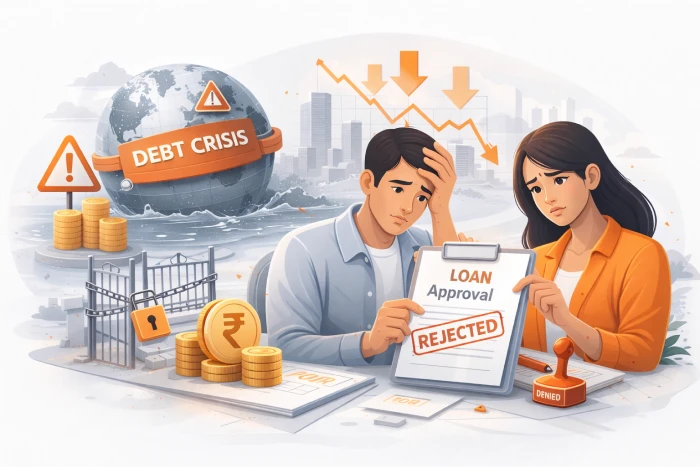
A global debt crisis may sound like a distant macroeconomic event, but its effects can quietly reach Indian borrowers. If major economies struggle to repay sovereign or corporate debt, global markets react through higher bond yields, capital outflows, currency volatility, and liquidity tightening. This raises a practical question for Indian households and businesses: could a global debt crisis trigger stricter loan approvals in India? The short answer is yes, especially if it leads to inflation pressure, funding stress, or reduced risk appetite among lenders. In this article, we explain how such a crisis could impact loan eligibility, interest rates, and job stability, and how you can stay financially prepared.
What Is a Global Debt Crisis?
A global debt crisis occurs when:
Governments struggle to service high sovereign debt
Corporations default on large borrowings
Bond markets lose confidence
Yields rise sharply due to risk perception
When debt levels rise faster than economic growth, investors demand higher returns. If defaults increase, global financial markets can face stress.
As reported frequently by Economic Times, rising global debt levels remain a key risk factor in volatile economic cycles.
How a Global Debt Crisis Spreads to India
India may not be at the center of such a crisis, but global integration means indirect impact.
1. Capital Outflows
If investors seek safety in US Treasuries or gold:
Foreign portfolio investors may exit Indian markets
Bond yields may rise
Rupee may weaken
2. Currency Depreciation
Capital outflows increase dollar demand, weakening the rupee. A weaker rupee makes imports like crude oil more expensive.
3. Inflation Pressure
Higher import costs push up fuel and commodity prices, raising inflation.
The Reserve Bank of India monitors inflation closely because it directly influences repo rate decisions.
Why Loan Approvals Could Become Stricter
When global uncertainty rises, lenders typically become cautious.
1. Higher Risk Premium
Banks and NBFCs may:
Increase interest spreads
Tighten eligibility criteria
Reduce maximum loan amounts
Unsecured loans such as personal loans are usually affected first.
You can compare personal loan offers on Saarathi.ai to see how different lenders adjust pricing during volatile cycles.
2. Stricter Income Assessment
If job markets show signs of stress:
Lenders may prefer applicants from stable sectors
Income verification may become more detailed
Startup or export dependent profiles may face closer scrutiny
3. Lower Loan to Value Ratios
For home loans, lenders may reduce loan to value slightly to manage risk exposure.
You can compare home loan offers on Saarathi.ai to identify lenders offering competitive and flexible funding structures.
Impact on Existing Borrowers
Floating Rate Loans
If inflation rises and the Reserve Bank of India raises repo rates:
EMIs may increase
Loan tenure may extend
Fixed Rate Loans
EMIs remain stable, but new borrowers may see higher rates.
Business Loans
MSMEs dependent on global trade may face:
Reduced export demand
Working capital pressure
Higher borrowing costs
Is India Financially Prepared?
India today has stronger buffers compared to past global stress episodes.
1. Improved Bank Balance Sheets
Banks have reduced non performing assets and improved capital adequacy ratios.
Rating agencies such as CRISIL have highlighted stronger provisioning and improved asset quality across major lenders.
2. Strong Forex Reserves
India maintains substantial foreign exchange reserves, providing cushion against capital outflows.
3. Active RBI Oversight
The Reserve Bank of India conducts regular stress tests and monitors sector wise credit exposure.
While global shocks can create temporary tightening, systemic collapse is less likely due to improved regulatory frameworks.
Which Borrowers Are Most Vulnerable?
During global debt stress, higher risk profiles include:
High EMI to income ratio above 45 percent
Unsecured loan heavy borrowers
Employees in export dependent sectors
Highly leveraged MSMEs
Prime salaried borrowers with stable jobs and strong credit scores remain relatively insulated.
Practical Steps to Strengthen Your Approval Chances
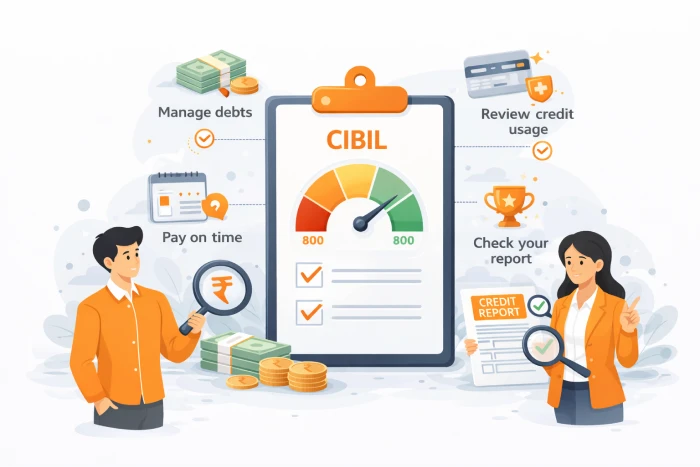
1. Maintain a Strong Credit Score
Keep your score above 750.
Pay all dues on time and reduce credit card utilization.
2. Lower Existing Debt
Reduce unsecured debt before applying for new loans.
3. Build Emergency Savings
Maintain at least 6 months of EMIs and expenses.
4. Choose the Right Lender
Different lenders have different risk appetites.
You can ask eligibility questions via Saarathi AI expert to understand your approval probability before applying.
5. Compare Transparently
Instead of approaching one bank, compare loan offers on Saarathi.ai across 110 plus lenders to find the best fit.
6. Track Your Application Digitally
Use Saarathi Bazaar to track your application in Saarathi Bazaar and monitor progress in real time.
Could Loan Approvals Freeze Completely?
Highly unlikely.
Even during global stress:
Retail lending continues
Housing demand persists
Domestic consumption supports credit growth
However, pricing may rise and eligibility norms may tighten temporarily.
India’s domestic demand driven growth model provides resilience against external debt shocks.
FAQs
Can a global debt crisis directly stop loan approvals in India?
No, but it can tighten eligibility norms and increase interest rates indirectly.
Will home loan EMIs increase?
If inflation rises and repo rates are hiked, floating rate EMIs may increase.
Are personal loans more affected?
Yes, unsecured loans are typically repriced faster during global stress.
Should I delay taking a loan?
If your income is stable and EMI ratio manageable, borrowing remains viable with careful planning.
How can I reduce rejection risk?
Maintain a high credit score, stable income documentation, and compare lenders before applying.
Conclusion
A global debt crisis can create ripple effects in India through capital outflows, currency volatility, and inflation pressure. This may lead to stricter loan approvals, higher risk premiums, and tighter eligibility norms.
However, India’s improved banking resilience, strong forex reserves, and active regulatory oversight provide stability.
For borrowers, the best strategy is disciplined financial planning, conservative EMI ratios, and smart lender comparison.
Discover personalized loan options on Saarathi.ai today and secure the right financing solution, even in uncertain global debt conditions.