Where should you keep your emergency fund?
|
Building an emergency fund is step one. Keeping it in the right place is step two. And that decision can make a huge difference.
If your emergency fund is locked in risky investments or hard-to-access instruments, it defeats the purpose. In 2026, with rising EMIs, job uncertainty, and business volatility, liquidity matters more than high returns.
At Saarathi.ai, we have observed that borrowers with properly structured emergency funds rarely miss EMIs and maintain healthier credit profiles. This guide explains exactly where you should keep your emergency fund in India and how to balance safety, liquidity, and modest returns.
What an Emergency Fund Must Do
Before choosing where to keep it, understand what your emergency fund must provide:
Immediate access
Capital safety
Low risk
Minimal paperwork
Stable returns
It is not meant for high growth. It is meant for protection.
According to financial literacy guidelines promoted by the Reserve Bank of India, maintaining liquid savings is essential to avoid debt traps during sudden income disruptions.
Option 1: High Interest Savings Account
Why It Works
A high interest savings account is the simplest and most accessible option.
Benefits:
Instant withdrawal
No lock-in
Capital safety
Easy transfer via UPI or net banking
Drawbacks:
Lower interest compared to investments
Temptation to use funds for non-emergency expenses
Best For:
First 1-2 months of emergency fund
Immediate liquidity needs
Example Strategy:
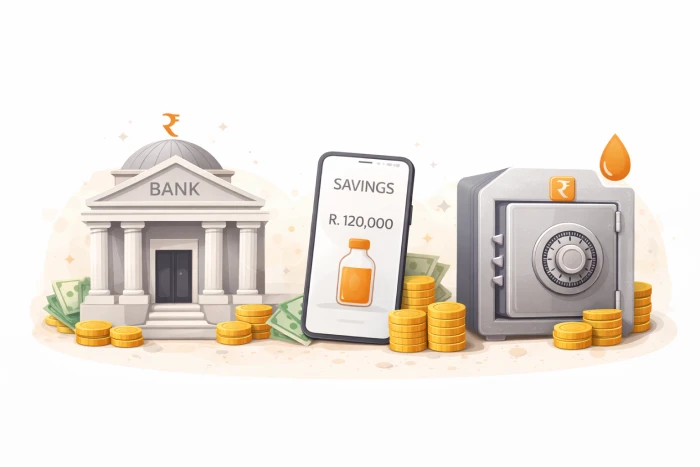
If your monthly expenses are Rs 60,000, keep at least Rs 1,20,000 in a savings account for quick access.
This ensures you never depend on credit cards during sudden expenses.
Option 2: Liquid Mutual Funds
Liquid mutual funds invest in short-term money market instruments.
Benefits:
Higher returns than savings account
Low volatility
Redemption within 1 working day
Suitable for short-term parking
Risks:
Not 100 percent risk free
Returns fluctuate slightly
According to CRISIL reports on debt mutual funds, liquid funds generally maintain low risk profiles when invested in high-quality instruments.
Best For:
2-4 months of emergency corpus
Funds that do not need same-day withdrawal
Option 3: Short-Term Fixed Deposits
Short-term FDs with tenure of 3-12 months are another safe option.
Benefits:
Guaranteed returns
Low risk
Suitable for conservative investors
Drawbacks:
Premature withdrawal penalty
Less flexible than savings account
Best For:
A portion of emergency fund that you are unlikely to use immediately
You may ladder FDs in different maturity cycles to maintain flexibility.
Option 4: Sweep-In FD Facility
Many banks offer sweep-in facilities where surplus savings automatically convert into FD and can be withdrawn anytime.
Benefits:
Better returns than savings
Flexible access
Automatic management
This can be a practical hybrid solution.
What You Should Avoid
Never keep your emergency fund in:
Equity mutual funds
Stock market
Real estate
Long lock-in tax saving instruments
Cryptocurrency
Market volatility can reduce value exactly when you need funds urgently.
Emergency money must be stable, not speculative.
Ideal Emergency Fund Allocation Structure
If your total emergency fund target is Rs 3,60,000:
Rs 1,20,000 in high interest savings account
Rs 1,20,000 in liquid mutual fund
Rs 1,20,000 in short-term FD
This diversification ensures liquidity and modest returns.
How EMIs Affect Where You Keep Funds
If you have high EMIs:
Maintain at least 2 EMI cycles worth funds in instant-access account
Keep remaining buffer in low-risk instruments
Lenders calculate FOIR, meaning Fixed Obligation to Income Ratio. If EMIs are close to 50 percent of income, liquidity becomes even more critical.
At Saarathi.ai, we have observed that borrowers who maintain emergency liquidity rarely face repayment delays.
If EMIs are too high, you can compare personal loan offers on Saarathi.ai to explore refinancing options and reduce monthly burden.
Special Advice for Irregular Income Earners
Freelancers and business owners should:
Keep 3 months in savings account
Keep 3-6 months in liquid funds or FDs
Maintain separate tax reserve account
Income volatility requires a higher liquidity cushion.
You can ask eligibility questions via Saarathi AI before committing to any EMI to ensure affordability aligns with your cash flow.
Should You Keep an Emergency Fund in a Joint Account?
For families:
Keep primary portion accessible to both partners
Maintain nomination
Ensure clarity of account access
Financial emergencies often require quick coordination.
How Inflation Impacts Emergency Funds
Inflation reduces purchasing power over time.
To balance safety and inflation:
Review fund annually
Increase target as expenses rise
Adjust allocation if interest rates change
According to data trends reported in Economic Times, rising living costs in urban India require periodic reassessment of financial buffers.
When Can You Move Funds to Higher Returns?
Only when:
You have more than 6-9 months emergency corpus
Your income is stable
EMIs are manageable
Insurance coverage is strong
Excess beyond your emergency requirement can be invested for growth.
Real-Life Example
Monthly Essentials Including EMIs: Rs 70,000
Target Emergency Fund: 6 months
Rs 70,000 x 6 = Rs 4,20,000
Allocation:
Savings Account: Rs 1,40,000
Liquid Fund: Rs 1,40,000
Short-Term FD: Rs 1,40,000
This structure balances safety and modest return.
How Emergency Fund Supports Loan Stability
An emergency fund:
Prevents missed EMIs
Protects credit score
Reduces need for high-interest personal loans
Improves financial discipline
At Saarathi.ai, our AI Recommendation Engine helps you choose lenders aligned with your repayment capacity. When your liquidity is strong, you can confidently select appropriate EMI structures.
You can track loan applications and obligations clearly in Saarathi Bazaar for full transparency.
Common Mistakes to Avoid
Keeping entire fund in equity
Locking full amount in long-term FD
Using emergency fund for vacations
Not increasing fund after salary hike
Ignoring EMIs in fund calculation
FAQs
1. Is a savings account enough for an emergency fund?
Yes for the first 1-2 months of expenses. Beyond that, diversify into liquid funds or FDs.
2. Are liquid mutual funds safe?
Generally low risk, but not risk free. Suitable for short-term parking.
3. Should I break FD during an emergency?
Yes, if needed. But keep some funds instantly accessible to avoid penalties.
4. Can I invest in an emergency fund in stocks?
No. Emergency funds must prioritize safety over returns.
5. How often should I review my emergency fund?
At least once a year or after major income or expense change.
6. Does having an emergency fund help in loan approval?
Indirectly yes. It prevents defaults and protects your credit profile.
Conclusion
Where you keep your emergency fund is just as important as building it.
Key Takeaways:
Prioritize liquidity and safety
Use combination of savings account, liquid funds, and short-term FDs
Avoid risky investments
Adjust allocation based on EMIs and income stability
Review annually
Financial resilience begins with accessible savings. Once your emergency cushion is secure, you can plan loans confidently and strategically. Discover personalized loan options on Saarathi.ai today. Compare lenders, track your application in Saarathi Bazaar, and get AI-powered expert guidance in a transparent, paperless journey.