What is a Balance Transfer in Loans?
|
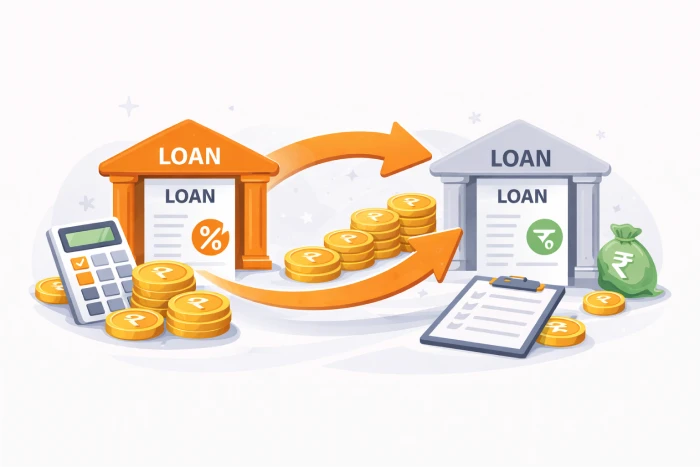
What is a balance transfer in loans? A balance transfer allows you to shift your existing loan from one bank or NBFC to another lender offering a lower interest rate or better terms. This simple move can reduce your EMI, shorten your tenure, or help you access additional funds at competitive rates.
In India’s fast-growing digital lending ecosystem, balance transfers are becoming popular for home loans, personal loans, business loans, and loan against property. At Saarathi.ai, we have observed that borrowers who compare refinancing offers at the right time can save lakhs in interest over the loan tenure. This guide explains how balance transfer works, charges involved, RBI rules, and when it makes financial sense.
What Is a Balance Transfer?
A loan balance transfer means transferring your outstanding loan amount from your current lender to a new lender offering:
Lower interest rate
Better repayment terms
Top-up loan facility
Improved customer service
The new lender pays off your existing loan. You then continue repayment with the new lender under revised terms.
This is common for:
Home loans
Personal loans
Business loans
Loan against property
You can easily compare refinancing options using the compare personal loan offers on Saarathi.ai feature and track them inside track your application in Saarathi Bazaar for full transparency.
How Does a Balance Transfer Work?
Here is the step-by-step process:
Step 1: Check Outstanding Amount
Request a foreclosure statement from your current lender.
Step 2: Compare New Offers
Evaluate lower interest rates, processing fees, and tenure flexibility.
At Saarathi.ai, our AI Recommendation Engine analyzes your credit profile and matches you with suitable lenders across 110+ banks and NBFCs.
Step 3: Apply with New Lender
Submit required documents digitally for approval.
Step 4: Loan Closure
The new lender pays your existing lender directly.
Step 5: Start New EMI
You repay the new lender as per revised terms.
Most lenders complete this process within 7 to 15 working days if documents are complete.
Why Do Borrowers Opt for Balance Transfer?
1. Lower Interest Rate
Interest rate cycles change frequently based on repo rate revisions by the Reserve Bank of India. If rates fall, transferring your loan can reduce EMIs significantly.
Example:
Home Loan of Rs 40 lakh
Old Rate: 9.5 percent
New Rate: 8.4 percent
Savings over 15 years can run into several lakhs.
2. Reduced EMI Burden
If your monthly cash flow is tight, extending tenure with a lower rate can reduce EMI pressure.
3. Better Loan Terms
Some lenders offer:
No foreclosure charges
Flexible prepayment
Online account management
4. Top-Up Loan Facility
Many banks allow additional funds over your existing loan during transfer. This is helpful for:
Home renovation
Business expansion
Medical emergencies
At Saarathi.ai, we have observed rising demand for home loan balance transfers with top-up facilities, especially in metro cities.
Types of Balance Transfers
Home Loan Balance Transfer
This is the most common. Floating rate home loans often do not attract foreclosure penalties as per RBI guidelines for individuals.
Personal Loan Balance Transfer
Used to shift from high-interest unsecured loans to lower-rate options. However, foreclosure charges may apply.
Loan Against Property Transfer
Useful for businesses seeking better working capital terms.
Business Loan Transfer
Helps MSMEs reduce borrowing costs and improve cash flow.
Industry reports by CRISIL indicate that refinancing trends are increasing as borrowers become rate-sensitive in a competitive lending environment.
Charges Involved in Balance Transfer
Before transferring, calculate total cost carefully.
Common charges include:
Foreclosure charges by old lender
Processing fee by new lender
Legal and technical evaluation charges for property loans
Stamp duty in some states
Typical cost range:
Foreclosure: 2 to 4 percent for fixed loans
Processing fee: 0.5 to 1 percent
Always compare savings vs total cost.
You can use ask eligibility questions via Saarathi AI to instantly check whether transfer makes financial sense for your profile.
When Is a Balance Transfer a Good Idea?
A balance transfer is usually beneficial when:
Interest rate difference is at least 0.5 percent to 1 percent
Remaining tenure is long
Outstanding amount is substantial
Processing and foreclosure charges are low
Not ideal when:
Loan is near completion
Rate difference is minimal
Charges cancel out savings
At Saarathi.ai, we guide borrowers through AI-powered comparisons so they avoid switching for negligible savings.
Impact on Credit Score
A balance transfer does not hurt your credit score if handled correctly.
Positive impact:
Lower EMI improves repayment capacity
Consistent payments boost credit history
Temporary dip possible if:
Multiple loan applications are made simultaneously
As discussed in financial insights published by The Economic Times, maintaining repayment discipline is key to long-term credit health.
Balance Transfer vs Loan Restructuring
Feature | Balance Transfer | Loan Restructuring |
Lender | New lender | Same lender |
Purpose | Lower rate | Ease financial stress |
Credit Impact | Neutral to positive | May affect score |
Approval | Based on credit profile | Based on hardship |
Balance transfer is proactive savings. Restructuring is usually reactive support.
Fixed vs Floating Rate Consideration
Floating rate loans generally offer easier prepayment options due to RBI borrower protection norms.
Fixed rate loans may have higher foreclosure charges.
Always check:
Lock-in period
Penalty clauses
Conversion fees
You can review these transparently while exploring loan options on Saarathi.ai.
Common Myths About Balance Transfer
Myth 1: It is complicated
Digital processing has made it simple and largely paperless.
Myth 2: Only home loans can be transferred
Personal and business loans can also be transferred.
Myth 3: It damages credit score
Incorrect, if managed responsibly.
Myth 4: Savings are always high
Not true. Proper calculation is essential.
At Saarathi.ai, we emphasize data-backed comparisons before recommending refinancing.
Real-Life Example
Let us consider a personal loan:
Loan Amount: Rs 8,00,000
Old Interest Rate: 15 percent
Remaining Tenure: 3 years
New Offer: 12.5 percent
Even after paying 3 percent foreclosure charge and 1 percent processing fee, total interest savings can be meaningful if tenure is long enough.
Our AI Recommendation Engine evaluates such scenarios instantly.
FAQs
1. Is balance transfer allowed on floating rate home loans?
Yes. Most floating rate home loans can be transferred without foreclosure penalty for individuals.
2. How long does balance transfer take?
Typically 7 to 15 working days, depending on documentation.
3. Can I get extra money during transfer?
Yes, many lenders offer top-up loans during balance transfer.
4. Will my EMI always reduce?
Not necessarily. You can also choose to reduce tenure instead.
5. Is there a minimum tenure before transferring?
Most lenders require at least 6 to 12 months of repayment history.
Conclusion
A balance transfer in loans is a powerful financial strategy when used wisely. It can reduce EMIs, lower total interest cost, and provide better flexibility.
Key takeaways:
Transfer your loan to a lower interest lender to save money
Calculate charges before switching.
Ideal when tenure is long and rate gap is meaningful.
Maintain strong repayment discipline.
Use AI tools to compare options smartly.
If you are paying a high interest rate today, explore smarter refinancing options. Discover personalized offers, compare lenders transparently, and track your journey digitally on Saarathi.ai today. Let our AI Recommendation Engine help you save more and repay smarter in 2026.