What Happens to Indian Loan Interest Rates If Crude Oil Prices Cross $120
|
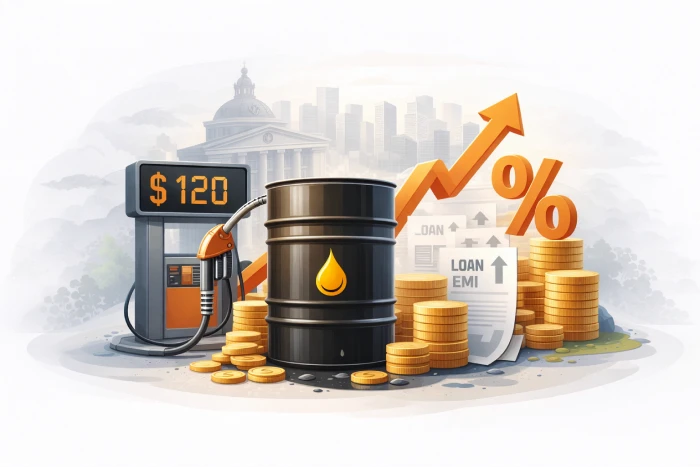
If crude oil prices cross $120 per barrel, Indian loan interest rates are likely to rise. Oil is a critical import for India, and higher crude prices increase inflation, widen the current account deficit, and put pressure on the rupee. In response, the Reserve Bank of India may tighten monetary policy to control inflation, which can directly affect home loan, personal loan, and business loan interest rates. In this guide, we explain the economic chain reaction, what the RBI may do, how banks and NBFCs respond, and how borrowers can protect their EMIs during such volatility.
Why Crude Oil Prices Matter for India
India imports more than 80 percent of its crude oil requirements. When global crude prices surge above $120 per barrel, import costs jump sharply.
Higher oil prices impact:
Fuel prices such as petrol and diesel
Transportation costs
Manufacturing expenses
Food prices due to logistics costs
Overall retail inflation
According to data released periodically by the Reserve Bank of India, fuel inflation has a direct and indirect effect on the Consumer Price Index. When inflation rises beyond the RBI’s comfort band of 2 to 6 percent, monetary tightening becomes more likely.
How $120 Oil Impacts Inflation and the Rupee
1. Rising Inflation
Fuel is a base input cost across sectors. If oil crosses $120:
Airlines increase fares
FMCG companies raise prices
Logistics becomes expensive
Power generation costs rise
This pushes headline inflation higher. Persistent inflation reduces purchasing power and affects savings.
2. Pressure on the Rupee
Higher oil imports increase demand for US dollars. This can weaken the rupee. A weaker rupee makes imports even more expensive, creating a feedback loop.
Currency volatility often triggers capital outflows from foreign investors, adding further stress to financial markets.
What Will RBI Likely Do?
The Reserve Bank of India has one primary mandate in such scenarios: control inflation while maintaining growth stability.
If crude remains above $120 for a sustained period, RBI may:
Increase the repo rate
Maintain a tighter liquidity stance
Conduct open market operations
Signal hawkish forward guidance
When the repo rate increases, banks’ cost of funds rises. This typically results in higher lending rates for consumers.
As frequently reported by Economic Times, even small repo hikes can translate into noticeable EMI increases for floating rate borrowers.
How Loan Interest Rates React
Repo-Linked Loans
Most new floating rate home loans in India are linked to the repo rate. If RBI hikes rates:
Banks revise repo-linked lending rates upward
EMIs increase or loan tenure extends
For example:
If your home loan is Rs 50 lakh at 8 percent for 20 years, and rates rise to 9 percent:
EMI can increase by several thousand rupees per month
Or tenure may extend by 2 to 3 years
MCLR-Linked Loans
Older loans linked to MCLR adjust with a lag. However, they eventually reflect higher funding costs.
NBFC Loan Rates
NBFCs borrow from banks and debt markets. If system liquidity tightens:
Borrowing costs increase
New loan rates may rise
Credit approval may become stricter
At Saarathi.ai, we have observed that during rising rate cycles, lenders differentiate strongly based on credit score and income stability. Strong borrowers continue to receive competitive offers, while marginal profiles see higher pricing.
Impact on Different Loan Types
Home Loans
Home loans are most sensitive to repo rate changes. Even a 0.5 percent hike significantly impacts long tenure loans.
Borrowers should monitor:
EMI to income ratio
Fixed vs floating options
Prepayment flexibility
You can compare home loan offers on Saarathi.ai to evaluate which lenders are adjusting rates more gradually.
Personal Loans
Personal loans already carry higher interest rates. During inflationary cycles:
Rates may increase further
Eligibility norms may tighten
Processing time may increase
If you are planning a personal loan, check eligibility first and avoid multiple hard inquiries.
You can compare personal loan offers on Saarathi.ai to see transparent rate differences across lenders.
Business Loans and MSME Finance
MSMEs feel a double impact:
Input costs rise due to expensive fuel
Borrowing costs increase
This can strain working capital cycles. However, digital underwriting based on GST cash flows can still help viable businesses access credit faster.
At Saarathi.ai, our AI-driven Recommendation Engine matches MSMEs with lenders that best fit their sector risk profile, even in volatile cycles.
Secondary Effects on the Lending Ecosystem
Liquidity Conditions
If inflation persists, RBI may absorb excess liquidity. Tighter liquidity often leads to:
Slower loan disbursements
Conservative underwriting
Reduced risk appetite
Credit Growth Moderation
When oil prices spike, GDP growth forecasts may be revised downward. Slower growth impacts credit expansion.
However, India’s domestic consumption-driven economy provides a cushion compared to export-heavy economies.
Historical Context: Have We Seen This Before?
In previous oil spikes, including 2008 and 2011, inflation surged globally. However, India’s financial system today is more resilient.
Key structural improvements include:
Better capital buffers for banks and NBFCs
Tighter RBI supervision
Digital loan underwriting
Stronger credit bureau penetration
Agencies such as CRISIL have noted that improved asset quality and capital adequacy ratios make the financial system more shock resistant than in earlier cycles.
What Borrowers Should Do If Oil Crosses $120
1. Review Your EMI Exposure
Keep total EMIs below 40 percent of monthly income.
2. Consider Partial Prepayment
If you have surplus funds, reducing principal early lowers interest burden.
3. Lock Competitive Rates Early
Before rates rise further, finalize your loan approval.
You can track your application in Saarathi Bazaar to monitor rate revisions and lender communication in real time.
4. Improve Your Credit Score
Higher credit scores help secure lower spreads even in rising rate cycles.
You can ask eligibility questions via Saarathi AI expert before applying, which reduces rejection risk.
5. Maintain Emergency Liquidity
Keep at least 6 months of EMIs as contingency buffer.
Will Fixed Rate Loans Become Popular?
Yes, during volatile oil cycles, borrowers prefer fixed rates for predictability. However:
Fixed rates are usually slightly higher initially
Some fixed loans convert to floating after a few years
Compare total cost, not just EMI.
Digital comparison dashboards make this process easier and transparent.
FAQs
Will RBI immediately raise rates if crude crosses $120?
Not immediately. RBI evaluates inflation trends, core inflation, and global conditions before acting. Sustained oil spikes are more likely to trigger hikes.
How much can my home loan EMI increase?
A 1 percent rate hike on a Rs 50 lakh loan over 20 years can increase EMI by roughly Rs 3,000 to Rs 3,500 depending on tenure.
Are NBFC loan rates more volatile than bank rates?
NBFCs may adjust faster if funding costs rise sharply, but well-capitalized NBFCs manage pricing strategically.
Should I delay taking a loan during high oil prices?
Not necessarily. If your income is stable and EMI ratio is healthy, borrowing remains viable.
Can oil prices affect loan approvals?
Indirectly yes. During high inflation periods, lenders may tighten risk assessment and income stability checks.
Conclusion
If crude oil prices cross $120 per barrel, inflationary pressures are likely to increase in India. In response, the Reserve Bank of India may tighten monetary policy, which can push loan interest rates upward. Home loans, personal loans, and business loans may become costlier, especially floating rate products.
However, India’s financial system today is stronger and more regulated than in past oil shocks. Borrowers who maintain strong credit scores, stable income, and disciplined financial planning can still access competitive rates.
The key is proactive comparison, smart timing, and transparency.
Discover personalized loan options on Saarathi.ai today and secure the best possible rates even in volatile economic conditions.