Tax Saving Tips for Self-Employed Professionals in India
|
Self-employed professionals in India often face unique tax challenges compared to salaried employees. Freelancers, consultants, doctors, lawyers, business owners, and other independent professionals must manage their own tax planning without the structured deductions that salary structures sometimes provide. However, the Income Tax Act offers several legal ways for self-employed individuals to reduce their tax liability through deductions, investments, and business expense claims.
Strategic tax planning can help self-employed professionals lower taxable income while building long-term financial security. At Saarathi.ai, we have observed that professionals who actively plan taxes throughout the financial year are able to optimize both business growth and personal financial stability. Understanding key deductions and tax-saving strategies can significantly reduce annual tax payments.
Understand Your Taxable Income Structure
Unlike salaried employees, self-employed professionals pay tax on their net income after deducting business expenses.
Taxable income is calculated as:
Total business revenue minus eligible business expenses.
Examples of deductible business expenses include:
Office rent
Professional tools and equipment
Internet and communication costs
Employee salaries
Marketing expenses
Travel related to business
By accurately recording expenses, professionals can reduce taxable income before calculating tax liability.
Maintaining proper accounting records throughout the year is essential.
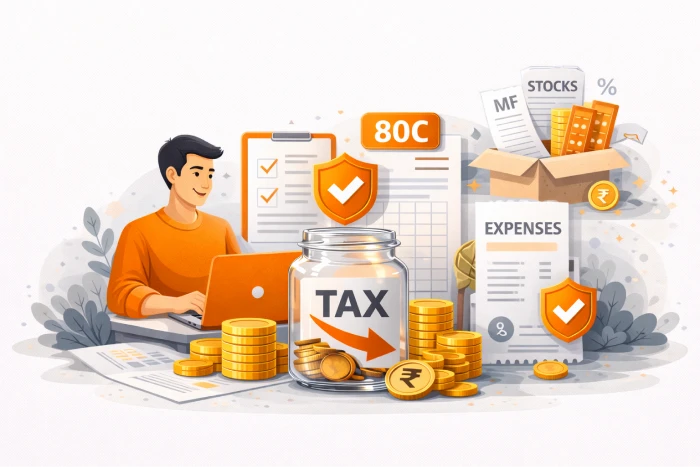
Claim Deductions Under Section 80C
Section 80C remains one of the most widely used tax-saving provisions available to taxpayers.
Self-employed individuals can claim deductions up to ₹1.5 lakh annually through eligible investments.
Popular Section 80C options include:
Public Provident Fund
Equity Linked Savings Schemes
Tax-saving fixed deposits
National Savings Certificate
Life insurance premiums
Sukanya Samriddhi Yojana
These investments not only reduce taxable income but also support long-term savings goals.
Take Advantage of National Pension System Contributions
The National Pension System offers additional tax benefits beyond Section 80C.
Under Section 80CCD(1B), individuals can claim an extra deduction of ₹50,000 for contributions to NPS.
This deduction is available in addition to the ₹1.5 lakh Section 80C limit.
For self-employed professionals who do not receive employer retirement benefits, NPS provides an effective way to build retirement savings while reducing taxable income.
Claim Health Insurance Deductions Under Section 80D
Health insurance premiums qualify for deductions under Section 80D.
Self-employed individuals can claim deductions for policies purchased for:
Self
Spouse
Dependent children
Parents
Deduction limits include:
Category | Maximum Deduction
Self and family | ₹25,000
Senior citizen parents | ₹50,000
Purchasing health insurance provides financial protection while reducing taxable income.
Deduct Interest on Business Loans
Self-employed professionals often use loans to expand their business operations.
If a loan is used for business purposes, the interest paid on that loan can be deducted as a business expense.
Examples include:
Loans used to purchase equipment
Loans used for office expansion
Loans used for working capital
This deduction reduces taxable profits.
Many entrepreneurs evaluate financing options carefully. Business owners often compare business loan options or compare personal loan offers on Saarathi.ai to identify lenders offering competitive interest rates.
Claim Education Loan Interest Deduction
If self-employed professionals take education loans for themselves, spouse, or children, the interest paid on these loans may qualify for deductions under Section 80E.
This deduction applies only to the interest component of the loan repayment.
There is no maximum deduction limit, and the benefit can be claimed for up to eight years.
Education loan deductions can significantly reduce taxable income during the repayment period.
Consider Home Loan Tax Benefits
Self-employed professionals purchasing property can claim tax deductions on housing loans.
These include:
Principal repayment deductions under Section 80C
Interest deductions under Section 24
Interest payments on home loans may qualify for deductions up to ₹2 lakh annually for self-occupied property.
Many professionals planning property purchases explore financing options carefully. Borrowers often compare home loan offers on Saarathi.ai to identify lenders offering competitive interest rates and faster approvals.
Maintain Proper Accounting and Documentation
Accurate documentation is essential for claiming tax deductions.
Important financial records include:
Business expense receipts
Loan interest certificates
Insurance premium receipts
Investment proofs
Bank statements
Maintaining organized financial records helps simplify tax filing and reduces the risk of errors.
Many professionals also work with chartered accountants to ensure proper compliance.
Role of Digital Platforms in Financial Planning
Digital financial platforms are transforming how professionals manage finances, taxes, and borrowing decisions.
Technology-driven platforms allow users to evaluate financial products, check eligibility, and track financial progress.
For example, individuals can ask eligibility questions via Saarathi AI expert to understand loan documentation requirements and approval timelines instantly.
Saarathi.ai connects borrowers with more than 110 banks and NBFCs across India. The Saarathi Recommendation Engine matches borrowers with lenders suited to their financial profiles.
Borrowers can also track your application in Saarathi Bazaar through a transparent dashboard that monitors documentation progress, approvals, and lender responses.
These digital tools help professionals integrate borrowing decisions with long-term financial planning.
Common Tax Planning Mistakes Self-Employed Professionals Should Avoid
Self-employed taxpayers often make avoidable mistakes that increase tax liability.
Not tracking business expenses
Missing legitimate expense deductions increases taxable income.
Delaying tax planning
Waiting until the end of the financial year limits available tax-saving opportunities.
Ignoring retirement planning
Self-employed professionals should build retirement savings through instruments like NPS and PPF.
Mixing personal and business expenses
Separate bank accounts help maintain financial clarity.
Avoiding these mistakes improves tax efficiency and financial stability.
Frequently Asked Questions
Do self-employed professionals get tax deductions in India?
Yes. Self-employed professionals can claim deductions for business expenses, investments, insurance premiums, and loan interest.
What is the maximum deduction under Section 80C?
Taxpayers can claim deductions up to ₹1.5 lakh annually under Section 80C.
Can self-employed individuals invest in NPS?
Yes. Self-employed individuals can contribute to NPS and claim an additional deduction of ₹50,000 under Section 80CCD(1B).
Can business loan interest reduce taxable income?
Yes. Interest paid on loans used for business purposes can be deducted as a business expense.
Is health insurance deductible for self-employed professionals?
Yes. Health insurance premiums qualify for deductions under Section 80D.
Conclusion
Tax planning is especially important for self-employed professionals who manage their own income and expenses. By claiming legitimate business deductions, investing in tax-saving instruments, purchasing health insurance, and utilizing loan-related deductions, individuals can significantly reduce taxable income.
Strategic tax planning throughout the financial year helps professionals improve financial efficiency while supporting long-term financial goals.
At Saarathi.ai, we believe informed financial decisions lead to stronger financial outcomes. Whether you are managing business finances, exploring loan options, or planning investments, digital platforms can simplify your financial journey.
Discover personalized loan options and make smarter financial decisions with Saarathi.ai today.