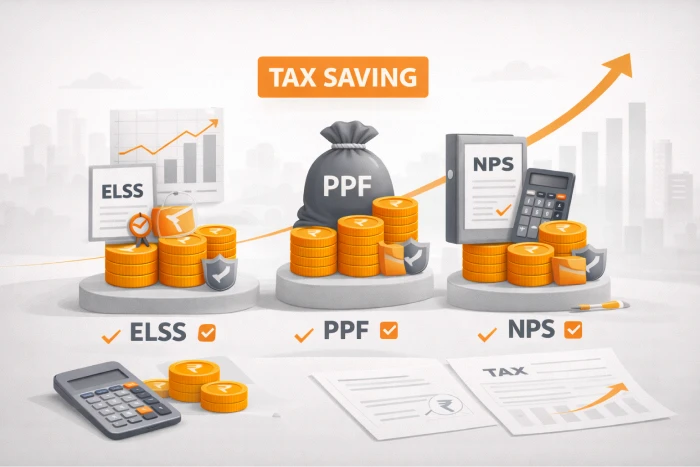
Tax-Saving Investments in India: ELSS, PPF, NPS Explained
|
Tax-saving investments are one of the most effective ways for Indians to reduce taxable income while building long-term wealth. Popular options like ELSS, PPF, and NPS allow individuals to claim deductions under Section 80C and Section 80CCD of the Income Tax Act while growing their savings through equity or government-backed schemes.
Choosing the right tax-saving investment in India depends on factors such as risk tolerance, investment horizon, and retirement planning goals. At Saarathi.ai, we have observed that many borrowers exploring home loans or personal loans also want smarter ways to reduce taxes and improve financial stability. Understanding how ELSS, PPF, and NPS work can help you maximize tax benefits and build a strong financial foundation in 2026 and beyond.
Why Tax-Saving Investments Matter for Indian Investors
Tax-saving instruments are designed to encourage long-term savings while offering deductions on taxable income. Under Section 80C of the Income Tax Act, individuals can claim deductions up to Rs. 1.5 lakh annually by investing in eligible instruments.
These investments serve two purposes:
Reduce taxable income
Build long-term wealth for goals like retirement, home purchase, or education
Many Indian professionals begin exploring tax-saving investments during the financial year end, especially between January and March. However, spreading investments throughout the year can reduce financial stress and improve compounding benefits.
According to data published by the Reserve Bank of India, household financial savings remain a key driver of long-term wealth creation in India. Government-backed schemes like PPF and retirement programs like NPS are designed to strengthen financial security for citizens.
For professionals planning large financial goals such as buying property or expanding a business, structured investments also improve financial credibility when applying for credit. For example, borrowers often use platforms to compare personal loan offers on Saarathi.ai while planning their broader financial strategy.
Understanding Section 80C and Tax Benefits
Section 80C is the most commonly used tax deduction provision available to Indian taxpayers.
The maximum deduction available under Section 80C is Rs. 1.5 lakh per financial year. Investments that qualify include several government-backed and market-linked instruments.
Common Section 80C investment options include:
Equity Linked Savings Scheme (ELSS)
Public Provident Fund (PPF)
National Pension System (NPS partial under 80CCD)
Tax-saving Fixed Deposits
Life Insurance Premiums
Sukanya Samriddhi Yojana
Employee Provident Fund (EPF)
Among these, ELSS, PPF, and NPS are considered the most effective long-term wealth-building instruments because they combine tax benefits with growth potential.
ELSS (Equity Linked Savings Scheme)
What is ELSS?
ELSS funds are diversified equity mutual funds that provide tax deductions under Section 80C. These funds invest primarily in stocks and equity-related instruments, offering the potential for higher long-term returns.
The lock-in period for ELSS is three years, which is the shortest among all tax-saving investments in India.
Key Features of ELSS
Eligible for Section 80C tax deduction up to Rs. 1.5 lakh
Minimum lock-in period of 3 years
Market-linked returns through equity exposure
Investment allowed via SIP or lump sum
No maximum investment limit
Because ELSS invests in equities, returns are not guaranteed. However, historically many ELSS funds have delivered higher returns compared to traditional tax-saving instruments.
According to CRISIL mutual fund reports, equity mutual funds have delivered stronger long-term returns compared to fixed-income instruments over extended periods.
Advantages of ELSS
Short lock-in period
ELSS has the shortest lock-in among tax-saving options. Investors can access funds after three years.
Potential for higher returns
Since ELSS invests in equities, it offers the possibility of higher growth compared to PPF or tax-saving FDs.
Flexible investment options
Investors can start SIPs with small monthly contributions, making ELSS accessible for young professionals.
Risks of ELSS
Market volatility
Returns depend on stock market performance, which means short-term fluctuations are possible.
Requires long-term mindset
Even though the lock-in is three years, experts often recommend holding ELSS investments for 5 to 7 years to maximize returns.
Public Provident Fund (PPF)
What is PPF?
The Public Provident Fund is a government-backed savings scheme that offers guaranteed returns and tax-free interest.
It is one of the safest long-term investment options available in India. PPF is ideal for conservative investors who prefer stability over market-linked growth.
Interest rates for PPF are revised periodically by the Government of India. You can view current rates on the official RBI website.
Key Features of PPF
Government-backed investment scheme
Lock-in period of 15 years
Tax deduction under Section 80C
Interest earned is tax-free
Minimum annual investment Rs. 500
Maximum annual investment Rs. 1.5 lakh
PPF follows the EEE tax model:
Investment is tax deductible
Interest earned is tax free
Maturity proceeds are tax free
Advantages of PPF
High safety
Since PPF is backed by the government, it carries minimal risk.
Stable returns
Interest rates are relatively stable compared to market-linked investments.
Long-term wealth building
The 15-year tenure allows compounding to work effectively.
Limitations of PPF
Long lock-in period
Investors must stay invested for 15 years, though partial withdrawals are allowed after specific conditions.
Limited liquidity
PPF is not suitable for investors who require quick access to funds.
At Saarathi.ai, we often see borrowers using PPF savings as part of their financial planning before applying for large credit products such as home loans.
National Pension System (NPS)
What is NPS?
The National Pension System is a government-backed retirement savings scheme regulated by the Pension Fund Regulatory and Development Authority.
It is designed to help individuals accumulate retirement savings while benefiting from tax deductions.
NPS offers an additional tax benefit under Section 80CCD(1B), allowing deductions up to Rs. 50,000 beyond the Section 80C limit.
Key Features of NPS
Tax deduction under Section 80C up to Rs. 1.5 lakh
Additional deduction of Rs. 50,000 under Section 80CCD(1B)
Long-term retirement focused investment
Mix of equity, corporate bonds, and government securities
Low fund management costs
Advantages of NPS
Additional tax savings
NPS provides an extra Rs. 50,000 deduction beyond Section 80C.
Retirement focused planning
It helps individuals build a retirement corpus through disciplined contributions.
Low-cost structure
NPS has one of the lowest fund management fees among investment products.
Limitations of NPS
Withdrawal restrictions
A portion of the corpus must be used to purchase an annuity at retirement.
Long investment horizon
Funds remain locked until retirement age with limited partial withdrawal options.
ELSS vs PPF vs NPS Comparison
Choosing between ELSS, PPF, and NPS depends on your financial goals, risk appetite, and investment horizon.
Here is a simplified comparison:
Investment Type | Lock-in Period | Risk Level | Tax Benefit | Returns
ELSS | 3 years | Moderate to High | Section 80C | Market linked
PPF | 15 years | Low | Section 80C | Government fixed rate
NPS | Till retirement | Moderate | 80C + 80CCD | Market linked
ELSS suits investors looking for growth and tax savings.
PPF is ideal for conservative investors who prefer guaranteed returns.
NPS works best for long-term retirement planning.
Many financial planners recommend combining these instruments to balance risk and returns.
How to Choose the Right Tax-Saving Investment?
Selecting the right investment option depends on your financial goals and time horizon.
Consider the following factors:
Risk tolerance
Investors comfortable with stock market fluctuations may prefer ELSS.
Conservative investors may prefer PPF.
Investment horizon
Shorter horizons favor ELSS due to the three-year lock-in.
Long-term retirement planning aligns with NPS and PPF.
Liquidity needs
If you require flexibility, avoid instruments with long lock-ins.
Retirement goals
NPS is specifically designed for retirement income planning.
At Saarathi.ai, we have observed that individuals who combine smart investments with responsible borrowing improve their long-term financial health. Tools like the Saarathi Recommendation Engine can help borrowers evaluate financial options before making major commitments.
You can also track your application in Saarathi Bazaar while reviewing loan offers and financial products in one transparent dashboard.
How Digital Platforms Simplify Financial Decisions?
Digital platforms are transforming how Indians manage loans and investments.
AI-powered platforms help individuals understand eligibility, compare offers, and make informed financial decisions faster.
For example, users can ask eligibility questions via Saarathi AI expert to understand loan options before making a financial commitment.
Saarathi.ai connects borrowers with more than 100 lenders including banks and NBFCs. This allows users to compare multiple loan offers, track approvals, and complete documentation through a paperless journey.
Better financial planning often begins with understanding tax-saving opportunities and aligning them with long-term financial goals.
Frequently Asked Questions
Which tax-saving investment gives the highest returns?
ELSS funds have the potential to generate higher long-term returns because they invest in equities. However, returns depend on market performance and are not guaranteed.
Is PPF better than ELSS?
PPF is safer because it is government-backed and offers fixed returns. ELSS offers higher potential growth but comes with market risk.
The right choice depends on your risk tolerance and investment horizon.
Can I invest in both PPF and ELSS?
Yes. Many investors diversify by investing in both PPF and ELSS. This balances stability and growth while maximizing tax deductions under Section 80C.
What is the additional tax benefit of NPS?
NPS offers an additional deduction of Rs. 50,000 under Section 80CCD(1B) beyond the Rs. 1.5 lakh limit of Section 80C.
Are tax-saving investments helpful for loan eligibility?
Yes. Consistent savings and financial discipline improve financial profiles. Lenders often consider income stability and financial behavior when evaluating loan applications.
Conclusion
Tax-saving investments in India are not only about reducing tax liability. They are also powerful tools for long-term wealth creation and financial security.
ELSS offers growth potential through equity exposure. PPF provides stability with government-backed returns. NPS focuses on retirement planning with additional tax benefits.
A balanced investment strategy that combines these instruments can help individuals optimize tax savings while building a strong financial future.
At Saarathi.ai, we believe informed financial decisions lead to stronger financial outcomes. Whether you are planning investments or applying for credit, digital platforms can simplify the journey.
Discover personalized loan options, compare offers, and track your financial progress on Saarathi.ai today.