Tax Benefits on Under Construction vs Ready-to-Move Homes
|
Buying a home is a major financial milestone, and tax benefits often play a significant role in the decision-making process. In India, property buyers can reduce their tax liability through deductions available on home loans under the Income Tax Act. However, these benefits vary depending on whether the property is under construction or ready to move.
Understanding the difference between tax benefits for under construction homes and ready-to-move properties helps buyers plan their finances more efficiently. At Saarathi.ai, we have observed that many borrowers overlook these differences when selecting property types, which can affect their tax planning and cash flow. Knowing how deductions under Section 80C and Section 24 apply to each scenario can help individuals make smarter property investment decisions.
Key Tax Provisions for Home Buyers
Home loan tax benefits in India are primarily available under two sections of the Income Tax Act:
Section 80C for principal repayment
Section 24 for interest payments
These deductions apply differently depending on whether the property is completed or still under construction.
Understanding how these provisions work is essential before choosing between under construction and ready-to-move homes.
Tax Benefits for Ready-to-Move Homes
Ready-to-move homes are properties that are fully constructed and ready for occupancy at the time of purchase.
Homebuyers purchasing ready properties can start claiming tax benefits immediately after the loan is disbursed and EMI payments begin.
Section 80C Deduction for Principal Repayment
Principal repayment on home loans qualifies for deduction under Section 80C.
The maximum deduction allowed is ₹1.5 lakh per financial year.
However, this limit includes other eligible investments such as:
Public Provident Fund
Equity Linked Savings Schemes
Life insurance premiums
Employee Provident Fund contributions
Tax-saving fixed deposits
Principal repayment deductions become available only after property construction is completed.
Section 24 Deduction for Interest Payments
Interest payments on home loans qualify for deductions under Section 24.
For self-occupied property, borrowers can claim deductions up to ₹2 lakh per financial year.
Since ready-to-move homes are already completed, buyers can begin claiming these deductions immediately after starting EMI payments.
This makes ready properties attractive for buyers seeking immediate tax benefits.
Tax Benefits for Under Construction Homes
Under construction homes are properties that are still being built at the time of purchase.
Buyers may start paying interest on home loans during the construction phase, but tax deductions work differently.
Interest Deduction During Pre-Construction Phase
Interest paid during the construction period is known as pre-construction interest.
Borrowers cannot claim deductions for this interest immediately.
Instead, the accumulated interest can be claimed in five equal installments after construction is completed.
Example:
Total pre-construction interest paid: ₹5 lakh
After construction completion, the borrower can claim:
₹1 lakh per year for five years under Section 24.
Principal Repayment Deduction
Principal repayment deductions under Section 80C can be claimed only after the construction of the property is completed.
This means buyers of under construction homes may need to wait several years before claiming these deductions.
Comparison: Under Construction vs Ready-to-Move Homes
Property Type | Principal Deduction (80C) | Interest Deduction (24) | Tax Benefit Timing
Ready-to-move | Available immediately | Available immediately | Immediate
Under construction | After completion | After completion | Delayed
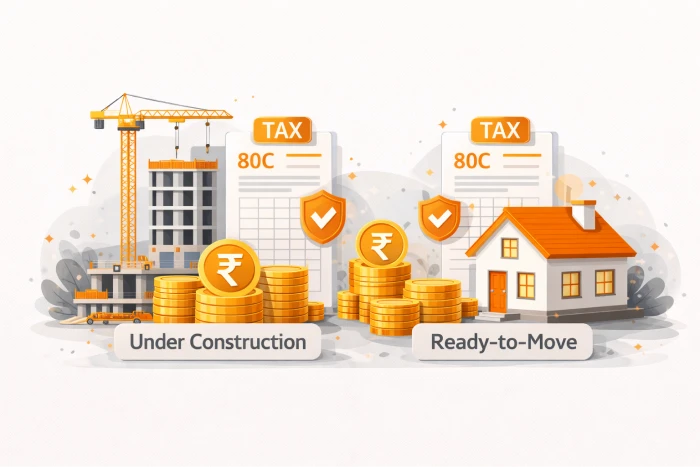
This comparison highlights that ready-to-move homes offer immediate tax benefits, while under construction homes delay deductions until project completion.
Other Financial Considerations
While tax benefits are important, property buyers should also evaluate other financial factors.
Loan disbursement structure
Under construction homes often involve staged loan disbursements based on project progress.
Rental opportunities
Ready-to-move homes can generate rental income immediately.
Construction risk
Under construction properties may face delays in project completion.
Budget flexibility
Under construction properties sometimes offer lower prices during early project stages.
Balancing these factors helps buyers make informed decisions.
Role of Digital Platforms in Home Loan Planning
Technology is transforming how individuals plan property purchases and evaluate loan options.
Digital financial platforms allow borrowers to compare lenders, evaluate eligibility, and track loan applications easily.
For example, borrowers can compare home loan offers on Saarathi.ai to identify lenders offering competitive interest rates and flexible repayment options.
Users can also ask eligibility questions via Saarathi AI expert to understand loan documentation requirements and approval timelines instantly.
Saarathi.ai connects borrowers with more than 110 banks and NBFCs across India. The Saarathi Recommendation Engine matches borrowers with lenders suited to their financial profiles.
Borrowers can also track your application in Saarathi Bazaar through a transparent dashboard that displays documentation progress, lender responses, and approval status.
These digital tools simplify the home buying journey and help borrowers integrate tax planning into property decisions.
Common Mistakes Buyers Should Avoid
Many property buyers misunderstand tax rules when purchasing homes.
Assuming deductions apply immediately
Tax benefits for under construction homes are available only after completion.
Ignoring construction delays
Project delays can postpone tax benefits and affect financial planning.
Not understanding deduction limits
Borrowers should clearly understand limits under Section 80C and Section 24.
Choosing property solely for tax benefits
Property decisions should consider long-term financial goals.
Avoiding these mistakes ensures better financial planning.
Frequently Asked Questions
Can tax benefits be claimed for under construction homes?
Yes. However, deductions for principal repayment and interest payments are available only after construction is completed.
What is pre-construction interest?
Pre-construction interest refers to the interest paid on a home loan before the construction of the property is completed.
How is pre-construction interest claimed?
The total pre-construction interest can be claimed in five equal installments after the property is completed.
Which property type offers immediate tax benefits?
Ready-to-move homes allow borrowers to claim deductions immediately after EMI payments begin.
What is the maximum deduction available on home loan interest?
Borrowers can claim up to ₹2 lakh annually under Section 24 for self-occupied property.
Conclusion
Tax benefits play an important role in home buying decisions in India. While both under construction and ready-to-move homes provide deductions under Section 80C and Section 24, the timing of these benefits differs significantly.
Ready-to-move homes offer immediate tax advantages, while under construction properties delay deductions until project completion. Understanding these differences helps buyers plan their finances more effectively.
At Saarathi.ai, we believe informed financial decisions help individuals achieve their goals faster. Whether you are planning property purchases, evaluating loan options, or optimizing tax strategies, digital platforms can simplify your financial journey.
Discover personalized loan options and start your home ownership journey with Saarathi.ai today.