Snowball vs avalanche method: Which saves more?
|
If you are managing multiple loans, you have likely heard of the snowball and avalanche methods. Both promise faster debt freedom. But which one actually saves more money?
In 2026, with rising unsecured lending and multiple EMI commitments becoming common in urban India, choosing the right repayment strategy can save you lakhs in interest. At Saarathi.ai, we have observed that borrowers often choose based on emotion rather than math. The result is either burnout or unnecessary interest outgo.
This guide breaks down the snowball vs avalanche method in simple terms, compares savings, and helps you decide what works best for your situation.
What Is the Snowball Method?
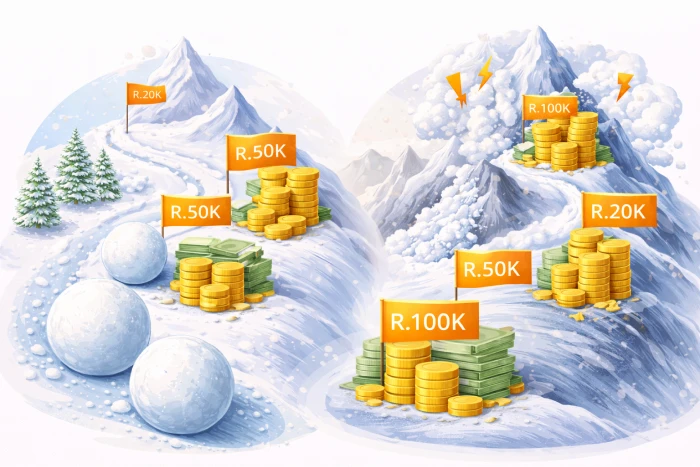
The snowball method focuses on repaying the smallest loan first, regardless of interest rate.
How It Works
List all loans from smallest outstanding to largest.
Pay minimum EMI on all loans.
Use extra money to close the smallest loan first.
Once closed, redirect that EMI to the next smallest loan.
Example
Loan | Outstanding | Interest Rate |
Personal Loan | Rs 2 lakh | 15% |
Car Loan | Rs 4 lakh | 9% |
Home Loan | Rs 30 lakh | 8.5% |
Under snowball, you clear the Rs 2 lakh loan first because it is smallest.
Why People Like It
Quick psychological wins
Fewer EMIs faster
High motivation
Easier discipline
The strategy is behavioral, not mathematical.
What Is the Avalanche Method?
The avalanche method targets the highest interest rate first.
How It Works
List loans from highest interest rate to lowest.
Pay minimum EMI on all.
Use extra funds to close the highest-rate loan first.
Move to the next highest-rate loan.
Using the same example:
Loan | Outstanding | Interest Rate |
Personal Loan | Rs 2 lakh | 15% |
Car Loan | Rs 4 lakh | 9% |
Home Loan | Rs 30 lakh | 8.5% |
If a personal loan has the highest rate, it gets cleared first even if it is not the smallest. If a larger loan carried 18 percent, that would be targeted first.
Why It Works
Reduces total interest paid
Speeds up wealth building
Mathematically optimal
Financial advisors often recommend this method because it minimizes cost.
Which Method Saves More Money?
Short answer: The avalanche method saves more money in most cases.
Because you attack the highest interest rate first, you reduce compounding faster.
According to consumer credit analysis and commentary covered in the Economic Times, unsecured loan interest rates in India often range between 12 to 20 percent. Paying off these faster dramatically cuts total repayment.
Mathematically, avalanche reduces interest outgo more efficiently.
However, money decisions are not purely mathematical.
Real Comparison: Example Scenario
Assume:
Loan A: Rs 5 lakh at 16 percent
Loan B: Rs 3 lakh at 10 percent
Extra repayment capacity: Rs 20,000 per month
Snowball Approach
If Loan B is smaller, you close it first. Meanwhile, Loan A at 16 percent continues compounding.
Total interest paid over time: Higher.
Avalanche Approach
You close Loan A first. High interest stops earlier.
Total interest paid: Lower.
Over a few years, the difference may run into tens of thousands.
Why Many Indians Still Prefer Snowball
At Saarathi.ai, we have observed that borrowers often struggle with motivation.
If you have:
Four active loans
Long tenures
Tight cash flow
Seeing one loan fully closed gives confidence. That emotional boost keeps you consistent.
Behavioral finance studies show that quick wins improve financial discipline.
If you abandon an avalanche midway due to fatigue, snowball may actually be better for you.
When Avalanche Method Is Ideal
Choose avalanche if:
You are disciplined
You track numbers regularly
You want to minimize interest
You have high-interest personal loans or credit card debt
You are financially organized
In India, unsecured personal loans carry higher rates than secured home loans. According to policy data and oversight from the Reserve Bank of India, unsecured credit growth has been closely monitored due to rising risk exposure.
Clearing high-interest unsecured loans first reduces risk and cost.
When Snowball Method Makes Sense
Choose snowball if:
You feel overwhelmed
You need motivation
You have multiple small loans
Interest rates are similar
You want fewer EMIs quickly
For example, if three loans all carry 10 to 12 percent interest, the difference in savings may not be huge. In that case, psychological momentum matters more.
Hybrid Strategy: Smart Indian Approach
You do not have to choose only one.
Many smart borrowers use a hybrid approach:
First, clear extremely high-interest debt above 18 percent.
Then switch to snowball for remaining loans.
Reassess annually.
At Saarathi.ai, our Recommendation Engine helps borrowers evaluate restructuring options before choosing repayment order. Sometimes refinancing a high-interest loan to a lower rate is smarter than aggressive prepayment.
You can compare personal loan offers on Saarathi.ai to check if refinancing reduces interest burden.
Should You Prepay a Home Loan First?
Usually, no.
Home loans:
Have lower interest rates
Offer tax benefits
Have longer tenure
If your home loan rate is 8.5 percent and your personal loan is 15 percent, prioritizing personal loan makes more sense.
Credit rating commentary from CRISIL often highlights that unsecured retail loans carry higher risk weight compared to secured housing loans.
Clearing high-risk debt first strengthens financial stability.
Key Factors to Consider Before Choosing
1. Interest Rate Gap
The large gap between loans favors avalanche.
2. Number of Loans
Too many small loans may justify snowballing for simplicity.
3. Emotional Discipline
If math overwhelms you, snowball may keep you consistent.
4. Prepayment Charges
Check for:
Foreclosure penalties
Lock-in periods
Processing fees for refinancing
You can track and manage structured offers via Saarathi Bazaar if refinancing.
Common Mistakes to Avoid
Closing lowest-interest loan first
Ignoring emergency fund
Using bonus without strategy
Taking new loan after closing one
Missing EMIs during aggressive prepayment
Total EMIs should remain below 35 to 40 percent of net income even during accelerated repayment.
Quick Comparison Table
Factor | Snowball | Avalanche |
Saves More Interest | No | Yes |
Motivational Boost | High | Moderate |
Best For | Behavioral discipline | Cost optimization |
Mathematical Efficiency | Lower | Higher |
Stress Reduction | Faster emotional relief | Slower but optimal |
Digital Tools Make It Easier in 2026
Instead of guessing, you can:
Simulate EMI scenarios
Compare refinancing rates
Evaluate affordability
Avoid multiple applications
At Saarathi.ai, borrowers can explore structured refinancing options across 110 plus lenders, check eligibility through Saarathi AI expert chatbot, and track progress in Saarathi Bazaar dashboard.
Transparent comparisons reduce both interest cost and emotional stress.
FAQs
1. Which method saves more money in India?
The avalanche method typically saves more because it targets the highest interest rate first.
2. Is the snowball method wrong?
No. It is psychologically powerful and helps maintain repayment discipline.
3. Can I switch methods midway?
Yes. Many borrowers start with an avalanche and move to snowball for motivation.
4. Should I refinance before using an avalanche?
If refinancing significantly lowers interest rate, it may be smarter than aggressive prepayment.
5. How can Saarathi.ai help manage multiple loans?
You can compare refinancing options, check EMI affordability, and get AI-based structured recommendations tailored to your profile.
Conclusion
Snowball vs avalanche is not about right or wrong. It is about what saves more and what keeps you consistent.
If you want maximum interest savings, choose avalanche.
If you need motivation and quick wins, choose snowball.
The best strategy is the one you follow consistently.
Before accelerating repayment, compare structured loan options, check refinancing opportunities, and calculate affordability carefully.
Take control of your EMIs and explore smarter loan management solutions on Saarathi.ai today.