Should you take a loan or use savings?
Saarathi
Saarathi
|
Feb 26, 2026
Feb 26, 2026
Should you take a loan or use savings? This is one of the most common financial questions Indians face in 2026. Whether it is buying a home, funding a wedding, handling a medical emergency, or expanding a business, the decision between loan vs savings can significantly impact your long-term wealth.
The right answer depends on your cash flow, interest rates, investment returns, and financial goals. At Saarathi.ai, we have observed that many borrowers either overuse savings and hurt liquidity or overborrow and struggle with EMIs. In this guide, we break down when to borrow, when to use savings, and how to make a data-backed decision using the Saarathi Recommendation Engine.
Understanding the Core Difference: Loan vs Savings
Before deciding, let us clarify what each option really means.
What Happens When You Use Savings?
Using savings means:
You avoid paying interest
You reduce your liquidity
You may disturb long-term investments
You avoid EMI commitments
If you break a fixed deposit earning 6.5 percent to fund a purchase, you lose future compounding.
What Happens When You Take a Loan?
Taking a loan means:
You preserve savings and investments
You pay interest
You commit to EMIs
You may get tax benefits in some cases
For example, under RBI regulated lending norms, interest rates vary based on credit score and lender policies. According to data and policy releases from the Reserve Bank of India, repo rate movements directly affect floating-rate loans.
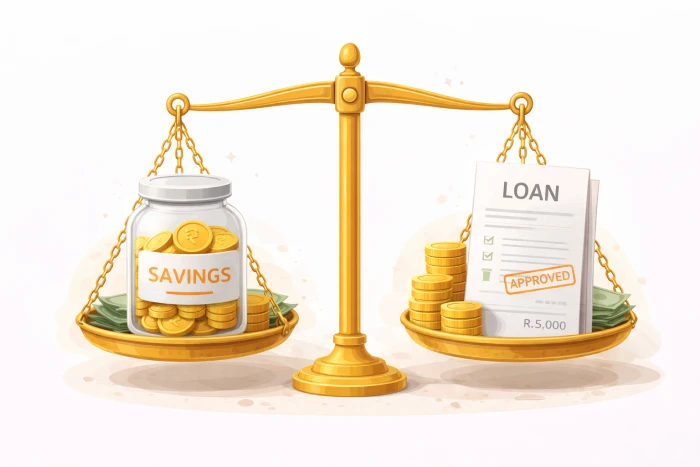
The real question is not loan vs savings. It is the cost of capital vs opportunity cost.
The 5 Key Factors to Decide
1. Emergency Fund Status
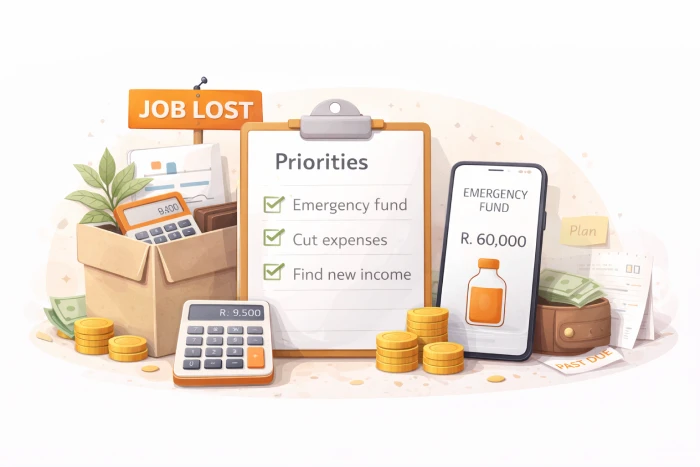
First rule: never exhaust your emergency fund.
You should ideally maintain:
6 months of expenses for salaried individuals
9 to 12 months for self-employed professionals
If using savings reduces your emergency buffer below safe levels, taking a loan is often smarter.
At Saarathi.ai, we have seen borrowers struggle when unexpected medical or job loss situations arise after they empty savings for big purchases.
2. Interest Rate vs Investment Returns
This is pure math.
Ask yourself:
What is your loan interest rate?
What returns are your savings generating?
For example:
Scenario | Loan Interest | Investment Return | Better Choice |
Personal Loan | 14% | FD at 6.5% | Use savings |
Home Loan | 8.5% | Equity MF at 12% long term | Consider loan |
According to reports published in the Economic Times, long-term equity mutual fund returns in India have averaged around 11 to 13 percent over extended periods. If your investments generate higher returns than loan cost, borrowing may preserve wealth.
However, equity returns are market-linked and not guaranteed.
3. Tax Benefits
Some loans offer tax advantages.
Home Loans
Under Section 24 and Section 80C of the Income Tax Act:
Interest deduction up to Rs 2 lakh
Principal repayment deduction up to Rs 1.5 lakh
This reduces effective interest cost.
You can explore competitive home loan offers and check eligibility instantly on Saarathi.ai through our AI-powered matching system.
Education Loans
Interest deduction under Section 80E.
Personal Loans
Usually no tax benefit unless used for business purposes.
If tax savings reduce your effective interest rate, borrowing may make more sense.
4. Nature of Expense: Asset vs Liability
This is crucial.
Productive Asset
Home purchase
Business expansion
Education
Machinery purchase
In such cases, borrowing can be strategic.
Depreciating Asset or Lifestyle Expense
Vacation
Luxury gadgets
Wedding overspending
Using savings is often safer than taking high-interest personal loans.
At Saarathi.ai, we advise borrowers to align debt with income-generating or appreciating assets.
5. Liquidity and Psychological Comfort
Money decisions are not only mathematical.
Some people:
Hate EMIs
Prefer debt-free peace
Sleep better without obligations
Others:
Prefer liquidity
Want investments untouched
Are comfortable managing leverage
Choose what aligns with your financial personality.
Case Studies: Real-Life Scenarios in India
Scenario 1: Medical Emergency
Rohan has:
Rs 8 lakh savings
Rs 6 lakh medical expense
No health insurance coverage
If he uses savings:
Remaining savings: Rs 2 lakh
Emergency fund almost gone
Better option:
Use Rs 3 lakh savings
Take Rs 3 lakh personal loan
Maintain buffer
You can compare personal loan offers on Saarathi.ai and get AI-based rate matching in minutes.
Scenario 2: Home Down Payment
Priya wants to buy a Rs 70 lakh home in Pune.
She has:
Rs 25 lakh savings
Eligible for 80 percent home loan
Using full savings leaves no cushion for registration, interiors, and emergencies.
Smart approach:
Use Rs 18 to 20 lakh
Keep Rs 5 to 7 lakh as buffer
Finance rest via home loan
You can check your eligibility and interest rates across 110 plus lenders on Saarathi.ai in one dashboard.
Scenario 3: Business Expansion
A small manufacturer needs Rs 15 lakh to expand.
Savings invested in mutual funds earning 12 percent long term.
Business ROI expected at 18 percent.
Borrowing at an 11 percent business loan rate may be strategic, as long as cash flow supports EMI.
According to industry insights from CRISIL, MSME credit growth in India has remained strong due to expansion demand and digital lending adoption.
When Using Savings Is Better
You should consider using savings if:
Loan interest rate is above 14 percent
Expense is discretionary
Your savings earn low returns
You have sufficient emergency buffer left
You want zero financial stress
Example: Using Rs 2 lakh from savings for a car down payment instead of taking a 16 percent personal loan.
When Taking a Loan Is Smarter
Borrowing may be better when:
Interest rate is reasonable
You get tax benefits
Investment returns exceed borrowing cost
You want liquidity
Asset is income generating
Digital lending has simplified the process significantly in 2026. With paperless KYC, Aadhaar based verification, and instant eligibility checks, loan approvals are much faster than before.
On Saarathi.ai, you can:
Compare personal loan offers on Saarathi.ai
Explore home loan options from leading banks and NBFCs
Track your application in Saarathi Bazaar
Ask eligibility questions via Saarathi AI expert chatbot
All in one place, fully transparent.
The Hybrid Strategy: Best of Both Worlds
Often, the smartest approach is not extreme.
Use:
40 to 60 percent savings
40 to 60 percent loan
This balances:
Liquidity
EMI burden
Wealth growth
Risk management
At Saarathi.ai, our Recommendation Engine analyzes:
Credit score
Income
Loan eligibility
Lender offers
EMI affordability
It then suggests the optimal borrowing amount instead of pushing maximum eligibility.
Hidden Risks to Watch
1. Prepayment Penalties
Some loans, especially fixed-rate or NBFC loans, may have charges.
2. Breaking Investments
Premature FD closure may reduce interest.
Selling equity during market dips locks losses.
3. Overleveraging
High EMI to income ratio above 40 percent is risky.
4. Ignoring Credit Score Impact
Frequent loan applications reduce scores temporarily.
Use a single platform like Saarathi.ai to compare multiple lenders without harming your credit profile through unnecessary multiple applications.
Quick Decision Framework
Ask these 7 questions:
Do I have 6 months emergency savings after this expense?
Is the expense essential?
What is the effective interest rate after tax?
What returns do my investments generate?
Can I comfortably manage EMI below 35 to 40 percent of income?
Is the asset income generating?
Am I emotionally comfortable with debt?
If most answers favor liquidity and returns, take a loan.
If most favor simplicity and low cost, use savings.
FAQs
1. Is it better to take a personal loan or break a fixed deposit?
If FD earns 6 to 7 percent and personal loan costs 13 to 16 percent, using savings is usually cheaper unless you need liquidity.
2. Should I take a loan even if I have enough savings?
Yes, if your savings generate higher returns than the loan interest and you maintain an emergency buffer.
3. Does taking a loan hurt my credit score?
Timely EMI payments improve credit score. Multiple random applications may reduce it temporarily.
4. What is a safe EMI to income ratio in India?
Ideally below 35 to 40 percent of monthly income.
5. Can Saarathi.ai help me decide the right loan amount?
Yes. Saarathi.ai uses AI-driven recommendations to match you with suitable lenders and EMI structures based on your financial profile.
Conclusion
The loan vs savings decision is not emotional. It is strategic.
Remember:
Protect your emergency fund
Compare interest vs returns
Factor in tax benefits
Avoid lifestyle debt
Maintain EMI discipline
At Saarathi.ai, we believe informed borrowing builds wealth, not stress. Whether you decide to use savings or take a loan, make it data-driven.
Discover personalized loan options, compare lenders, and track approvals seamlessly on Saarathi.ai today.
Should you take a loan or use savings? This is one of the most common financial questions Indians face in 2026. Whether it is buying a home, funding a wedding, handling a medical emergency, or expanding a business, the decision between loan vs savings can significantly impact your long-term wealth.
The right answer depends on your cash flow, interest rates, investment returns, and financial goals. At Saarathi.ai, we have observed that many borrowers either overuse savings and hurt liquidity or overborrow and struggle with EMIs. In this guide, we break down when to borrow, when to use savings, and how to make a data-backed decision using the Saarathi Recommendation Engine.
Understanding the Core Difference: Loan vs Savings
Before deciding, let us clarify what each option really means.
What Happens When You Use Savings?
Using savings means:
You avoid paying interest
You reduce your liquidity
You may disturb long-term investments
You avoid EMI commitments
If you break a fixed deposit earning 6.5 percent to fund a purchase, you lose future compounding.
What Happens When You Take a Loan?
Taking a loan means:
You preserve savings and investments
You pay interest
You commit to EMIs
You may get tax benefits in some cases
For example, under RBI regulated lending norms, interest rates vary based on credit score and lender policies. According to data and policy releases from the Reserve Bank of India, repo rate movements directly affect floating-rate loans.
The real question is not loan vs savings. It is the cost of capital vs opportunity cost.
The 5 Key Factors to Decide
1. Emergency Fund Status
First rule: never exhaust your emergency fund.
You should ideally maintain:
6 months of expenses for salaried individuals
9 to 12 months for self-employed professionals
If using savings reduces your emergency buffer below safe levels, taking a loan is often smarter.
At Saarathi.ai, we have seen borrowers struggle when unexpected medical or job loss situations arise after they empty savings for big purchases.
2. Interest Rate vs Investment Returns
This is pure math.
Ask yourself:
What is your loan interest rate?
What returns are your savings generating?
For example:
Scenario | Loan Interest | Investment Return | Better Choice |
Personal Loan | 14% | FD at 6.5% | Use savings |
Home Loan | 8.5% | Equity MF at 12% long term | Consider loan |
According to reports published in the Economic Times, long-term equity mutual fund returns in India have averaged around 11 to 13 percent over extended periods. If your investments generate higher returns than loan cost, borrowing may preserve wealth.
However, equity returns are market-linked and not guaranteed.
3. Tax Benefits
Some loans offer tax advantages.
Home Loans
Under Section 24 and Section 80C of the Income Tax Act:
Interest deduction up to Rs 2 lakh
Principal repayment deduction up to Rs 1.5 lakh
This reduces effective interest cost.
You can explore competitive home loan offers and check eligibility instantly on Saarathi.ai through our AI-powered matching system.
Education Loans
Interest deduction under Section 80E.
Personal Loans
Usually no tax benefit unless used for business purposes.
If tax savings reduce your effective interest rate, borrowing may make more sense.
4. Nature of Expense: Asset vs Liability
This is crucial.
Productive Asset
Home purchase
Business expansion
Education
Machinery purchase
In such cases, borrowing can be strategic.
Depreciating Asset or Lifestyle Expense
Vacation
Luxury gadgets
Wedding overspending
Using savings is often safer than taking high-interest personal loans.
At Saarathi.ai, we advise borrowers to align debt with income-generating or appreciating assets.
5. Liquidity and Psychological Comfort
Money decisions are not only mathematical.
Some people:
Hate EMIs
Prefer debt-free peace
Sleep better without obligations
Others:
Prefer liquidity
Want investments untouched
Are comfortable managing leverage
Choose what aligns with your financial personality.
Case Studies: Real-Life Scenarios in India
Scenario 1: Medical Emergency
Rohan has:
Rs 8 lakh savings
Rs 6 lakh medical expense
No health insurance coverage
If he uses savings:
Remaining savings: Rs 2 lakh
Emergency fund almost gone
Better option:
Use Rs 3 lakh savings
Take Rs 3 lakh personal loan
Maintain buffer
You can compare personal loan offers on Saarathi.ai and get AI-based rate matching in minutes.
Scenario 2: Home Down Payment
Priya wants to buy a Rs 70 lakh home in Pune.
She has:
Rs 25 lakh savings
Eligible for 80 percent home loan
Using full savings leaves no cushion for registration, interiors, and emergencies.
Smart approach:
Use Rs 18 to 20 lakh
Keep Rs 5 to 7 lakh as buffer
Finance rest via home loan
You can check your eligibility and interest rates across 110 plus lenders on Saarathi.ai in one dashboard.
Scenario 3: Business Expansion
A small manufacturer needs Rs 15 lakh to expand.
Savings invested in mutual funds earning 12 percent long term.
Business ROI expected at 18 percent.
Borrowing at an 11 percent business loan rate may be strategic, as long as cash flow supports EMI.
According to industry insights from CRISIL, MSME credit growth in India has remained strong due to expansion demand and digital lending adoption.
When Using Savings Is Better
You should consider using savings if:
Loan interest rate is above 14 percent
Expense is discretionary
Your savings earn low returns
You have sufficient emergency buffer left
You want zero financial stress
Example: Using Rs 2 lakh from savings for a car down payment instead of taking a 16 percent personal loan.
When Taking a Loan Is Smarter
Borrowing may be better when:
Interest rate is reasonable
You get tax benefits
Investment returns exceed borrowing cost
You want liquidity
Asset is income generating
Digital lending has simplified the process significantly in 2026. With paperless KYC, Aadhaar based verification, and instant eligibility checks, loan approvals are much faster than before.
On Saarathi.ai, you can:
Compare personal loan offers on Saarathi.ai
Explore home loan options from leading banks and NBFCs
Track your application in Saarathi Bazaar
Ask eligibility questions via Saarathi AI expert chatbot
All in one place, fully transparent.
The Hybrid Strategy: Best of Both Worlds
Often, the smartest approach is not extreme.
Use:
40 to 60 percent savings
40 to 60 percent loan
This balances:
Liquidity
EMI burden
Wealth growth
Risk management
At Saarathi.ai, our Recommendation Engine analyzes:
Credit score
Income
Loan eligibility
Lender offers
EMI affordability
It then suggests the optimal borrowing amount instead of pushing maximum eligibility.
Hidden Risks to Watch
1. Prepayment Penalties
Some loans, especially fixed-rate or NBFC loans, may have charges.
2. Breaking Investments
Premature FD closure may reduce interest.
Selling equity during market dips locks losses.
3. Overleveraging
High EMI to income ratio above 40 percent is risky.
4. Ignoring Credit Score Impact
Frequent loan applications reduce scores temporarily.
Use a single platform like Saarathi.ai to compare multiple lenders without harming your credit profile through unnecessary multiple applications.
Quick Decision Framework
Ask these 7 questions:
Do I have 6 months emergency savings after this expense?
Is the expense essential?
What is the effective interest rate after tax?
What returns do my investments generate?
Can I comfortably manage EMI below 35 to 40 percent of income?
Is the asset income generating?
Am I emotionally comfortable with debt?
If most answers favor liquidity and returns, take a loan.
If most favor simplicity and low cost, use savings.
FAQs
1. Is it better to take a personal loan or break a fixed deposit?
If FD earns 6 to 7 percent and personal loan costs 13 to 16 percent, using savings is usually cheaper unless you need liquidity.
2. Should I take a loan even if I have enough savings?
Yes, if your savings generate higher returns than the loan interest and you maintain an emergency buffer.
3. Does taking a loan hurt my credit score?
Timely EMI payments improve credit score. Multiple random applications may reduce it temporarily.
4. What is a safe EMI to income ratio in India?
Ideally below 35 to 40 percent of monthly income.
5. Can Saarathi.ai help me decide the right loan amount?
Yes. Saarathi.ai uses AI-driven recommendations to match you with suitable lenders and EMI structures based on your financial profile.
Conclusion
The loan vs savings decision is not emotional. It is strategic.
Remember:
Protect your emergency fund
Compare interest vs returns
Factor in tax benefits
Avoid lifestyle debt
Maintain EMI discipline
At Saarathi.ai, we believe informed borrowing builds wealth, not stress. Whether you decide to use savings or take a loan, make it data-driven.
Discover personalized loan options, compare lenders, and track approvals seamlessly on Saarathi.ai today.
Discover the
Best Bank Loan Offer
Discover the
Best Bank Loan Offer
Say goodbye to endless bank visits and uncertainty!
With our smart loan matchmaking, you can instantly discover the right lenders and compare multiple offers - quickly and seamlessly. Built with 300+years of combined industry experience, our platform ensures efficiency, accuracy, and higher conversions.
Experience the future of lending.
Say goodbye to endless bank visits and uncertainty!
With our smart loan matchmaking, you can instantly discover the right lenders and compare multiple offers - quickly and seamlessly. Built with 300+years of combined industry experience, our platform ensures efficiency, accuracy, and higher conversions.
Experience the future of lending.
Download the Saarathi Bazaar App
Download the Saarathi Bazaar App