Should You Take a Large Home Loan During Global Stagflation?
|
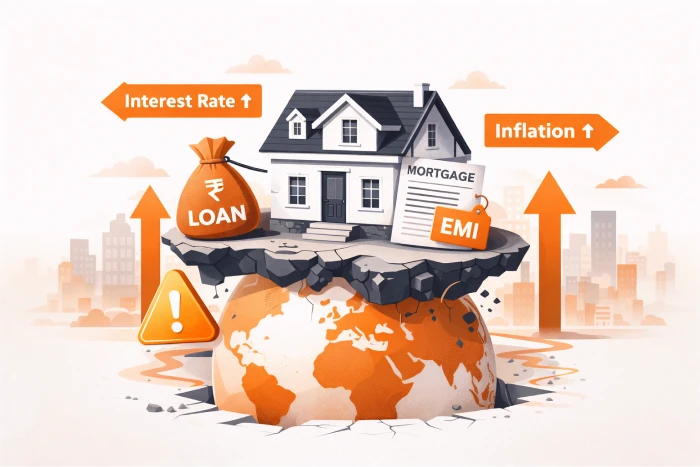
Stagflation is one of the most challenging economic environments. It combines slow growth with high inflation. If the world enters stagflation in 2026 or 2027, Indian borrowers may face a tough decision: is it safe to take a large home loan during such a period? The answer depends on inflation trends, interest rate outlook, job stability, and your financial cushion. In this guide, we explain how stagflation affects EMIs, property prices, and lender behavior, and how to decide responsibly before committing to a high value mortgage.
What Is Stagflation?
Stagflation occurs when:
Economic growth slows
Unemployment rises
Inflation remains elevated
Unlike a typical recession where inflation falls, stagflation keeps prices high while incomes grow slowly.
For India, stagflation risk can emerge if:
Oil prices surge
Global supply chains remain disrupted
Export demand weakens
As frequently reported by Economic Times, oil driven inflation combined with global slowdown creates policy challenges for emerging markets.
How Stagflation Affects Interest Rates
The Reserve Bank of India has a primary mandate to control inflation within a defined band.
If inflation stays above 6 percent while growth slows:
RBI may keep repo rates elevated
Rate cuts may be delayed
Borrowing costs remain high
This means home loan rates may stay expensive for longer.
Floating rate borrowers face:
Higher EMIs
Or longer loan tenure
In a stagflation environment, immediate rate relief is unlikely.
Impact on Home Loan Affordability
High inflation affects affordability in two ways:
Rising Cost of Living
Food, fuel, and utility bills increase, reducing disposable income.Higher Interest Cost
If home loan rates stay elevated, EMI burden increases.
For example:
A Rs 80 lakh loan at 9 percent carries significantly higher EMI than at 7 percent.
Over 20 to 25 years, total interest outgo rises sharply.
You can compare home loan offers on Saarathi.ai to evaluate rate differences and tenure impact before committing.
Will Property Prices Fall During Stagflation?
Property prices may behave differently depending on location.
Possible outcomes:
Luxury demand may weaken
Affordable housing may remain stable
Developers may offer discounts or flexible payment plans
However, high construction costs due to inflation may prevent sharp price corrections.
So you may not see deep property discounts even during slow growth.
Job Stability Risk
Stagflation increases risk for:
Export dependent sectors
IT services tied to global demand
MSMEs facing higher input costs
If job visibility is uncertain, taking a large home loan increases financial vulnerability.
At Saarathi.ai, we have observed that borrowers who overstretch EMI capacity during uncertain cycles face higher stress later.
When It May Still Be Safe
Taking a large home loan can still be reasonable if:
You work in a stable sector such as government, healthcare, or essential domestic services
EMI remains below 35 to 40 percent of income
You have at least 6 to 9 months of emergency savings
You expect steady income growth
In such cases, long term property ownership can remain viable.
You can ask eligibility questions via Saarathi AI expert before applying to assess affordability safely.
When You Should Be Cautious
Avoid aggressive borrowing if:
Your job depends heavily on global demand
You rely on bonuses or variable income
You have existing high unsecured loans
You lack emergency reserves
Stagflation combines income uncertainty with high cost of borrowing, which is a difficult combination.
Fixed vs Floating During Stagflation
In stagflation:
Floating rates may stay elevated
Rate cuts may be delayed
A fixed or hybrid rate structure may offer stability if you expect prolonged high rates.
You can compare home loan offers on Saarathi.ai and evaluate fixed, floating, and hybrid options across lenders.
Practical Safety Checklist
Before taking a large home loan, ask:
Can I manage EMI if rates rise by 1 percent?
Can I handle an income reduction of 20 percent temporarily?
Is my emergency fund strong?
Is the property purchase essential or discretionary?
Am I stretching tenure beyond comfort?
Answering these honestly reduces regret later.
Smart Borrowing Strategy in Stagflation
Choose conservative loan amount
Opt for longer tenure but plan prepayments
Avoid maxing out eligibility
Maintain liquidity buffer
Review refinance opportunities periodically
You can track your application in Saarathi Bazaar and monitor every stage of approval transparently.
FAQs
Is it risky to take a home loan during stagflation?
It can be riskier due to high inflation and uncertain growth, especially if income is unstable.
Will EMIs fall during stagflation?
Unlikely, unless inflation declines significantly.
Should I wait for rate cuts?
Rate cuts may be delayed in stagflation, so waiting may not guarantee cheaper loans.
Are property prices likely to crash?
Not necessarily. Construction costs may keep prices supported.
How can I reduce risk?
Keep EMI below 40 percent of income and maintain strong emergency savings.
Conclusion
If the world enters stagflation, taking a large home loan in India requires extra caution. High inflation keeps borrowing costs elevated, while slow growth increases job uncertainty.
However, for borrowers with stable income, strong savings, and disciplined EMI ratios, home ownership can still be safe and strategic.
Instead of reacting to macro headlines, evaluate your personal financial strength and loan structure carefully.
Discover personalized home loan options on Saarathi.ai today and make a confident decision, even in a challenging global economic environment.