Secured vs Unsecured Loans: Which Is Better?
|
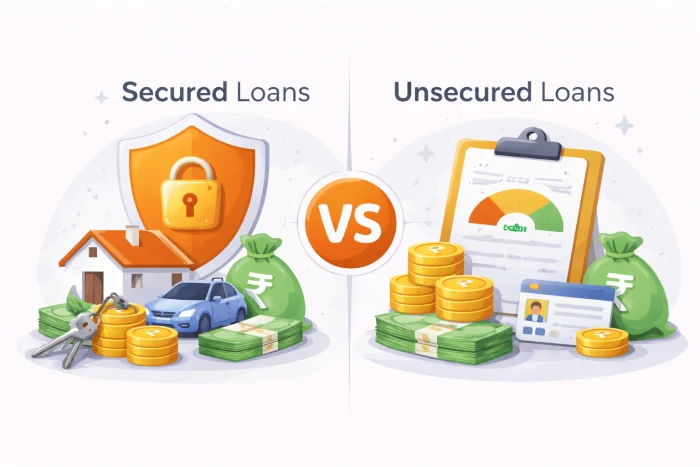
Secured vs unsecured loans - which is better for you in 2026? The answer depends on your financial needs, risk appetite, and repayment capacity. Secured loans require collateral like property or gold, while unsecured loans rely mainly on your credit score and income profile.
Both options have advantages and trade-offs. At Saarathi.ai, we have observed that borrowers often focus only on interest rates without evaluating risk exposure, approval timelines, or long-term impact. In this detailed guide, we compare secured and unsecured loans across interest rates, eligibility, risk, documentation, and ideal use cases so you can make an informed decision.
What Is a Secured Loan?
A secured loan is backed by collateral. The lender can recover dues by selling the pledged asset in case of default.
Common examples:
Home loans
Loan against property
Gold loans
Secured business loans
Collateral can include:
Residential or commercial property
Gold jewellery
Fixed deposits
Business assets
Because risk is lower, secured loans typically offer lower interest rates and higher loan amounts.
You can compare secured loan options easily through compare loan against property offers on Saarathi.ai and check eligibility instantly.
What Is an Unsecured Loan?
An unsecured loan does not require collateral. Approval depends on:
Credit score
Income stability
Employer or business profile
Existing liabilities
Examples include:
Personal loans
Credit cards
Some small business loans
Since there is no asset backing, interest rates are usually higher.
At Saarathi.ai, our AI Recommendation Engine evaluates your profile and matches you with lenders offering competitive unsecured loan terms across 110+ banks and NBFCs.
Secured vs Unsecured Loans: Key Differences
Feature | Secured Loan | Unsecured Loan |
Collateral | Required | Not required |
Interest Rate | Lower | Higher |
Loan Amount | Higher | Moderate |
Approval Speed | Slower | Faster |
Risk to Borrower | Asset at risk | No asset risk |
Credit Score Importance | Important | Very critical |
Understanding these differences is essential before choosing the right option.
Interest Rates: Which Is Cheaper?
Interest rates vary based on lender policies and market conditions influenced by the Reserve Bank of India.
Typical ranges in India:
Home loans: 8.3 to 9.5 percent
Loan against property: 8.5 to 11 percent
Personal loans: 11 to 20 percent
Secured loans are generally cheaper because collateral reduces default risk.
At Saarathi.ai, we have observed that borrowers switching from high-interest personal loans to secured options like loan against property often save significantly on total interest outgo.
Loan Amount and Eligibility
Secured Loans
Higher eligibility due to:
Asset value
Loan to Value ratio
Stable repayment capacity
For example:
Property value: Rs 1 crore
LTV allowed: 60 percent
Eligible loan: Rs 60 lakh
Unsecured Loans
Eligibility depends primarily on:
Monthly income
Debt-to-income ratio
Credit score
Loan amounts usually range between Rs 50,000 and Rs 40 lakh for personal loans, depending on profile.
If you are unsure about eligibility, ask eligibility questions via Saarathi AI for quick guidance.
Approval Time and Documentation
Secured Loans
Require:
Legal verification
Technical valuation
Property documentation
Processing time: 7 to 20 days
Unsecured Loans
Require:
Income proof
Identity and address proof
Bank statements
Processing time: 24 hours to 5 days
If speed is critical, unsecured loans may be more suitable.
You can monitor every step digitally and track your application in Saarathi Bazaar for complete transparency.
Risk Comparison
Risk in Secured Loans
Property or gold can be auctioned upon default
Recovery action may be initiated under legal frameworks
Risk in Unsecured Loans
No asset seizure
Legal recovery through civil action
Credit score damage
Industry analysis by CRISIL highlights that secured lending typically has lower default rates due to asset backing.
However, borrowers must assess whether they are comfortable risking valuable property.
Credit Score Impact
Both loan types affect credit score.
Positive impact if:
EMIs paid on time
Loan utilization managed properly
Negative impact if:
Delays or defaults occur
As discussed in financial coverage by The Economic Times, disciplined repayment behavior strengthens your long-term credit profile.
Unsecured loans require higher credit scores at the time of application compared to secured loans.
When Is a Secured Loan Better?
Choose secured loans if:
You need a large loan amount
You want lower interest rates
You have stable income
You can commit to long tenure
Example:
A business owner seeking Rs 75 lakh expansion funding may benefit from loan against property at 9 percent instead of unsecured credit at 16 percent.
When Is an Unsecured Loan Better?
Choose unsecured loans if:
You need urgent funds
Loan amount is moderate
You do not want to risk assets
Documentation needs to be minimal
Example:
For a Rs 3 lakh medical emergency, a personal loan may be faster and simpler than mortgaging property.
At Saarathi.ai, we have observed strong demand for quick personal loans during festival seasons and financial year-end expenses.
Cost Comparison Example
Let us compare:
Loan Amount: Rs 20 lakh
Tenure: 10 years
Secured Loan at 9 percent
Unsecured Loan at 15 percent
The difference in total interest paid over 10 years can be substantial.
However, if tenure is short and amount small, the interest gap may not justify asset risk.
Always calculate EMI and total interest before deciding.
Our AI-powered recommendation system on Saarathi.ai performs this comparison instantly.
Hidden Costs to Watch
For secured loans:
Legal valuation charges
Processing fees
Prepayment penalties
For unsecured loans:
Higher processing fee percentage
Foreclosure charges during lock-in period
Transparency matters. Always review sanction letters carefully.
Common Myths
Myth 1: Secured loans are always better
Not true. They are cheaper but riskier.
Myth 2: Unsecured loans ruin credit score
Only missed payments harm your score.
Myth 3: Collateral guarantees approval
Income and repayment capacity still matter.
Myth 4: Unsecured loans are always expensive
High credit score borrowers can get competitive rates.
At Saarathi.ai, we encourage borrowers to compare both options objectively before applying.
How to Decide: 5-Step Checklist
Before choosing, ask:
How much loan amount do I need?
Can I comfortably repay EMIs for full tenure?
Am I comfortable pledging property or gold?
How urgent is the requirement?
What is the total cost including fees?
Use our AI tools to simulate different scenarios and compare lenders side by side.
FAQs
1. Which loan is easier to get?
Unsecured loans are quicker but require a strong credit score. Secured loans need asset documentation.
2. Which loan has lower EMI?
Secured loans usually have lower EMIs due to lower interest rates.
3. Can I convert an unsecured loan into secured?
Yes, through balance transfer to a secured loan option.
4. Does RBI regulate both loan types?
Yes. The Reserve Bank of India regulates banks and NBFC lending practices.
5. Which loan improves credit score faster?
Both help equally if EMIs are paid on time.
Conclusion
Secured vs unsecured loans is not about which is universally better. It is about which suits your financial situation.
Key takeaways:
Secured loans offer lower rates and higher eligibility.
Unsecured loans offer speed and no asset risk.
Evaluate interest, tenure, and repayment comfort.
Consider long-term financial stability before pledging assets.
Compare multiple lenders for transparency and better deals.
If you are unsure which loan type fits your needs, explore personalized recommendations on Saarathi.ai today. Compare secured and unsecured loan options, check eligibility instantly, and move forward with confidence in 2026.