Section 80C Explained: Best Ways to Save Tax in India
|
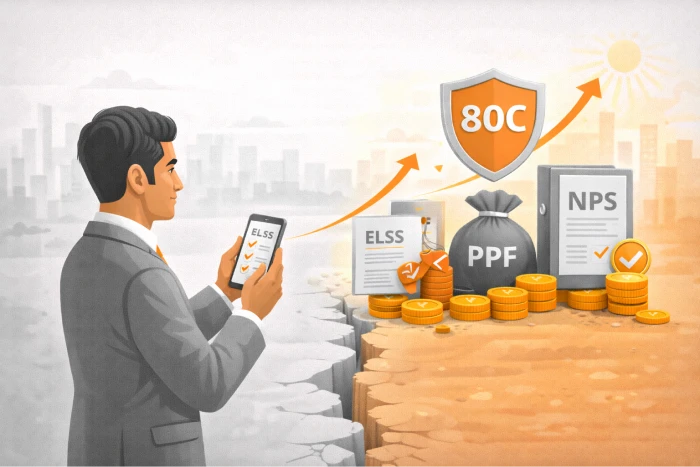
Section 80C of the Income Tax Act is one of the most widely used provisions for reducing taxable income in India. It allows individuals and Hindu Undivided Families to claim deductions of up to ₹1.5 lakh per financial year by investing in specific financial instruments or making eligible payments.
For salaried professionals and taxpayers, Section 80C offers an opportunity to reduce tax liability while building long-term savings and investments. Popular options include Public Provident Fund, Equity Linked Savings Schemes, Employee Provident Fund, life insurance premiums, and home loan principal repayment. At Saarathi.ai, we have observed that individuals who strategically use Section 80C deductions often combine tax savings with disciplined financial planning, enabling them to manage loans, investments, and long-term goals more effectively.
What is Section 80C?
Section 80C is a provision under the Income Tax Act that allows taxpayers to deduct certain investments and expenses from their gross total income.
The maximum deduction allowed under this section is ₹1.5 lakh per financial year.
This means if an individual's taxable income is ₹10 lakh and they invest ₹1.5 lakh in eligible Section 80C instruments, their taxable income reduces to ₹8.5 lakh.
This deduction applies only under the old tax regime, as most deductions are not available under the new tax regime.
Section 80C encourages individuals to invest in long-term savings and financial security instruments.
Popular Investment Options Under Section 80C
There are several investment and expense options that qualify for deductions under Section 80C.
Public Provident Fund (PPF)
PPF is a government-backed long-term savings scheme offering stable returns and tax-free interest.
Key features include:
15-year lock-in period
Tax-free interest earnings
Low risk due to government backing
Annual investment limit up to ₹1.5 lakh
PPF is ideal for conservative investors seeking stable long-term growth.
Equity Linked Savings Scheme (ELSS)
ELSS mutual funds are equity-based tax-saving investments.
They offer potential for higher returns compared to traditional savings instruments.
Key features include:
3-year lock-in period
Market-linked returns
Tax deduction under Section 80C
Potential long-term capital appreciation
ELSS funds are popular among investors seeking both tax savings and growth potential.
Employee Provident Fund (EPF)
EPF contributions made by salaried employees are eligible for deductions under Section 80C.
Both employee contributions and employer contributions help build retirement savings.
EPF provides stable returns and long-term retirement benefits.
Tax-Saving Fixed Deposits
Certain fixed deposits offered by banks have a mandatory five-year lock-in period and qualify for Section 80C deductions.
These deposits provide fixed interest rates and predictable returns.
However, interest earned from these deposits is taxable.
Life Insurance Premiums
Premiums paid toward life insurance policies for self, spouse, or children are eligible for tax deductions under Section 80C.
Life insurance provides financial protection for families while also helping reduce taxable income.
National Savings Certificate (NSC)
NSC is a government-backed investment option that offers fixed returns and tax benefits.
It has a lock-in period of five years and is considered a low-risk investment.
Sukanya Samriddhi Yojana
This scheme is designed to support long-term savings for a girl child's future education and marriage.
Parents or guardians can claim tax deductions for contributions made to the account.
The scheme offers attractive interest rates and tax-free maturity proceeds.
Home Loan Principal Repayment Under Section 80C
Home loan borrowers can also claim deductions under Section 80C for principal repayment.
The principal portion of EMI payments qualifies for deduction up to ₹1.5 lakh annually.
In addition to this benefit, home loan interest payments may qualify for deductions under Section 24 of the Income Tax Act.
Because of these tax benefits, home ownership becomes financially attractive for many individuals.
Before committing to property purchases, borrowers often compare home loan offers on Saarathi.ai to evaluate lenders and select suitable financing options.
Best Strategy to Maximize Section 80C Benefits
To make the most of Section 80C deductions, taxpayers should plan investments strategically throughout the financial year.
Start Investments Early
Investing early allows individuals to spread investments across months rather than making large lump-sum contributions at the end of the financial year.
This also helps reduce financial pressure.
Diversify Investments
Instead of investing the entire amount in one instrument, investors can diversify across multiple options such as ELSS, PPF, and insurance.
Diversification helps balance risk and returns.
Align Investments with Financial Goals
Tax-saving investments should also support long-term financial goals such as retirement planning, children's education, or wealth creation.
Choosing investments purely for tax savings without considering financial objectives may reduce overall effectiveness.
Section 80C Investment Comparison
Investment Option | Lock-in Period | Risk Level | Return Type
PPF | 15 years | Low | Government fixed rate
ELSS | 3 years | Moderate to high | Market linked
EPF | Till retirement | Low | Fixed interest
Tax-saving FD | 5 years | Low | Fixed interest
NSC | 5 years | Low | Fixed interest
Sukanya Samriddhi Yojana | Long term | Low | Government fixed rate
This comparison helps investors select instruments that align with their financial goals and risk tolerance.
Common Mistakes to Avoid
Many taxpayers make avoidable mistakes while claiming Section 80C deductions.
Waiting until the end of the financial year
Last-minute investments often lead to poor decisions and unsuitable financial products.
Ignoring long-term financial goals
Tax-saving investments should align with broader financial planning.
Overinvesting in low-return instruments
While safety is important, investors should consider growth potential when selecting instruments.
Not maintaining investment proof
Proper documentation is required for claiming deductions during tax filing.
Role of Digital Platforms in Financial Planning
Technology is simplifying how individuals manage financial decisions including tax planning and borrowing.
Digital financial platforms allow users to evaluate financial products, compare lenders, and access financial insights quickly.
For example, users can ask eligibility questions via Saarathi AI expert to understand loan eligibility, documentation requirements, and approval timelines instantly.
Saarathi.ai connects borrowers with more than 110 banks and NBFCs across India. The Saarathi Recommendation Engine matches borrowers with lenders based on financial profiles.
Borrowers can also track your application in Saarathi Bazaar, providing transparency throughout the loan process from application to approval.
These tools help individuals align tax-saving investments, borrowing decisions, and long-term financial planning.
Frequently Asked Questions
What is the maximum deduction allowed under Section 80C?
Taxpayers can claim deductions up to ₹1.5 lakh per financial year under Section 80C.
Does Section 80C apply under the new tax regime?
No. Most deductions under Section 80C are available only under the old tax regime.
Which investment has the shortest lock-in under Section 80C?
ELSS mutual funds have the shortest lock-in period of three years among Section 80C investments.
Can home loan EMIs be claimed under Section 80C?
Yes. The principal repayment portion of home loan EMIs qualifies for deduction under Section 80C.
Is PPF a safe tax-saving investment?
Yes. PPF is considered a low-risk government-backed investment with tax-free returns.
Conclusion
Section 80C remains one of the most powerful tools for reducing taxable income while encouraging long-term savings and investments. By investing in eligible instruments such as PPF, ELSS, EPF, tax-saving fixed deposits, and insurance policies, taxpayers can claim deductions up to ₹1.5 lakh annually.
Strategic planning and early investments help maximize the benefits of this provision while supporting broader financial goals.
At Saarathi.ai, we believe smarter financial decisions begin with the right information and accessible tools. Whether you are planning tax-saving investments, managing loans, or preparing for major financial milestones, digital platforms can simplify your financial journey.
Discover personalized loan options and build a smarter financial future with Saarathi.ai today.