Risk vs Return: How to Choose Investments Based on Your Goals
|
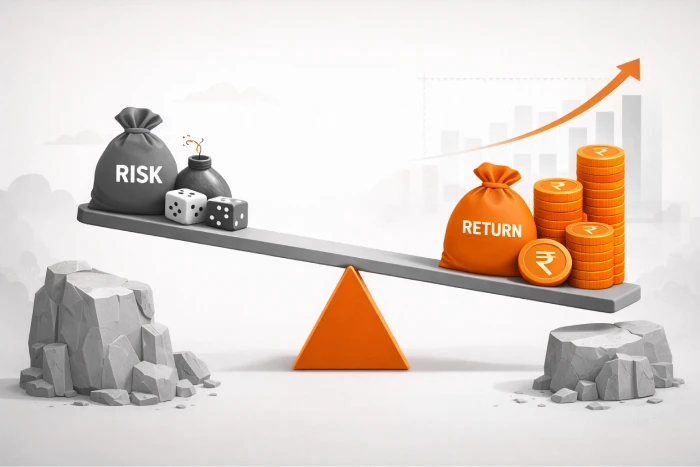
Every investment decision involves balancing two important factors: risk and return. The concept of risk vs return helps investors understand that higher potential returns usually come with higher levels of risk. In India, where investors can choose from equities, mutual funds, fixed deposits, gold, and government schemes, selecting the right investment strategy depends on financial goals, time horizon, and personal risk tolerance. Many investors either take too much risk chasing high returns or play too safe and miss out on long term growth. This guide explains the relationship between risk and return, how different investments carry varying levels of risk, and how you can choose the right investment options based on your financial goals.
Understanding Risk and Return
Risk refers to the possibility that an investment's actual returns may differ from expected returns. In some cases, investors may even lose a portion of their capital.
Return refers to the profit or income generated from an investment over time.
In simple terms:
Higher potential returns usually involve higher risk, while safer investments typically offer lower returns.
For example, equity investments may generate higher long term returns but also experience short term market volatility. On the other hand, fixed deposits offer stable returns but with lower growth potential.
Understanding this balance is essential for making smart investment decisions.
Types of Investment Risks
Different investments carry different types of risks. Investors should be aware of these before allocating money.
Market Risk
Market risk arises from fluctuations in financial markets.
Stock prices, mutual funds, and other market linked investments may rise or fall depending on economic conditions, interest rates, and global events.
Inflation Risk
Inflation reduces the purchasing power of money over time.
Investments with low returns may struggle to keep up with inflation, reducing real wealth growth.
Credit Risk
Credit risk occurs when a borrower or institution fails to repay the invested amount.
Corporate bonds or certain debt instruments may carry this risk.
Liquidity Risk
Liquidity risk refers to the difficulty of converting an investment into cash quickly without significant loss.
Real estate and certain long term investments may have limited liquidity.
Risk Levels Across Different Investments in India
Understanding the risk levels of common investments helps investors build balanced portfolios.
Investment Type | Risk Level | Expected Return |
Savings accounts | Very low | Low |
Fixed deposits | Low | Moderate |
Government bonds | Low | Moderate |
Debt mutual funds | Moderate | Moderate |
Equity mutual funds | Moderate to high | High |
Direct stocks | High | Very high |
Real estate | Moderate to high | Moderate to high |
Each investment serves different financial goals and risk profiles.
The Risk Return Tradeoff
The risk return tradeoff is a fundamental principle in investing.
It means that investors must accept higher levels of uncertainty if they want the possibility of higher returns.
For example:
Safe investments such as fixed deposits provide predictable but limited returns.
Growth investments such as equities can generate higher long term returns but also experience market volatility.
Successful investors balance these investments to create portfolios aligned with their financial goals.
Choosing Investments Based on Financial Goals
Investment strategies should always align with specific financial goals.
Short Term Goals (1 to 3 Years)
For short term goals, protecting capital is usually more important than chasing high returns.
Suitable investments include:
Savings accounts
Fixed deposits
Short term debt funds
Treasury bills
These options offer stability and liquidity.
Medium Term Goals (3 to 7 Years)
Investors planning for goals within a few years may consider a balanced investment approach.
Suitable options include:
Hybrid mutual funds
Debt mutual funds
Conservative equity funds
Gold investments
These investments balance moderate growth with controlled risk.
Long Term Goals (7+ Years)
Long term goals benefit from growth oriented investments that can outperform inflation.
Suitable options include:
Equity mutual funds
Index funds
Direct equities
Retirement investment schemes
Long investment horizons allow investors to ride out market volatility and benefit from compounding.
Assessing Your Personal Risk Tolerance
Risk tolerance varies widely among investors.
Factors that influence risk tolerance include:
Age
Income stability
Financial responsibilities
Investment experience
Psychological comfort with market fluctuations
For example, young professionals with stable income and long investment horizons may tolerate higher risk compared to retirees who depend on investment income.
The Role of Asset Allocation
Asset allocation is the process of dividing investments across different asset classes to balance risk and return.
A well diversified portfolio may include:
Equity investments for growth
Debt instruments for stability
Gold as a hedge against uncertainty
International investments for global diversification
This approach helps investors manage risk while maintaining growth potential.
Example allocation for moderate risk investors:
Asset Class | Allocation |
Equity mutual funds | 50% |
Debt instruments | 30% |
Gold | 10% |
International investments | 10% |
Asset allocation should evolve as financial goals and life stages change.
Common Mistakes Investors Make
Many investors struggle with risk and return decisions due to common behavioral mistakes.
Examples include:
Chasing high returns without understanding risks
Investing too conservatively and missing growth opportunities
Panic selling during market downturns
Failing to diversify investments
Ignoring long term financial goals
Avoiding these mistakes improves investment outcomes.
How Diversification Helps Manage Risk
Diversification spreads investments across multiple assets, sectors, and markets.
Benefits include:
Reduced portfolio volatility
Protection against sector specific losses
More stable long term performance
For example, if equity markets decline temporarily, debt or gold investments may help stabilize the portfolio.
Diversification is one of the most effective risk management strategies.
Practical Example of Risk Based Investing
Consider two investors with different financial goals.
Investor A:
Goal: Retirement in 25 years
Strategy: 70 percent equity, 20 percent debt, 10 percent gold
Investor B:
Goal: Buying a home in 3 years
Strategy: 70 percent fixed income, 20 percent debt funds, 10 percent gold
Both investors make smart decisions by aligning investments with their time horizons and risk tolerance.
FAQs
What is the relationship between risk and return?
Higher potential returns usually involve higher levels of investment risk.
Which investments have the lowest risk in India?
Savings accounts, government bonds, and fixed deposits are considered among the lowest risk investments.
Are equities always risky?
Equities can be volatile in the short term but historically provide strong returns over long investment horizons.
How do I know my risk tolerance?
Your risk tolerance depends on factors such as age, income stability, financial goals, and comfort with market fluctuations.
Can diversification reduce investment risk?
Yes. Diversification spreads investments across different assets, helping reduce overall portfolio risk.
Conclusion
Understanding the relationship between risk and return is essential for building a successful investment strategy. Every investment carries some level of uncertainty, but the potential rewards often compensate for the risk taken. By aligning investments with financial goals, time horizon, and risk tolerance, investors can create balanced portfolios that support long term wealth creation. Instead of chasing the highest returns, smart investors focus on disciplined investing, diversification, and goal based financial planning. When risk and return are managed effectively, investors can build sustainable financial growth and achieve their long term objectives.