Risk-Based Lending: How Lenders Price Your Loan Today
|
Have you ever wondered why two people with similar salaries get different loan interest rates? The answer lies in risk-based lending. In 2026, lenders in India no longer offer one-size-fits-all interest rates. Instead, they assess each borrower’s risk profile and price loans accordingly. This means your credit score, income stability, and financial behavior directly impact how expensive or affordable your loan will be. In this guide, we explain how risk-based lending works, what factors affect your loan pricing, and how you can secure better rates using Saarathi.ai.
What Is Risk-Based Lending?
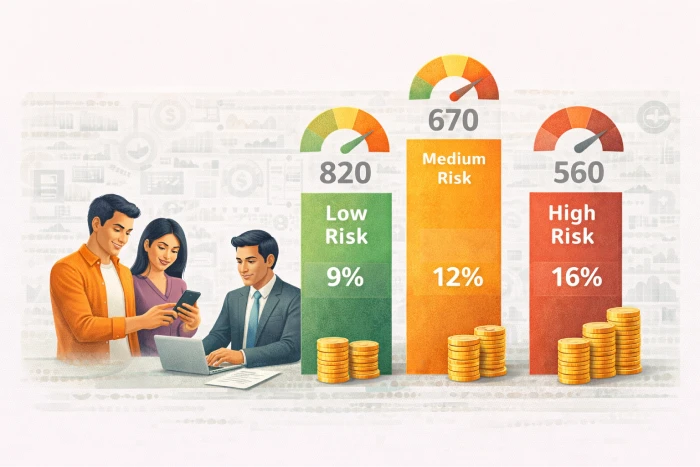
Risk-based lending is a pricing model where lenders assign interest rates based on the borrower’s risk level.
Simple Explanation:
Lower risk borrower = Lower interest rate
Higher risk borrower = Higher interest rate
This model is widely used by banks, NBFCs, and digital lenders in India.
Why Lenders Use Risk-Based Pricing
The Reserve Bank of India encourages responsible lending practices.
Key Reasons:
Reduce default risk
Price loans fairly
Improve financial stability
Instead of charging everyone the same rate, lenders align pricing with risk.
Key Factors That Affect Your Loan Interest Rate
Your loan pricing depends on multiple factors.
Credit Score
Your credit score is the most important factor.
Impact:
750 and above: Lowest interest rates
650 to 750: Moderate rates
Below 650: Higher rates
Credit bureaus like CIBIL play a major role in this evaluation.
Income and Employment Stability
Lenders assess your ability to repay.
Preferred Profiles:
Salaried employees with stable jobs
Consistent monthly income
Irregular income increases perceived risk.
Existing Debt (FOIR)
Fixed Obligation to Income Ratio (FOIR) measures your debt burden.
High FOIR Means:
Lower eligibility
Higher interest rate
Loan Amount and Tenure
Larger Loans:
Higher risk
May attract higher rates
Longer Tenure:
Increased uncertainty
Slightly higher cost
Credit History and Repayment Behavior
Past behavior predicts future risk.
Includes:
EMI payment history
Defaults or delays
Credit utilization
Type of Lender
Different lenders price risk differently.
Banks:
Lower rates, stricter criteria
NBFCs:
Moderate rates, flexible
Digital Lenders:
Higher rates, faster approvals
At Saarathi.ai, we have observed that lender selection significantly impacts final loan pricing.
How Risk-Based Pricing Works in Practice
Let us understand with a simple example.
Borrower A:
Credit score: 780
Stable job
Low debt
Outcome:
Interest rate: 10.5 percent
Borrower B:
Credit score: 650
High existing EMIs
Outcome:
Interest rate: 16 percent
Same loan, different pricing due to risk.
Risk-Based Lending vs Fixed Pricing
Feature | Risk-Based Lending | Fixed Pricing |
Interest Rate | Varies by borrower | Same for all |
Fairness | High | Low |
Flexibility | High | Limited |
Market Usage | Widely used | Rare today |
Risk-based lending is now the standard in India.
Benefits of Risk-Based Lending
Fair Pricing
You pay based on your risk profile.
Better Opportunities for Good Borrowers
Strong profiles get lower rates.
Improved Credit Discipline
Encourages responsible financial behavior.
Efficient Lending System
Reduces defaults and improves stability.
Challenges for Borrowers
Higher Rates for Risky Profiles
Low credit scores lead to expensive loans.
Complex Evaluation
Multiple factors affect pricing.
Lack of Awareness
Many borrowers do not understand why rates differ.
How Saarathi.ai Helps You Get Better Loan Pricing
Understanding your risk profile is key. Saarathi.ai makes it easier.
AI-Based Eligibility Check
Ask eligibility questions via Saarathi AI expert to understand your profile.
Smart Lender Matching
The Saarathi Recommendation Engine connects you with lenders offering best rates for your risk category.
Compare Multiple Offers
Compare personal loan offers on Saarathi.ai to find competitive pricing.
Saarathi Bazaar Dashboard
Track your application in Saarathi Bazaar and evaluate offers.
Transparent Cost Breakdown
Understand total cost before making a decision.
At Saarathi.ai, we have observed that borrowers who compare multiple lenders get significantly better rates.
Tips to Get Lower Interest Rates
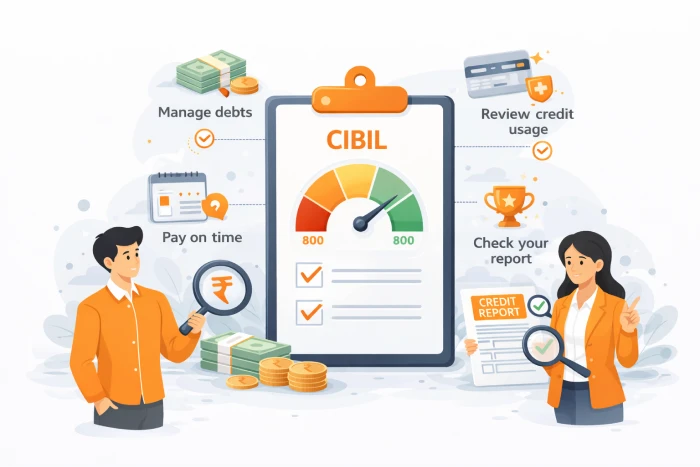
Improve Your Credit Score
Pay EMIs on time and reduce credit utilization.
Reduce Existing Debt
Lower your FOIR before applying.
Choose Shorter Tenure
Reduces risk perception.
Maintain Stable Income
Avoid frequent job changes.
Apply Strategically
Avoid multiple random applications.
Real-Life Scenario
Consider Deepak, a salaried professional in India.
Situation:
Credit score: 680
Action:
Improved score to 750
Reduced existing EMIs
Applied via Saarathi.ai
Outcome:
Got lower interest rate
Saved significantly on EMI
This shows how improving your profile impacts pricing.
FAQs
What is risk-based lending?
It is a system where loan interest rates depend on borrower risk.
Why do lenders charge different rates?
Because each borrower has a different risk profile.
Does credit score affect interest rate?
Yes, it is one of the most important factors.
Can I reduce my loan interest rate?
Yes, by improving your financial profile.
Do all lenders follow risk-based pricing?
Yes, most lenders in India use this model.
How can I get the best loan rate?
You can compare personal loan offers on Saarathi.ai for better options.
Conclusion
Risk-based lending is now the foundation of loan pricing in India. Your credit score, income stability, and financial behavior directly determine how much you pay for a loan. While this system may seem complex, it is designed to reward responsible borrowers and maintain financial stability.
The key is to understand your profile, improve it where possible, and compare multiple lenders before making a decision. Saarathi.ai simplifies this process with AI-driven recommendations, transparent comparisons, and faster approvals.
Discover personalized loan options on Saarathi.ai today and get the best possible rate based on your profile.