Rate Cycle Strategy: Floating, Fixed or Hybrid Loans?
|
In a volatile global economy, interest rate cycles can shift quickly. Inflation spikes, global bond yields surge, capital flows reverse, and central banks adjust policy. For Indian borrowers, this raises a crucial question: should you choose a floating, fixed, or hybrid loan in 2026? The right answer depends on where we are in the rate cycle, your income stability, and your risk tolerance. In this guide, we decode rate cycle strategy in simple terms and help you select the most suitable loan structure for your home loan, personal loan, or business loan.
Understanding the Rate Cycle
Interest rates move in cycles:
Rising rate phase during high inflation
Peak phase when rates stabilize
Falling rate phase during slowdown
Low rate phase before next inflation cycle
The Reserve Bank of India adjusts the repo rate based on inflation and growth.
In a volatile global environment, cycles may shorten or become unpredictable.
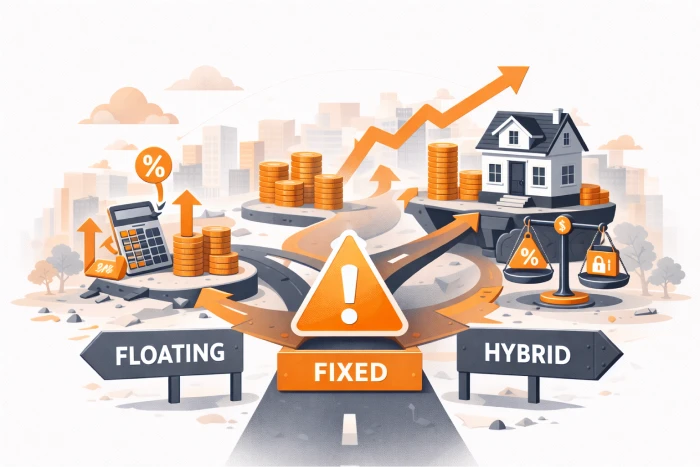
Floating Rate Loans
A floating rate loan is linked to an external benchmark such as the repo rate.
Advantages
Lower initial interest rate during stable or falling cycles
Automatic benefit when repo rates decline
No long term rate lock
Risks
EMI increases during rate hikes
Tenure extension if EMI is kept constant
Budget unpredictability
Floating loans work well when:
Inflation is expected to decline
RBI signals possible rate cuts
You plan aggressive prepayments
You can compare home loan offers on Saarathi.ai to evaluate floating rate spreads across lenders.
Fixed Rate Loans
A fixed rate loan keeps the interest rate constant for a defined period.
Advantages
EMI certainty
Protection against rate hikes
Easier budgeting
Risks
Higher starting rate compared to floating
Limited benefit if rates fall
Some fixed loans convert to floating after few years
Fixed rate loans make sense when:
Inflation remains high
Repo rate is rising
You prefer predictability over speculation
In volatile global cycles driven by oil price shocks or geopolitical risks, fixed rates provide psychological comfort.
Hybrid Loans
Hybrid loans combine fixed and floating features.
Examples:
Fixed for first 3 to 5 years, then floating
Split loan structure with part fixed, part floating
Advantages
Balanced risk
Partial protection during early years
Flexibility in uncertain cycles
Risks
Slightly complex structure
May carry moderate premium
Hybrid loans are useful when:
Rate direction is uncertain
You want initial EMI stability
You expect rate softening later
How Global Volatility Changes the Equation
In a volatile global economy:
Bond yields may rise sharply
Capital flows may reverse
Currency depreciation may increase inflation
If inflation rises, the Reserve Bank of India may maintain a tighter stance.
As reported by Economic Times, global yield spikes often influence emerging market interest rate expectations.
This increases uncertainty in floating rate projections.
Rate Strategy by Borrower Profile
1. Salaried Employee in Stable Sector
If you work in government or essential domestic sectors:
Income risk is lower
Floating rate may work if rates appear near peak
2. IT or Export Sector Employee
If global slowdown risk exists:
EMI predictability becomes important
Fixed or hybrid may reduce stress
3. MSME Owner
Business cash flows fluctuate.
Liquidity flexibility matters
Hybrid structure often works well
4. First Time Homebuyer
If stretching affordability:
Fixed rate may protect against surprise hikes
Conservative EMI ratio below 40 percent is essential
Practical EMI Illustration
Suppose:
Loan amount: Rs 50 lakh
Tenure: 20 years
If rate increases from 8 percent to 9 percent:
EMI can increase by several thousand rupees per month
Or tenure may extend significantly
Rate risk matters more in long tenure loans.
When to Lock Fixed Rate in 2026
Consider fixed if:
Inflation remains above 6 percent
RBI signals prolonged tight policy
Global bond yields remain elevated
You value predictability
When Floating May Be Better
Choose floating if:
Inflation is trending downward
Rate cuts are likely in next 12 months
You plan early prepayment
Hybrid as Middle Ground
Hybrid works best when:
Rate direction is unclear
You expect volatility
You want balance between cost and safety
At Saarathi.ai, we have observed that borrowers often over focus on current rate and ignore rate cycle stage. The smarter approach is matching loan type to your risk tolerance.
You can ask eligibility questions via Saarathi AI expert to understand which structure suits your profile.
You can also track your application in Saarathi Bazaar and compare rate types transparently across 110 plus lenders.
Key Decision Checklist
Is your EMI below 40 percent of income?
Do you have 6 months emergency savings?
Is inflation trending up or down?
How stable is your job sector?
Can you handle a 1 percent rate increase comfortably?
Answering these questions clarifies your strategy.
FAQs
Is fixed rate always safer?
It offers EMI stability but may cost more if rates fall quickly.
Can I switch from floating to fixed later?
Many lenders allow conversion with a fee. Check terms carefully.
Are hybrid loans popular in India?
Yes, especially during uncertain rate cycles.
Do personal loans follow the same logic?
Most personal loans are fixed rate, but new pricing reflects rate cycle.
How do I get the best rate structure?
Compare multiple lenders and evaluate total cost, not just EMI.
Conclusion
In a volatile global economy, choosing between floating, fixed, and hybrid loans requires understanding the rate cycle. Floating works best in falling rate environments, fixed protects during rising cycles, and hybrid balances uncertainty.
Instead of guessing market direction, align your loan structure with income stability and risk tolerance.
Discover personalized loan options on Saarathi.ai today and choose the right rate strategy with confidence in 2026.