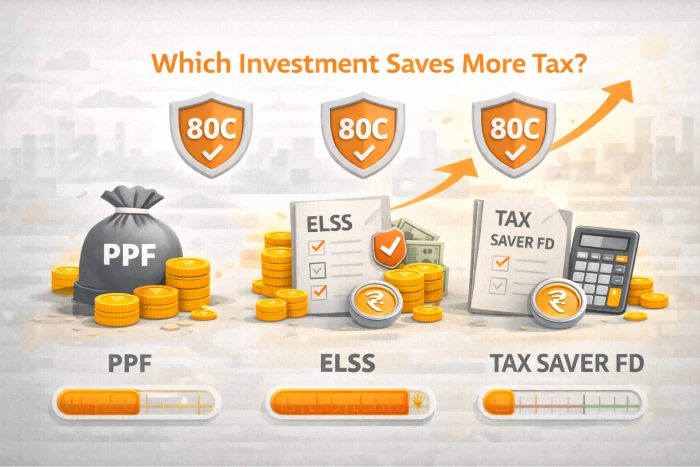
PPF vs ELSS vs Tax Saver FD: Which Investment Saves More Tax?
|
Tax saving investments are an important part of financial planning for Indian taxpayers. Among the most popular options under Section 80C of the Income Tax Act are Public Provident Fund (PPF), Equity Linked Savings Scheme (ELSS), and Tax Saver Fixed Deposits. Each of these investments allows taxpayers to claim deductions up to ₹1.5 lakh per financial year while supporting long-term savings.
However, these instruments differ significantly in terms of returns, risk levels, lock-in periods, and liquidity. Choosing the right tax-saving option depends on an individual's financial goals, risk tolerance, and investment horizon. At Saarathi.ai, we have observed that investors who understand the differences between these instruments are better able to balance tax efficiency with long-term wealth creation.
Understanding Section 80C Tax Benefits
Section 80C allows taxpayers to claim deductions for eligible investments and expenses up to ₹1.5 lakh per financial year.
This deduction reduces taxable income and therefore lowers total tax liability.
For example:
Annual income: ₹10 lakh
Section 80C investment: ₹1.5 lakh
Taxable income after deduction: ₹8.5 lakh
The tax saved depends on the taxpayer's income tax slab. Individuals in higher tax brackets benefit more from these deductions.
However, while the tax deduction amount remains the same across eligible investments, returns and lock-in periods vary significantly.
Public Provident Fund (PPF)
PPF is a government-backed savings scheme designed for long-term financial security.
Key Features of PPF
Maximum investment eligible under Section 80C: ₹1.5 lakh annually
Lock-in period: 15 years
Interest rate determined by the government
Interest income is tax free
Suitable for long-term wealth preservation
PPF follows the EEE taxation model:
Investment qualifies for deduction
Interest earned is tax free
Maturity proceeds are tax free
Because of its safety and tax efficiency, PPF is widely used for retirement planning and long-term savings.
Advantages of PPF
Government-backed security
Stable and predictable returns
Tax-free interest earnings
Long-term compounding benefits
Limitations of PPF
Long lock-in period of 15 years
Limited liquidity
Returns may be lower compared to equity investments
Equity Linked Savings Scheme (ELSS)
ELSS funds are equity mutual funds that offer tax benefits under Section 80C.
They invest primarily in stock markets and provide potential for higher returns.
Key Features of ELSS
Eligible for ₹1.5 lakh deduction under Section 80C
Lock-in period of three years
Market-linked returns
Investment through SIP or lump sum
ELSS has the shortest lock-in period among Section 80C investments.
Advantages of ELSS
Higher growth potential
Since ELSS invests in equities, it can generate higher long-term returns compared to fixed-income investments.
Short lock-in period
The three-year lock-in period is significantly shorter than most other tax-saving instruments.
Flexibility
Investors can start SIPs with relatively small monthly contributions.
Limitations of ELSS
Market risk
Returns depend on stock market performance and can fluctuate in the short term.
Requires long-term mindset
Although the lock-in period is three years, investors often benefit from holding ELSS investments longer.
Tax Saver Fixed Deposits
Tax Saver FDs are special fixed deposits offered by banks that qualify for Section 80C deductions.
Key Features of Tax Saver FDs
Lock-in period of five years
Fixed interest rate determined by banks
Eligible for deduction under Section 80C
Interest income is taxable
These deposits are suitable for investors who prefer predictable returns with minimal risk.
Advantages of Tax Saver FDs
Low risk
Bank deposits offer relatively stable and guaranteed returns.
Simple investment structure
Tax Saver FDs are easy to understand and widely available.
Predictable income
Investors know the interest rate and maturity value in advance.
Limitations of Tax Saver FDs
Interest income is taxable
Unlike PPF, interest from tax-saving FDs is added to taxable income.
Long lock-in period
Funds remain locked for five years.
Lower return potential
Returns are usually lower than equity-based investments.
PPF vs ELSS vs Tax Saver FD Comparison
Investment Option | Lock-in Period | Risk Level | Returns | Tax Treatment
PPF | 15 years | Low | Fixed government rate | Fully tax free
ELSS | 3 years | Moderate to high | Market linked | Long-term gains taxable above limits
Tax Saver FD | 5 years | Low | Fixed bank rate | Interest taxable
This comparison highlights that while all three options provide tax deductions under Section 80C, their return potential and liquidity vary significantly.
Which Investment Saves the Most Tax?
In terms of tax deduction alone, all three investments provide the same maximum benefit of ₹1.5 lakh under Section 80C.
However, the overall financial benefit depends on returns and tax treatment.
ELSS
ELSS may generate higher long-term returns because it invests in equities.
PPF
PPF offers stable returns and tax-free interest, making it attractive for conservative investors.
Tax Saver FD
Tax Saver FDs provide predictable returns but interest income is taxable.
Therefore, the best option depends on the investor's financial goals and risk tolerance.
Choosing the Right Tax Saving Investment
When selecting a tax-saving instrument, investors should consider several factors.
Risk tolerance
Investors comfortable with market fluctuations may prefer ELSS.
Conservative investors may prefer PPF or fixed deposits.
Investment horizon
Long-term investors may benefit from PPF due to compounding over 15 years.
Shorter investment horizons may favor ELSS due to its shorter lock-in.
Liquidity needs
ELSS offers the most liquidity among the three options due to the shorter lock-in period.
Role of Digital Platforms in Financial Planning
Technology is simplifying financial planning by providing easier access to financial products and insights.
Digital financial platforms help individuals compare financial options and make informed decisions.
For example, individuals planning major financial commitments often compare home loan offers on Saarathi.ai before purchasing property.
Users can also ask eligibility questions via Saarathi AI experts to understand loan requirements, documentation, and approval timelines instantly.
Saarathi.ai connects borrowers with more than 110 banks and NBFCs across India. The Saarathi Recommendation Engine matches borrowers with lenders based on financial profiles.
Borrowers can also track your application in Saarathi Bazaar through a transparent dashboard that monitors documentation progress and approval status.
These digital tools help individuals align investments, tax planning, and borrowing decisions within a single financial strategy.
Frequently Asked Questions
Which investment has the shortest lock-in under Section 80C?
ELSS mutual funds have the shortest lock-in period of three years.
Is PPF completely tax free?
Yes. PPF follows the EEE model where investment, interest, and maturity proceeds are all tax free.
Are returns from tax-saving fixed deposits taxable?
Yes. Interest earned from tax-saving fixed deposits is added to taxable income.
Can I invest in all three options?
Yes. Investors can diversify across PPF, ELSS, and tax-saving FDs while staying within the ₹1.5 lakh deduction limit.
Which investment is best for long-term wealth creation?
ELSS funds may offer higher long-term growth potential due to equity exposure, while PPF provides stable tax-free returns.
Conclusion
PPF, ELSS, and Tax Saver Fixed Deposits are three of the most widely used tax-saving investments under Section 80C. While each option provides the same tax deduction limit of ₹1.5 lakh, they differ significantly in terms of returns, risk levels, and liquidity.
ELSS offers the potential for higher returns with a shorter lock-in period. PPF provides long-term stability with tax-free returns. Tax Saver FDs offer predictable returns with low risk but taxable interest.
Choosing the right investment depends on individual financial goals, risk tolerance, and investment horizon.
At Saarathi.ai, we believe informed financial decisions help individuals achieve their financial goals faster. Whether you are planning tax-saving investments, evaluating loan options, or preparing for major financial milestones, digital platforms can simplify your financial journey.
Discover personalized loan options and build a smarter financial future with Saarathi.ai today.