Is India Decoupling From the Global Recession Risk in 2026
|
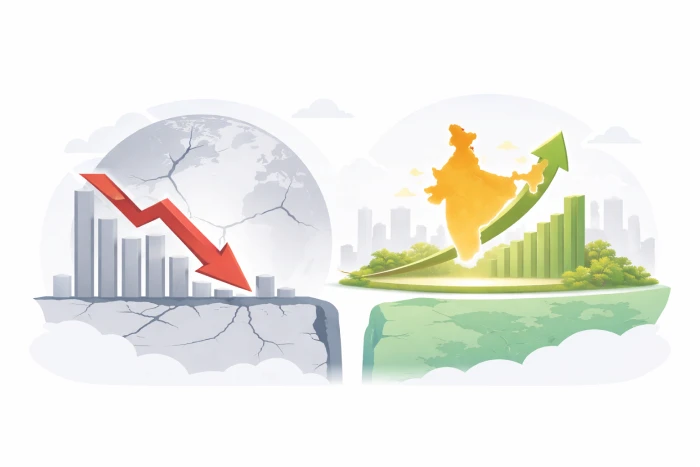
With recession fears rising in the US and parts of Europe, many Indians are asking a critical question in 2026: Is India decoupling from global recession risk? The answer is nuanced. While India’s domestic demand, strong banking system, and government capex push offer resilience, global trade, capital flows, and commodity prices still link us to the world economy.
For borrowers and homebuyers, this matters directly. Economic slowdowns influence RBI interest rates, liquidity, job stability, and loan approvals. At Saarathi.ai, we have observed that during uncertain global cycles, borrowers seek clarity on EMI stability and faster loan approvals. In this deep dive, we break down whether India is truly insulated and what it means for your financial decisions.
What Does Decoupling Really Mean?
Decoupling means that India’s economic growth remains stable even if major global economies slow down.
In theory, a decoupled economy would:
Maintain strong GDP growth despite global recession
See limited capital outflows
Keep inflation manageable
Protect domestic consumption and jobs
However, complete isolation is rare in a globalized world.
Global Recession Risk in 2026: What Is Happening?
US Growth Slowdown
The US economy has shown signs of cooling due to tight monetary policy cycles over the past few years. Rate hikes by the Federal Reserve reduced liquidity and raised borrowing costs.
Global financial media such as The Economic Times have reported volatility in global equity and bond markets due to recession fears.
Europe and China Challenges
Europe has struggled with energy price volatility and weak manufacturing demand. China’s property sector slowdown has also affected global commodity cycles.
These global stress points influence trade flows, export demand, and investor sentiment across emerging markets including India.
India’s GDP Growth in 2026
India remains one of the fastest growing major economies.
According to Reserve Bank of India projections and reports cited by CRISIL, India’s GDP growth remains in the 6 percent to 7 percent range, supported by:
Strong domestic consumption
Government infrastructure spending
Manufacturing push under PLI schemes
Expanding digital economy
RBI monetary policy statements emphasize stable macro fundamentals, moderate inflation, and robust banking sector health.
This growth differential is the core argument for partial decoupling.
Why India Looks More Resilient in 2026
1. Strong Domestic Consumption
Unlike export-dependent economies, India’s growth is largely driven by internal demand.
Key drivers:
Rising middle class
Urban housing demand
Vehicle and consumer durable purchases
Growing services sector
At Saarathi.ai, we have observed consistent demand for home loans and personal loans even during global volatility phases, particularly in Tier 1 and Tier 2 cities.
2. Healthy Banking and NBFC System
Post the 2018 to 2020 stress cycle, Indian banks strengthened balance sheets.
Key improvements:
Lower non-performing assets
Strong capital adequacy
Improved credit underwriting
This makes credit flow more stable even if global markets tighten.
Borrowers can compare home loan and business loan offers on Saarathi.ai across 110 plus lenders, ensuring diversified access to credit.
3. Government Capex Push
Union Budget 2026 continues strong infrastructure allocation.
Higher capital expenditure supports:
Construction jobs
Cement and steel demand
Housing and real estate activity
Real estate has strong multiplier effects across sectors.
Where India Is Still Linked to Global Risk
Despite resilience, India is not completely insulated.
1. Capital Flows and Rupee Volatility
If global investors pull money out of emerging markets:
Rupee may depreciate
Imported inflation may rise
RBI may need to intervene
Currency volatility impacts inflation expectations and interest rates.
2. Export Sensitivity
India’s IT services, pharma, and manufacturing exports depend on US and European demand.
If global recession deepens:
IT spending may slow
Manufacturing exports may weaken
Corporate profits could soften
This may impact employment in certain sectors.
3. Oil and Commodity Prices
India imports a significant portion of crude oil.
Global recession can lower oil prices, which helps India. However, geopolitical tensions can reverse this benefit quickly.
Inflation remains the key link between global events and RBI rate decisions.
RBI Policy in 2026: Balancing Growth and Inflation
The Reserve Bank of India focuses on inflation targeting while supporting growth.
If global recession reduces commodity prices:
Inflation may soften
RBI may consider rate cuts
Loan EMIs could reduce
If currency pressure or supply shocks increase inflation:
RBI may maintain higher rates
Lending costs remain elevated
At Saarathi.ai, we have observed that borrowers who track RBI policy trends early are better positioned to refinance or lock competitive rates.
You can ask eligibility questions via Saarathi AI expert to understand how rate changes impact your EMI in real time.
Impact on Home Loans and EMIs
Let us understand how recession risk affects your home loan.
Scenario 1: Global Recession Deepens
Possible outcomes:
Lower oil prices
Softer inflation
RBI rate cuts
Reduced home loan interest rates
This could lower EMIs for floating rate borrowers.
For example:
Loan amount: Rs 60 lakh
Tenure: 20 years
If interest falls from 9 percent to 8.25 percent, EMI reduction could be Rs 2,500 to Rs 3,000 per month.
Scenario 2: Financial Market Volatility
If global stress leads to:
Capital outflows
Rupee depreciation
Inflation spike
RBI may delay rate cuts.
Home loan rates may stay high for longer.
This is why comparing lenders and structures matters.
You can track your application in Saarathi Bazaar and monitor lender rate revisions transparently.
Is Real Estate Safe in 2026?
Housing demand in India remains structurally strong due to:
Urbanization
Nuclear families
Income growth
Government incentives
CRISIL data and industry reports show continued traction in mid-income and premium housing segments.
While luxury demand may fluctuate, affordable and mid-segment housing remains resilient.
At Saarathi.ai, we have seen steady application volumes even during global uncertainty, particularly for ready-to-move properties.
Should Borrowers Wait or Act?
Many potential homebuyers ask whether to delay decisions due to global recession risk.
Consider these factors:
Property prices often rise over time.
Interest rates are cyclical.
Income growth and job stability matter more than short-term headlines.
Balance transfer options allow future refinancing.
Rather than timing the global cycle perfectly, focus on affordability.
Use tools to:
Compare interest rates
Evaluate EMI scenarios
Check eligibility instantly
You can compare home loan offers on Saarathi.ai and receive AI-based lender recommendations suited to your income profile.
Key Indicators to Watch in 2026
If you want to assess India’s decoupling strength, monitor:
RBI repo rate announcements
Inflation data releases
Rupee versus US dollar trend
Government capex spending
Corporate earnings growth
These signals often matter more for EMIs than global headlines alone.
FAQs
1. Is India fully decoupled from global recession risk?
No. India shows resilience due to strong domestic demand, but capital flows, exports, and inflation still link it to global cycles.
2. Will a US recession reduce Indian home loan rates?
It could if it lowers commodity prices and inflation, prompting RBI to cut rates. However, currency volatility may offset benefits.
3. Are Indian banks safe during global recession?
Indian banks currently have stronger balance sheets compared to past cycles, with improved capital buffers and lower NPAs.
4. Should I take a floating home loan in 2026?
Floating loans benefit during rate cuts but expose you to volatility. Evaluate your income stability and tenure before deciding.
You can ask eligibility questions via Saarathi AI expert for personalized guidance.
5. How can I protect my EMI during uncertain times?
Maintain a strong credit score, build an emergency fund, consider partial prepayments, and monitor refinance opportunities.
Conclusion
India in 2026 is not fully decoupled from global recession risk, but it is more resilient than many major economies. Strong domestic consumption, government infrastructure spending, and a healthier banking system provide stability.
However, global capital flows, exports, and commodity prices still influence inflation and RBI rate decisions, which directly impact your home loan EMI.
The smartest approach is not fear, but preparation.
At Saarathi.ai, we empower borrowers with AI-driven lender comparisons, paperless documentation, transparent tracking through Saarathi Bazaar, and faster approvals across 110 plus lenders.
Discover personalized loan options on Saarathi.ai today and make confident decisions even in uncertain global times.