How to track expenses without complicated apps?
|
If you feel overwhelmed by budgeting apps, notifications, and dashboards, you are not alone. Many Indians want to track expenses without complicated apps but struggle to find a system that actually works. The good news is you do not need fancy tools to control your money. You need clarity, consistency, and a simple structure.
At Saarathi.ai, we have observed that borrowers who maintain even a basic manual expense tracking habit have stronger repayment discipline and better loan approval outcomes. Expense tracking is not about technology. It is about awareness. In this guide, we explain practical, low effort ways to track your expenses without apps and still stay financially ahead.
Why You Do Not Need Complicated Apps
Expense tracking apps can be useful, but they often fail because:
Too many features create confusion
Manual categorization feels tiring
Privacy concerns about linking bank accounts
Users stop updating after 2-3 weeks
According to coverage in Economic Times, digital payment adoption has increased significantly in India. With UPI, small frequent payments are common. That makes tracking more important than ever, even if you do it offline.
The key is choosing a system you can follow consistently.
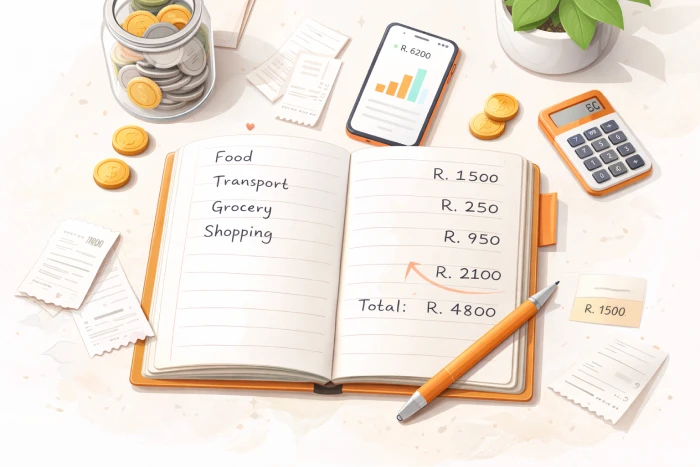
Method 1: The 5-Minute Daily Notebook System
This is the simplest and most effective method.
What You Need:
A small notebook
A pen
5 minutes daily
How It Works:
Every evening, write down:
Date
Expense
Amount
Category
Example:
Date | Expense | Amount | Category |
5 Feb | Groceries | Rs 850 | Needs |
5 Feb | Swiggy | Rs 420 | Wants |
5 Feb | Metro | Rs 60 | Transport |
At month-end, total each category.
Why this works:
Writing builds awareness
You remember spending patterns
You reduce impulse purchases naturally
At Saarathi.ai, we have seen that simple manual tracking reduces overspending faster than complex dashboards.
Method 2: The Envelope System for Cash and UPI
Even in a digital India, the envelope concept works well.
Step 1: Divide Your Salary
On salary day, allocate fixed amounts to:
Rent or EMI
Groceries
Utilities
Transport
Entertainment
Savings
If your income is Rs 50,000:
Needs: Rs 27,500
Wants: Rs 10,000
Savings: Rs 12,500
You can keep physical envelopes for cash expenses. For UPI and bank payments, mentally assign limits.
Once the category budget is exhausted, spending stops.
This method creates natural discipline.
If your EMIs are consuming too much of your envelope, it may be time to compare personal loan offers on Saarathi.ai and explore better interest rates.
Method 3: Weekly Bank Statement Review
If you use UPI, debit cards, and online payments, this method is powerful.
Every Sunday:
Open your bank app
Check transaction history
Write totals by category in a notebook
Most banks already categorize spending roughly.
Create 4 columns:
Essentials
EMIs
Lifestyle
Savings
This method takes 15 minutes weekly and prevents month-end surprises.
You can also track loan obligations and repayment schedules easily in Saarathi Bazaar, giving you a clear view of fixed commitments.
Method 4: The Whiteboard Wall Tracker
For families, visual tracking works best.
Place a small whiteboard in your home.
Create three sections:
Needs
Wants
Savings
Every major expense gets written immediately.
This builds:
Shared financial awareness
Accountability between family members
Conscious spending habits
Children also learn money management early.
Method 5: The 3-Category Shortcut Method
If detailed categories feel overwhelming, simplify.
Track only:
Fixed Costs
Flexible Spending
Savings
That is it.
Fixed Costs include:
Rent
EMIs
Insurance
School fees
Flexible Spending includes:
Groceries
Dining
Fuel
Shopping
Savings include:
SIP
Emergency fund
Investments
This approach prevents overcomplication.
Why Tracking Expenses Improves Loan Eligibility
Many people do not realize this.
Lenders evaluate:
FOIR ratio
Repayment capacity
Stability of expenses
Surplus income
If you cannot track your expenses, you may:
Overestimate affordability
Take high EMIs
Miss payments
Damage credit score
At Saarathi.ai, our AI Recommendation Engine analyses your income and obligations before suggesting lenders. When you know your exact monthly surplus, loan planning becomes smarter and safer.
You can ask eligibility questions via Saarathi AI before applying, reducing rejection risk and protecting your credit profile.
How Much EMI Is Too Much?
As per general lending practices, total EMIs should ideally remain under 40-50 percent of income.
If your expense tracking shows EMIs above this range, consider:
Balance transfer
Tenure restructuring
Comparing lenders for better rates
You can compare personal loan offers on Saarathi.ai in a fully paperless journey and track your application in Saarathi Bazaar for full transparency.
Common Mistakes While Tracking Expenses
1. Tracking for Only 7 Days
Real patterns appear after 30 days minimum.
2. Ignoring Small UPI Transactions
Rs 200 daily becomes Rs 6,000 monthly.
3. Forgetting Annual Expenses
Insurance premiums, school fees, festival shopping.
Create a monthly sinking fund for these.
4. Not Reviewing Data
Tracking without reviewing is useless.
Every month, ask:
Where did I overspend?
Can I reduce any fixed cost?
Can I increase savings by 5 percent?
Simple Monthly Tracking Template
Monthly Income: Rs 70,000
Fixed Costs
Rent: Rs 18,000
EMI: Rs 15,000
Utilities: Rs 5,000
Total: Rs 38,000
Flexible Spending
Groceries: Rs 8,000
Fuel: Rs 6,000
Dining: Rs 5,000
Miscellaneous: Rs 6,000
Total: Rs 25,000
Savings
SIP: Rs 5,000
Emergency Fund: Rs 2,000
Total: Rs 7,000
Remaining Surplus: Rs 0
If surplus is zero, any unexpected expense will push you into debt. That is your signal to adjust.
How to Stay Consistent Without Apps
Fix a daily time like 9 PM
Keep notebook near your wallet
Use reminders only for review day
Involve spouse or family member
Reward yourself for consistency
Tracking expenses should feel empowering, not exhausting.
The Link Between Expense Tracking and Credit Score
When you track expenses:
You avoid EMI delays
You maintain credit utilization below 30 percent
You reduce dependence on credit cards
This improves credit health over time.
A stronger credit score means:
Lower interest rates
Faster approvals
Higher eligibility
At Saarathi.ai, we have observed that financially disciplined borrowers get smoother approvals across 110+ lenders.
When Should You Use Technology?
If:
You have multiple loans
You run a business
You manage high transaction volume
Then simple AI tools can help.
With Saarathi.ai, you get:
AI-driven lender recommendations
Transparent comparison
Real-time application tracking
Fully paperless processing
You stay in control without unnecessary complexity.
FAQs
1. Can I track expenses without any app?
Yes. A notebook, weekly bank review, or envelope method works effectively.
2. How long should I track expenses?
Minimum 30 days to understand real patterns.
3. What is the easiest method?
The daily 5-minute notebook method is simplest and most sustainable.
4. Does expense tracking really reduce overspending?
Yes. Awareness naturally reduces impulsive spending.
5. How does expense tracking help with loans?
It helps you understand EMI affordability and maintain a healthy credit profile.
6. Should I track every rupee?
Initially yes. After 2-3 months, you can track broader categories.
Conclusion
Tracking expenses does not require complicated apps. It requires discipline and clarity.
Key Takeaways:
Use a simple notebook system
Review bank statements weekly
Follow 3 core categories
Plan EMIs carefully
Build emergency savings
Review monthly
Financial stability begins with awareness. Once you understand your cash flow, you can plan smarter loans and avoid month-end stress. Discover personalized loan options on Saarathi.ai today. Compare offers, track applications in Saarathi Bazaar, and get expert AI guidance in a transparent, paperless journey.