How to Track and Review Your Investments Effectively?
|
Investing is not just about selecting the right financial products. Regularly tracking and reviewing your investments is equally important for achieving long-term financial goals. Market conditions, inflation, personal income, and financial priorities can change over time, making it essential to evaluate whether your portfolio still aligns with your objectives.
Many investors in India focus on starting investments but often neglect monitoring their progress. At Saarathi.ai, we have observed that individuals who regularly review their investments tend to make better financial decisions and maintain stronger financial discipline. Understanding how to track and review your investments effectively can help optimize returns, manage risks, and keep your financial plan on track.
Why Tracking Investments is Important
Tracking investments allows investors to evaluate how their portfolio is performing over time.
Without regular monitoring, it becomes difficult to know whether investments are helping achieve financial goals.
Key benefits of tracking investments include:
Monitoring portfolio performance
Identifying underperforming assets
Maintaining balanced asset allocation
Adjusting strategies based on financial goals
Managing investment risks
Investment tracking also helps investors stay disciplined and avoid emotional decisions during market fluctuations.
Define Clear Financial Goals
Before reviewing investments, investors should clearly define their financial goals.
Financial goals provide direction for investment strategies and help measure progress.
Common financial goals include:
Buying a home
Funding children's education
Retirement planning
Wealth creation
Emergency savings
Each goal may require different investment timelines and risk levels.
For example, long-term goals such as retirement may allow higher exposure to equities, while short-term goals may require safer investments.
Monitor Portfolio Performance Regularly
Investment performance should be reviewed periodically rather than daily.
Daily market movements can create unnecessary anxiety and lead to impulsive decisions.
Most financial advisors recommend reviewing portfolios every six months or once a year.
During these reviews, investors should assess:
Overall portfolio returns
Performance of individual investments
Progress toward financial goals
Risk exposure across asset classes
Regular performance monitoring helps investors identify whether adjustments are required.
Evaluate Asset Allocation
Asset allocation refers to how investments are distributed across various asset classes such as equity, debt, gold, and real estate.
Over time, market movements may change portfolio allocation.
For example:
If equities perform strongly, they may occupy a larger share of the portfolio than originally planned.
This imbalance may increase portfolio risk.
Investors should periodically rebalance their portfolios to maintain the desired allocation.
Example allocation strategy:
Asset Class | Target Allocation
Equity | 60 percent
Debt | 30 percent
Gold | 10 percent
If equities grow beyond 60 percent, investors may rebalance by shifting funds into debt or other assets.
Compare Returns with Benchmark Indices
To evaluate investment performance accurately, investors should compare returns with relevant benchmarks.
Examples include:
Nifty 50 index for large-cap equity funds
Sensex for broader market performance
Government bond yields for debt investments
Benchmark comparisons help determine whether an investment is outperforming or underperforming the market.
Consistently underperforming investments may require reassessment.
Consider Investment Costs and Fees
Investment expenses can significantly impact long-term returns.
Common costs include:
Fund management fees
Brokerage charges
Transaction fees
Exit loads
Even small expense differences can affect long-term wealth creation.
Investors should review expense ratios and ensure that investment costs remain reasonable relative to returns.
Review Investment Risk
Risk tolerance often changes over time due to factors such as income growth, family responsibilities, or approaching retirement.
During portfolio reviews, investors should evaluate whether their current investments still match their risk tolerance.
Examples:
Young investors may accept higher equity exposure.
Investors nearing retirement may prefer lower volatility and stable returns.
Adjusting portfolio allocation based on changing risk tolerance helps maintain financial stability.
Track Tax Implications
Taxes play an important role in investment returns.
Investors should monitor tax implications related to:
Capital gains from equity or debt funds
Dividend income
Interest income from fixed deposits
Tax-saving investments under Section 80C
Effective tax planning can improve net investment returns.
Tax-efficient investments such as ELSS, PPF, and NPS can help reduce taxable income while building long-term wealth.
Use Technology to Track Investments
Digital platforms have made investment tracking easier and more transparent.
Many financial tools allow investors to monitor multiple investments in one place.
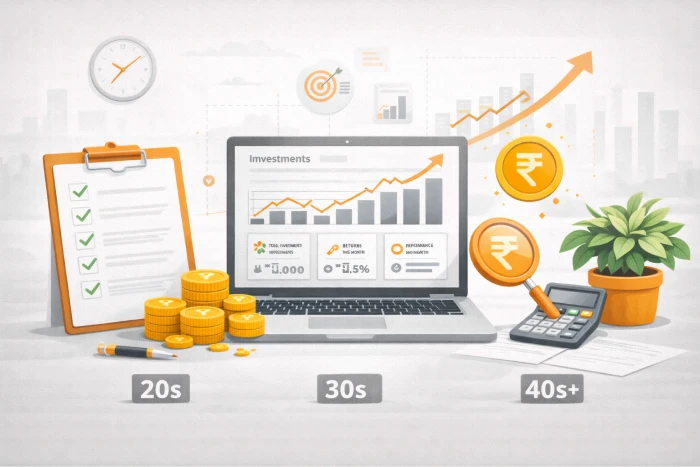
Key features offered by digital platforms include:
Portfolio dashboards
Performance analytics
Investment alerts
Goal tracking tools
Automated portfolio summaries
Technology simplifies investment management and reduces the need for manual tracking.
Similarly, digital lending platforms help individuals manage financial commitments more efficiently.
For example, borrowers can compare personal loan offers on Saarathi.ai before selecting lenders with competitive interest rates.
Users can also ask eligibility questions via Saarathi AI expert to understand documentation requirements and loan eligibility instantly.
Once applications are submitted, borrowers can track your application in Saarathi Bazaar and monitor progress through a transparent dashboard.
These digital tools allow individuals to integrate loan management with overall financial planning.
Avoid Emotional Investment Decisions
Market volatility can trigger emotional responses such as panic selling or excessive risk-taking.
Successful investors focus on long-term strategies rather than reacting to short-term market fluctuations.
Best practices include:
Maintain disciplined investment schedules
Avoid impulsive portfolio changes
Focus on long-term financial goals
Review portfolios systematically
A calm and structured approach improves investment outcomes.
Frequently Asked Questions
How often should I review my investments?
Most financial advisors recommend reviewing investments every six months or once a year.
What should I check during an investment review?
Investors should examine portfolio performance, asset allocation, risk exposure, and progress toward financial goals.
Why is asset allocation important?
Asset allocation helps balance risk and returns by distributing investments across different asset classes.
Can digital tools help track investments?
Yes. Many digital platforms provide dashboards and analytics that simplify portfolio tracking and performance monitoring.
Should I sell underperforming investments immediately?
Not always. Investors should evaluate the reasons for underperformance before making decisions.
Conclusion
Tracking and reviewing investments is a critical part of successful financial planning. Regular monitoring helps investors evaluate performance, maintain balanced asset allocation, and adjust strategies based on evolving financial goals.
By reviewing portfolios periodically, comparing returns with benchmarks, managing risks, and considering tax implications, investors can optimize long-term financial outcomes.
Technology has also simplified investment monitoring by providing real-time insights and centralized financial dashboards.
At Saarathi.ai, we believe better financial decisions come from better financial visibility. Whether you are managing investments, planning major purchases, or exploring loan options, digital tools can simplify your financial journey.
Discover personalized loan options and make smarter financial decisions with Saarathi.ai today.