How to prioritize multiple loans smartly?
|
Managing one EMI is simple. Managing three or four can feel overwhelming. If you have a home loan, a car loan, and a personal loan running together, the question is clear: which one should you repay first?
Knowing how to prioritize multiple loans smartly can save lakhs in interest and reduce financial stress. In 2026, with rising digital lending and flexible credit options, many Indian households carry more than one loan at a time.
At Saarathi.ai, we have observed that borrowers often repay loans emotionally instead of strategically. This guide will help you build a structured repayment plan that lowers interest costs, protects your credit score, and improves cash flow.
Why Loan Prioritization Matters
Every loan carries:
Interest cost
Tenure
EMI obligation
Credit score impact
Regulatory oversight from the Reserve Bank of India has strengthened transparency norms, but the repayment strategy still depends on you.
If loans are not prioritized correctly:
You may overpay interest
Your EMI burden stays high longer
Financial stress increases
Credit score may suffer
A structured approach makes debt manageable.
Step 1: List All Your Active Loans
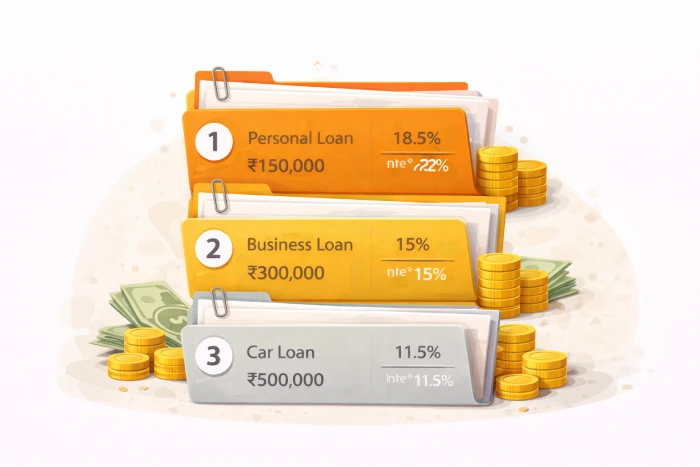
Create a simple table:
Loan Type | Outstanding | Interest Rate | EMI | Tenure Left |
Home Loan | Rs 35 lakh | 8.5% | Rs 32,000 | 18 years |
Car Loan | Rs 4 lakh | 9.5% | Rs 11,000 | 3 years |
Personal Loan | Rs 3 lakh | 16% | Rs 10,500 | 2 years |
This clarity is the first step toward control.
You can track multiple applications and loan statuses in Saarathi Bazaar if they were applied via Saarathi.ai.
Step 2: Understand the Two Core Repayment Strategies
1. The Avalanche Method
Focus on repaying the loan with the highest interest rate first while paying minimum EMIs on others.
In the above example, the personal loan at 16 percent should be cleared first.
Benefits:
Minimizes total interest paid
Mathematically optimal
This method is financially efficient.
2. The Snowball Method
Repay the smallest outstanding loan first, regardless of interest rate.
Example: Clear Rs 3 lakh personal loan first if it is smallest, even if interest is not highest.
Benefits:
Psychological motivation
Quick wins
Reduces number of EMIs faster
Choose based on your personality and discipline.
Step 3: Prioritize High-Interest Unsecured Loans
In India, unsecured loans like personal loans and credit card dues often carry higher interest rates compared to secured loans like home loans.
Financial trend reports in the Economic Times regularly highlight the rapid growth of unsecured retail credit.
High-interest loans should typically be cleared first because:
Interest compounds faster
EMI pressure is heavier
Default risk impacts credit score more sharply
At Saarathi.ai, our Recommendation Engine often suggests restructuring high-interest debt before adding new borrowing.
Step 4: Do Not Ignore Tax Benefits
Home loans offer tax deductions under applicable sections of the Income Tax Act.
If your home loan interest is 8.5 percent and offers tax savings, its effective cost may be lower than it appears.
Therefore:
Do not rush to prepay home loans if tax-adjusted cost is low
Focus on higher-cost loans first
This ensures capital efficiency.
Step 5: Maintain EMI-to-Income Balance
Total EMIs should ideally remain below 35 to 40 percent of your net income.
If your income increases, use surplus wisely:
Increase prepayment for high-interest loans
Avoid taking new lifestyle debt
Before applying for a fresh loan, you can compare personal loan offers on Saarathi.ai and check whether your existing EMIs leave enough affordability margin.
Step 6: Consider Loan Consolidation
If you have:
Multiple personal loans
High-interest credit card balances
Different due dates
You may consider consolidating into a single lower-rate loan.
Benefits include:
Simplified repayment
Possibly lower interest
Single EMI
Better financial tracking
However, consolidation only makes sense if the new interest rate is meaningfully lower and tenure is not extended excessively.
Step 7: Avoid Prepayment Penalty Traps
Before prepaying, check:
Prepayment charges
Foreclosure penalties
Lock-in period
Processing fees for refinancing
Industry analysis from CRISIL suggests that borrowers should compare refinancing costs carefully before switching lenders.
Sometimes prepayment charges may offset expected savings.
Smart Allocation of Extra Money
If you receive:
Annual bonus
Business profit
Tax refund
Gift money
Follow this priority sequence:
Clear high-interest unsecured loans
Build emergency fund if insufficient
Prepay medium-interest loans
Invest surplus for long-term goals
Do not invest aggressively while carrying 16 to 18 percent loan interest unless investment returns are consistently higher.
Psychological Discipline Matters
Debt prioritization is not just math. It is behavior.
To stay consistent:
Automate EMIs
Track outstanding monthly
Celebrate small milestones
Avoid new unnecessary loans
Using structured dashboards like Saarathi Bazaar helps you monitor applications and loan progress transparently.
When Not to Prepay Early
Sometimes early repayment is not ideal:
Home loan with low interest and tax benefit
Loan with no financial stress
When you lack emergency savings
When prepayment penalty is high
Liquidity is as important as debt reduction.
Example Strategy in Action
Assume:
Income: Rs 1,20,000 per month
Total EMIs: Rs 45,000
Loans:
Personal loan at 15%
Car loan at 9%
Home loan at 8.5%
Extra monthly surplus: Rs 15,000
Smart plan:
Pay Rs 15,000 extra toward personal loan
Close it 8 to 10 months earlier
Redirect freed EMI toward car loan
Then gradually prepay home loan
This cascade reduces interest dramatically.
Avoid These Common Mistakes
Prepaying lowest-interest loan first
Ignoring emergency fund
Extending tenure repeatedly
Taking new loan after closing one
Missing EMI due dates
Even one missed EMI can negatively impact credit score.
Digital Tools Make Prioritization Easier in 2026
Modern lending platforms allow:
EMI simulations
Refinancing comparisons
Eligibility checks
Transparent fee structures
At Saarathi.ai, you can explore refinancing options, compare structured offers across 110 plus lenders, and ask eligibility questions via Saarathi AI expert chatbot before restructuring debt.
Paperless processing ensures faster decisions without repeated documentation.
FAQs
1. Which loan should I repay first?
Usually the one with the highest interest rate, especially unsecured loans.
2. Is it smart to close a home loan early?
It depends on interest rate, tax benefits, and your liquidity position.
3. Should I consolidate multiple loans?
Yes, if the new rate is lower and tenure is reasonable.
4. Can prepayment hurt my credit score?
No. Timely repayment improves credit profile.
5. How can Saarathi.ai help with multiple loans?
You can compare refinancing options, evaluate EMI affordability, and track applications transparently through Saarathi Bazaar.
Conclusion
Managing multiple loans is not about panic. It is about priority.
Remember:
List all loans clearly
Target high-interest debt first
Maintain emergency fund
Avoid unnecessary refinancing
Keep EMIs within 40 percent of income
With discipline and data-driven decisions, debt becomes manageable.
Compare smarter refinancing and structured loan options on Saarathi.ai today and take control of your EMIs confidently.