How to manage money on an irregular income
|
Managing money on an irregular income is challenging, but absolutely possible with the right structure. Freelancers, gig workers, commission-based employees, small business owners, and consultants often face fluctuating monthly earnings. Some months feel abundant. Others feel tight.
The key is not earning the same amount every month. The key is building a system that works even when income changes.
At Saarathi.ai, we have observed that borrowers with irregular income can still qualify for loans and maintain strong credit profiles, provided they manage cash flow strategically. This guide explains how to manage money on an irregular income in India 2026 without stress, debt traps, or unstable EMIs.
Why Irregular Income Feels Risky
When income fluctuates:
Budgeting feels unpredictable
EMIs create anxiety
Savings become inconsistent
Credit card dependence increases
According to coverage in Economic Times, India’s gig economy and self-employed segment are growing rapidly. This makes income volatility a common reality.
The solution is not to eliminate volatility. It is to design your finances around it.
Step 1: Calculate Your Baseline Income
Do not budget based on your highest earning month.
Instead:
Review last 6-12 months income
Identify the lowest earning month
Identify the average monthly income
Example:
Highest month: Rs 1,20,000
Lowest month: Rs 55,000
Average: Rs 80,000
Your budget should be built around Rs 55,000 or slightly above, not Rs 1,20,000.
At Saarathi.ai, we recommend conservative income estimation when checking eligibility through our AI expert tool. This ensures sustainable EMI commitments.
Step 2: Separate Personal and Business Finances
If you are self-employed:
Maintain separate bank accounts
Pay yourself a fixed “salary” from business profits
Keep business buffer separate
This creates predictability.
Without separation, overspending becomes easy and tax planning becomes messy.
Step 3: Build a Larger Emergency Fund
Salaried employees may target 3 months of expenses.
For irregular income earners, target:
Minimum 6 months expenses
Ideally 9-12 months
Keep funds in:
High interest savings accounts
Liquid mutual funds
Short term FDs
This buffer absorbs slow months without borrowing.
Step 4: Convert Fixed Expenses into Flexible Ones
Irregular income works best with a flexible cost structure.
Reduce:
High rent commitments
Large EMIs
Long-term expensive subscriptions
Choose:
Affordable housing
Lower EMI structures
Pay-per-use services
If your EMIs are high, consider refinancing. You can compare personal loan offers on Saarathi.ai to explore better rates and flexible tenures.
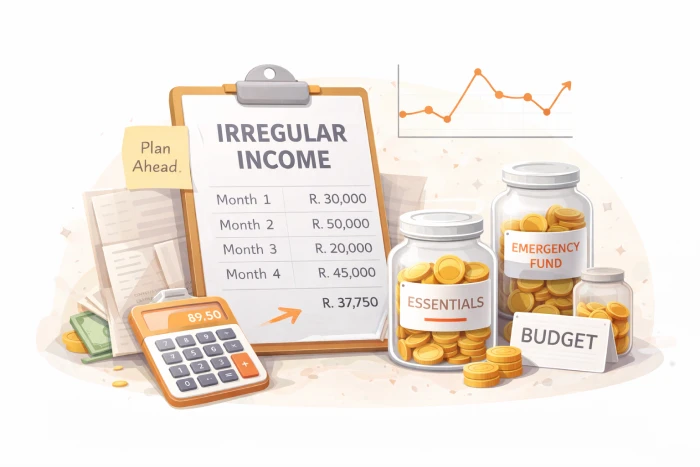
Step 5: Use the “Bucket System”
Divide money into three buckets:
Bucket 1: Essentials
Rent
Utilities
Groceries
Insurance
School fees
Bucket 2: EMIs and Financial Commitments
Home loan
Personal loan
Business loan
SIP investments
Bucket 3: Lifestyle and Growth
Travel
Dining
Shopping
Skill upgrades
Whenever income comes in, allocate to these buckets in priority order.
If a month is strong, fill future months’ essentials in advance.
Step 6: Plan EMIs Carefully
EMIs create pressure during low income months.
Lenders assess FOIR, meaning Fixed Obligation to Income Ratio. Ideally, EMIs should remain under 40-50 percent of income.
If your income fluctuates, keep EMIs below 35-40 percent for extra safety.
At Saarathi.ai, our AI Recommendation Engine analyses income patterns and repayment capacity before recommending lenders from 110+ banks and NBFCs. This reduces rejection risk.
You can ask eligibility questions via Saarathi AI before applying to protect your credit score.
Step 7: Create a “Income Smoothing Fund”
In high-income months:
Save surplus beyond baseline income
Move excess into a buffer account
Example:
Baseline budget: Rs 55,000
Actual income in good month: Rs 90,000
Extra: Rs 35,000
Allocate:
Rs 15,000 to emergency fund
Rs 10,000 to tax reserve
Rs 10,000 to income smoothing buffer
During weak month:
Transfer from buffer to maintain stability.
This prevents credit card borrowing.
Step 8: Track Real Disposable Income Monthly
Formula:
Real Disposable Income = Net Income - Fixed Costs - Essentials - Annual Adjusted Expenses
For irregular earners, calculate this every month.
If surplus drops below 10 percent, reduce discretionary spending immediately.
You can track loan commitments clearly in Saarathi Bazaar, giving full transparency over EMIs and application status.
Step 9: Plan for Taxes in Advance
Freelancers and business owners often forget tax planning.
Set aside:
20-30 percent of income for taxes
Use a separate account
Tax surprises often force borrowing at high interest rates.
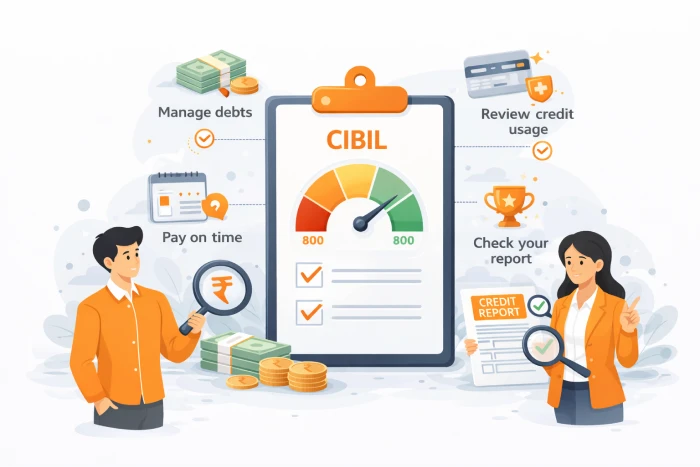
Step 10: Maintain Strong Credit Discipline
Irregular income does not mean a weak credit profile.
To protect your score:
Pay EMIs before due date
Keep credit utilization under 30 percent
Avoid frequent loan applications
Maintain consistent repayment record
According to CRISIL data on consumer credit trends, disciplined repayment behavior significantly improves future borrowing capacity.
With Saarathi.ai, AI-based lender matching helps you apply only where your income profile fits best.
Real-Life Example
Freelancer Average Income: Rs 80,000
Lowest Month: Rs 50,000
Budget Based on Rs 55,000:
Essentials
Rent: Rs 18,000
Utilities: Rs 4,000
Groceries: Rs 8,000
Total: Rs 30,000
EMIs
Personal Loan EMI: Rs 12,000
Total Fixed: Rs 42,000
Remaining: Rs 13,000
Savings Allocation:
Emergency fund: Rs 8,000
Tax reserve: Rs 5,000
During high month of Rs 1,00,000:
Surplus beyond Rs 55,000 baseline = Rs 45,000
Move to a buffer fund.
This structure creates stability despite volatility.
When to Avoid Taking a Loan
Avoid borrowing if:
No emergency fund exists
EMIs exceed 40 percent
Income has declined for 3 consecutive months
Credit card debt is rising
If you must borrow, compare lenders carefully.
With Saarathi.ai:
AI suggests suitable lenders
Transparent comparison available
Paperless documentation
Real-time tracking in Saarathi Bazaar
This reduces stress and speeds approvals.
Healthy Financial Ratios for Irregular Income
EMIs under 35-40 percent
Savings at least 20 percent in strong months
Emergency fund 6-12 months
Credit utilization under 30 percent
These ratios create resilience.
Common Mistakes to Avoid
Spending based on best month income
Ignoring tax liabilities
Taking high EMI commitments
Not separating business and personal funds
Using credit cards to smooth income gaps
FAQs
1. Can I get a loan with irregular income?
Yes, if you show stable average income and healthy repayment capacity.
2. How much emergency fund do I need?
Minimum 6 months of expenses, ideally up to 12 months.
3. Should I take EMI if income fluctuates?
Yes, but keep EMI under 35-40 percent of conservative income estimates.
4. How do I handle low-income months?
Use an income smoothing buffer instead of credit cards.
5. Can AI tools help irregular earners?
Yes. AI-based lender matching reduces rejection risk and suggests suitable options.
6. How often should I review my budget?
Monthly, especially if income fluctuates significantly.
Conclusion
Managing money on an irregular income is about structure, buffers, and discipline.
Key Takeaways:
Budget based on lowest earning month
Separate personal and business finances
Build 6-12 months emergency fund
Keep EMIs conservative
Use income smoothing buffer
Plan taxes early
Maintain strong credit discipline
Income may fluctuate, but financial stability does not have to. Discover personalized loan options on Saarathi.ai today. Compare lenders, track applications in Saarathi Bazaar, and get AI-powered expert guidance in a fast, transparent, paperless journey.