How to Invest During Market Volatility: Smart Strategies for Indian Investors?
|
Market volatility is a natural part of investing. Stock markets fluctuate due to factors such as economic data, global events, interest rate changes, and investor sentiment. For many Indian investors, these fluctuations can create uncertainty and lead to emotional decisions that negatively affect long-term financial outcomes.
However, volatility can also create opportunities for disciplined investors. Understanding how to invest during market volatility helps individuals protect their portfolios while continuing to build wealth over time. At Saarathi.ai, we have observed that investors who follow structured financial strategies during uncertain market conditions tend to achieve more stable long-term returns. With the right approach, market fluctuations can become an opportunity rather than a risk.
Understanding Market Volatility
Market volatility refers to rapid or significant price movements in financial markets over short periods.
These fluctuations may occur due to several factors including:
Global economic developments
Interest rate changes
Inflation trends
Geopolitical events
Corporate earnings announcements
During volatile periods, stock prices may rise or fall sharply. While this can create short-term uncertainty, long-term investors often benefit from staying invested.
According to market research published by CRISIL and major financial publications like the Economic Times, markets historically recover from periods of volatility and continue long-term upward trends.
Why Investors Should Not Panic During Volatile Markets
Many investors react emotionally when markets decline. Panic selling during downturns can lock in losses and prevent investors from benefiting when markets recover.
Volatility is temporary, but long-term wealth creation depends on consistent investing and patience.
Historically, markets have demonstrated resilience over long investment horizons. Investors who remain disciplined often benefit from long-term growth once markets stabilize.
Smart Strategies for Investing During Market Volatility
Continue Systematic Investment Plans (SIPs)
SIPs are one of the most effective ways to handle market volatility.
By investing a fixed amount regularly, investors benefit from rupee cost averaging. This means purchasing more units when prices are lower and fewer units when prices are higher.
Over time, this approach helps reduce the average cost of investment.
SIPs also encourage financial discipline and reduce the temptation to time the market.
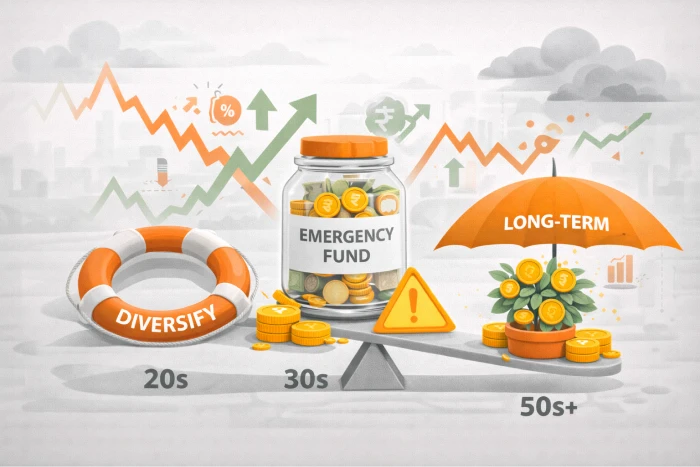
Diversify Your Investment Portfolio
Diversification helps reduce risk during volatile market conditions.
A diversified portfolio spreads investments across different asset classes such as:
Equity mutual funds
Debt instruments
Gold investments
Real estate
If one asset class performs poorly, other investments may help stabilize overall portfolio performance.
Diversification is a key principle of risk management.
Focus on Long-Term Goals
Short-term market movements should not distract investors from long-term financial objectives.
Common long-term goals include:
Retirement planning
Children's education
Home ownership
Wealth creation
Investors with long investment horizons can typically withstand temporary market fluctuations.
Maintaining a goal-based investment strategy helps reduce emotional decision making.
Maintain Emergency Savings
An emergency fund becomes particularly important during volatile economic periods.
Emergency savings allow investors to manage unexpected expenses without withdrawing investments during market downturns.
Financial planners generally recommend maintaining emergency funds equal to three to six months of living expenses.
Rebalance Your Portfolio
Market volatility may shift portfolio allocations away from their original targets.
For example, if equities decline significantly, the portfolio may become overly weighted toward debt investments.
Periodic rebalancing helps restore the intended asset allocation.
Rebalancing also encourages investors to buy undervalued assets and reduce exposure to overvalued ones.
Investment Opportunities During Market Corrections
While volatility can create uncertainty, market corrections may also present attractive investment opportunities.
When quality companies or funds decline in price due to broader market movements, long-term investors may find opportunities to accumulate assets at lower valuations.
However, investors should conduct proper research and avoid speculative investments during volatile periods.
Maintaining a disciplined investment approach remains essential.
Avoid Common Mistakes During Market Volatility
Investors often make several mistakes during uncertain market conditions.
Panic selling
Selling investments during temporary market declines can lock in losses.
Trying to time the market
Predicting market bottoms or peaks consistently is extremely difficult.
Overexposure to a single asset class
Lack of diversification increases portfolio risk during volatile periods.
Ignoring long-term strategy
Frequent changes in investment strategy can disrupt long-term financial planning.
Avoiding these mistakes helps maintain financial stability.
Role of Technology and Digital Platforms
Technology has made it easier for investors to monitor financial markets and manage investments efficiently.
Digital platforms provide tools for portfolio tracking, financial planning, and investment analysis.
Similarly, digital lending platforms help individuals manage borrowing decisions while planning investments.
For example, individuals planning major financial commitments can compare personal loan offers on Saarathi.ai to evaluate lenders and interest rates before borrowing.
Users can also ask eligibility questions via Saarathi AI experts to understand loan requirements, documentation, and eligibility instantly.
Saarathi.ai connects borrowers with more than 110 lenders including banks and NBFCs across India. The Saarathi Recommendation Engine helps match borrowers with lenders suited to their financial profile.
Borrowers can also track your application in Saarathi Bazaar through a transparent dashboard that monitors documentation, approvals, and lender responses.
These tools allow individuals to align borrowing decisions with long-term financial planning strategies.
Frequently Asked Questions
Is it safe to invest during market volatility?
Yes. Volatility is a natural part of financial markets. Long-term investors often benefit from continuing disciplined investments during such periods.
Should I stop SIPs when markets fall?
Financial experts generally recommend continuing SIPs during market declines because investors can accumulate more units at lower prices.
What investments are safer during volatile markets?
Debt funds, government-backed savings schemes, and diversified portfolios can provide relative stability during volatile periods.
How can diversification reduce investment risk?
Diversification spreads investments across multiple asset classes, reducing the impact of poor performance in any single investment.
Can market volatility create investment opportunities?
Yes. Market corrections may allow investors to purchase quality assets at lower prices, potentially improving long-term returns.
Conclusion
Market volatility can be unsettling for investors, but it is an unavoidable part of investing. Instead of reacting emotionally, investors should focus on disciplined strategies that prioritize long-term financial goals.
Approaches such as systematic investing, diversification, maintaining emergency funds, and periodic portfolio rebalancing help manage risk during uncertain market conditions.
By staying focused on long-term objectives and avoiding impulsive decisions, investors can turn market volatility into an opportunity for wealth creation.
At Saarathi.ai, we believe informed financial decisions lead to stronger financial outcomes. Whether you are planning investments, managing loans, or preparing for major financial milestones, digital tools can simplify the process.
Discover personalized loan options and make smarter financial decisions with Saarathi.ai today.