How to decide if an EMI is affordable?
|
How do you decide if an EMI is affordable? Many borrowers focus only on loan approval, not repayment comfort. But true financial stability depends on whether your EMI fits smoothly into your monthly cash flow without stress.
In 2026, with rising consumption, digital lending growth, and changing interest rates influenced by policy updates from the Reserve Bank of India, borrowers must evaluate affordability carefully. At Saarathi.ai, we have observed that people often qualify for higher loan amounts than they should actually take. Approval does not equal affordability.
This guide helps you calculate EMI affordability using practical frameworks, industry benchmarks, and smart decision tools.
What Does EMI Affordability Really Mean?
EMI affordability means:
You can pay your EMI on time
You still save every month
You maintain an emergency fund
Your lifestyle does not suffer
You are stress-free even if income fluctuates
If an EMI forces you to delay bills, reduce investments, or rely on credit cards, it is not affordable.
The 35-40 Percent Rule: The Basic Benchmark
Financial planners in India commonly recommend:
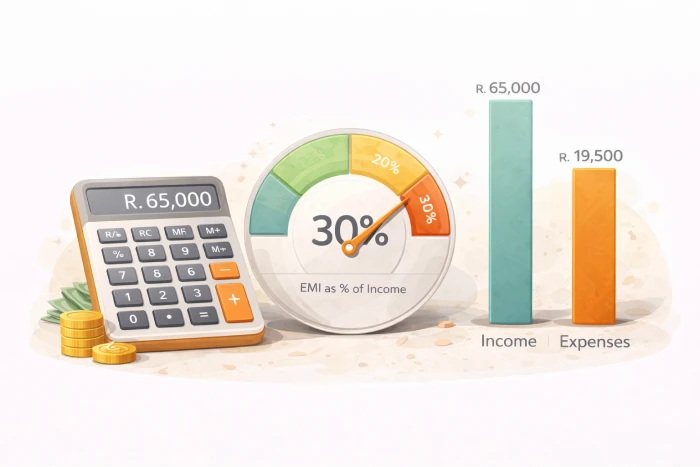
Total EMIs should not exceed 35 to 40 percent of your monthly net income.
Example:
Net monthly income: Rs 1,00,000
Safe total EMI range: Rs 35,000 to Rs 40,000
This includes:
Home loan EMI
Car loan EMI
Personal loan EMI
Credit card minimum payments
According to lending trend coverage in the Economic Times, banks increasingly assess fixed obligation to income ratio before sanctioning loans. However, approval limits can stretch up to 50 percent in some cases. That may not always be comfortable for you.
At Saarathi.ai, our Recommendation Engine evaluates EMI-to-income ratio and suggests safer borrowing levels rather than pushing maximum eligibility.
Step-by-Step EMI Affordability Framework
Step 1: Calculate Your Net Monthly Income
Include:
Salary after tax
Business income after expenses
Rental income
Regular side income
Do not include uncertain bonuses.
Step 2: List Fixed Monthly Expenses
Typical expenses:
Rent or home EMI
Groceries
Utilities
School fees
Insurance premiums
SIP investments
Medical expenses
Household help
Example:
Monthly income: Rs 1,20,000
Monthly expenses: Rs 70,000
Surplus: Rs 50,000
This does not mean you can take Rs 50,000 EMI. You must leave room for savings and emergencies.
Step 3: Maintain Minimum 20 Percent Savings
Before taking any EMI, ensure:
At least 20 percent of income goes to savings or investments.
Using the example:
Income: Rs 1,20,000
Minimum savings: Rs 24,000
Expenses: Rs 70,000
Remaining safe EMI room: Rs 26,000
That is your realistic EMI affordability.
Step 4: Stress-Test Your EMI
Ask yourself:
Can I handle this EMI if interest rates rise by 1 to 2 percent?
Can I manage if my income drops for 3 months?
What if an emergency medical expense arises?
Data from rating reports by CRISIL indicates that households with lower debt service ratios show stronger financial resilience during economic slowdowns.
At Saarathi.ai, we encourage borrowers to test EMI scenarios before finalizing loan tenure and amount.
EMI-to-Income Ratio Explained
What Is FOIR?
Banks use FOIR or Fixed Obligation to Income Ratio.
Formula:
FOIR = Total EMIs / Net Monthly Income
FOIR Percentage | Risk Level |
Below 30% | Very Safe |
30-40% | Comfortable |
40-50% | Risky |
Above 50% | High Risk |
Even if a lender approves 50 percent FOIR, your personal comfort may be lower.
On Saarathi.ai, you can compare personal loan offers on Saarathi.ai and instantly see EMI options aligned with your income profile.
How Loan Type Impacts Affordability
Home Loan
Longer tenure
Lower interest compared to personal loans
Tax benefits available
Home loan EMIs may stretch 20 to 30 years, so affordability must factor long-term life goals.
Personal Loan
Higher interest rates
Shorter tenure
No collateral
EMI burden is heavier due to higher rates.
Business Loan
Income generating potential
Variable cash flows
Affordability must consider seasonal income variations.
You can explore different loan types and track your application in Saarathi Bazaar after applying.
5 Practical Tests Before Saying Yes to an EMI
1. The Sleep Test
If thinking about EMI gives anxiety, reconsider the loan amount.
2. The Savings Continuity Test
Will your SIPs continue uninterrupted? If not, EMI may be too high.
3. The Emergency Buffer Test
After paying EMI and expenses, do you still have 6 months of expenses saved?
4. The Lifestyle Test
Will EMI reduce essential quality of life?
5. The Growth Test
Can you still invest for retirement and children’s education?
Common Mistakes Borrowers Make
Choosing longest tenure just to reduce EMI
Ignoring future interest rate changes
Not accounting for annual insurance premiums
Taking multiple small loans together
Applying randomly to many lenders, hurting credit score
Instead, use a single digital marketplace like Saarathi.ai to compare structured offers transparently and avoid multiple hard inquiries.
You can also ask eligibility questions via Saarathi AI expert chatbot before applying.
Example Calculation
Let us assume:
Income: Rs 80,000 per month
Expenses: Rs 45,000
Savings goal: Rs 16,000
Remaining safe EMI: Rs 19,000
If a bank offers:
Loan EMI: Rs 28,000
Even if approved, this exceeds safe range.
Smart decision:
Reduce loan amount
Increase tenure moderately
Improve credit score to get lower rate
Delay purchase and save more
When It Is Okay to Stretch Slightly
Sometimes stretching EMI to 42 to 45 percent may be acceptable if:
You expect salary increments soon
You have strong job stability
You have large emergency savings
The asset is appreciating, like property in a growth corridor
However, this must be calculated, not emotional.
Digital Tools Make It Easier in 2026
Modern lending platforms allow:
Instant EMI calculators
Pre-approved offers
AI-based eligibility checks
Real-time tracking
On Saarathi.ai, the Recommendation Engine evaluates income, credit profile, and lender criteria across 110 plus lenders. Instead of guessing, you receive personalized EMI suggestions aligned with affordability.
Everything is paperless, transparent, and trackable through the Saarathi Bazaar dashboard.
FAQs
1. What percentage of salary should go to EMI?
Ideally 35 to 40 percent of net monthly income.
2. Can I take a loan with a 50 percent EMI ratio?
Some lenders may approve it, but it increases financial stress risk.
3. Does higher salary mean higher safe EMI?
Yes, but only if expenses and savings goals are balanced.
4. Should I reduce tenure to save interest?
Shorter tenure reduces total interest but increases EMI. Ensure EMI remains affordable.
5. How can Saarathi.ai help me check EMI affordability?
You can compare loan offers, simulate EMIs, and get AI-based recommendations tailored to your income profile.
Conclusion
Deciding if an EMI is affordable is about balance, not approval.
Remember:
Keep EMI below 40 percent of income
Maintain 20 percent savings
Stress-test for rate hikes
Protect emergency funds
Avoid emotional borrowing
At Saarathi.ai, we believe responsible borrowing builds long-term wealth. Use AI-driven comparisons, transparent offers, and real-time tracking to make smarter EMI decisions.
Discover personalized loan options and calculate your comfortable EMI on Saarathi.ai today.