How to Choose the Right Investment Based on Your Age?
|
Investment strategies should evolve as your age, income, responsibilities, and financial goals change. A 25-year-old professional starting a career will likely prioritize growth and risk-taking, while someone in their 40s or 50s may focus more on stability and retirement planning. Choosing the right investment based on age helps balance risk, returns, and long-term financial security.
In India, investors have access to various instruments such as mutual funds, government savings schemes, real estate, and retirement plans. At Saarathi.ai, we have observed that individuals who align investments with their life stage often achieve better financial outcomes. Whether planning early wealth creation or preparing for retirement, age-based investment strategies can help individuals make smarter financial decisions.
Why Age Matters in Investment Planning
Age influences several financial factors that affect investment decisions.
These include:
Risk tolerance
Income stability
Financial responsibilities
Investment horizon
Retirement planning goals
Younger investors typically have longer investment horizons, allowing them to take more risk in pursuit of higher returns. Older investors often prefer stable investments that protect accumulated wealth.
Adapting investment strategies according to age helps maintain the right balance between growth and safety.
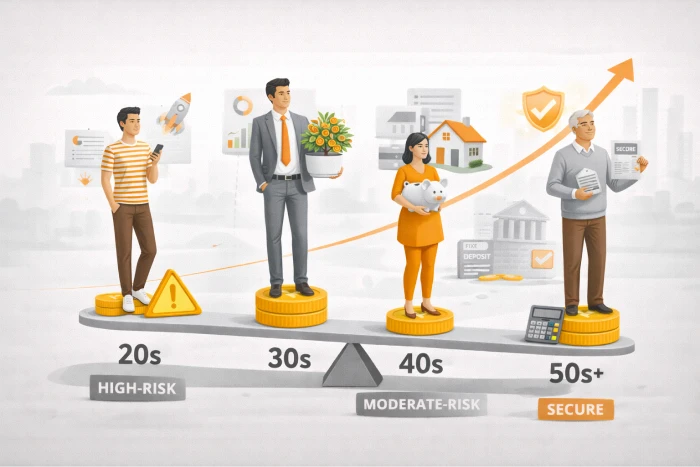
Investment Strategy in Your 20s
Your 20s are the ideal time to start investing because time is the most powerful asset in wealth creation.
Young investors can benefit from compounding by starting early, even with small amounts.
Focus on Growth-Oriented Investments
Since retirement is decades away, investors in their 20s can allocate a larger portion of their portfolio to growth assets.
Common options include:
Equity mutual funds
Index funds
Exchange traded funds
Systematic Investment Plans (SIPs)
Equity investments offer higher growth potential over long periods.
Build Financial Discipline
Investing in your 20s also helps develop strong financial habits such as regular saving, budgeting, and goal-based investing.
Many beginners start investing with small monthly SIP contributions and gradually increase them as income grows.
Build an Emergency Fund
Before investing aggressively, young professionals should maintain an emergency fund covering at least three months of living expenses.
This ensures investments remain untouched during financial emergencies.
Investment Strategy in Your 30s
Your 30s are often a period of increasing income but also growing responsibilities such as home purchases, family planning, and education expenses.
Investment strategies during this phase should focus on balancing growth with financial stability.
Diversify Investment Portfolio
Investors should diversify across multiple asset classes to manage risk effectively.
Typical allocations may include:
Equity mutual funds
Debt funds
Public Provident Fund (PPF)
Gold investments
Diversification helps reduce risk while maintaining long-term growth potential.
Plan Major Financial Goals
This stage often involves planning large financial goals such as buying a home.
Many individuals evaluate financing options during this phase. Borrowers frequently compare home loan offers on Saarathi.ai to find competitive interest rates before purchasing property.
Aligning investments with major financial milestones helps maintain financial stability.
Investment Strategy in Your 40s
In your 40s, financial priorities often shift toward protecting accumulated wealth while continuing long-term growth.
Retirement planning becomes increasingly important.
Balance Risk and Stability
Investors should gradually increase allocation to relatively stable assets while maintaining exposure to growth investments.
Possible allocation strategy:
50 to 60 percent equity investments
20 to 30 percent debt instruments
10 to 20 percent gold or other diversifiers
This balanced approach protects capital while allowing moderate growth.
Increase Retirement Contributions
Retirement-focused investments such as the National Pension System and long-term mutual funds become increasingly important during this stage.
Higher income levels often allow individuals to increase monthly investments and retirement contributions.
Investment Strategy in Your 50s and Beyond
Investors approaching retirement typically prioritize capital preservation and stable income.
The goal shifts from aggressive wealth accumulation to financial security and income generation.
Focus on Low-Risk Investments
Suitable options may include:
Senior citizen savings schemes
Fixed deposits
Debt mutual funds
Annuity-based retirement plans
These instruments provide predictable returns and lower risk.
Reduce Market Exposure Gradually
While equity investments can still remain part of the portfolio, exposure should be gradually reduced to minimize volatility risk.
A well-balanced retirement portfolio protects accumulated wealth while providing steady income.
Importance of Asset Allocation
Asset allocation refers to how investments are distributed across different asset classes.
A simple rule often used in financial planning is the "100 minus age" guideline.
Example:
If an investor is 30 years old:
100 minus 30 = 70 percent equity exposure
The remaining 30 percent can be allocated to debt or other stable assets.
Although this rule provides a starting point, investors should adjust allocations based on individual financial goals and risk tolerance.
Role of Digital Platforms in Investment and Financial Planning
Digital financial platforms have made it easier for individuals to manage investments and loans efficiently.
Technology-driven platforms allow users to evaluate financial products, compare lenders, and access personalized recommendations.
For example, individuals planning financial commitments can ask eligibility questions via Saarathi AI experts to understand loan requirements and documentation instantly.
Saarathi.ai connects borrowers with more than 110 lenders across banks and NBFCs. The Saarathi Recommendation Engine matches users with suitable loan options based on financial profiles.
Borrowers can also track your application in Saarathi Bazaar, providing full transparency during the loan process.
These digital tools allow individuals to integrate borrowing decisions with long-term financial planning.
Common Mistakes Investors Make at Different Ages
Many investors make avoidable mistakes that affect long-term financial growth.
Starting investments too late
Delaying investments reduces the benefits of compounding.
Taking excessive risk later in life
Investors nearing retirement should avoid aggressive high-risk investments.
Ignoring diversification
Relying on a single asset class increases financial risk.
Neglecting retirement planning
Many individuals underestimate the amount required for retirement.
Regular portfolio reviews help investors adjust strategies as financial circumstances change.
Frequently Asked Questions
What is the best investment in your 20s in India?
Equity mutual funds and SIPs are commonly recommended for young investors because they offer long-term growth potential.
How should investment strategies change in your 30s?
Investors should focus on diversification, goal-based planning, and balancing equity with safer investment options.
Is it safe to invest in equities in your 40s?
Yes, but investors should balance equity exposure with debt instruments to reduce overall portfolio risk.
What investments are suitable for retirement planning?
Retirement investments often include NPS, debt mutual funds, fixed deposits, and government-backed savings schemes.
How often should investment portfolios be reviewed?
Financial planners typically recommend reviewing investment portfolios at least once a year.
Conclusion
Investment strategies should evolve with age, financial responsibilities, and long-term goals. Younger investors can focus on growth-oriented assets, while individuals approaching retirement may prioritize stability and income generation.
By aligning investments with life stages, individuals can manage risk more effectively while building long-term financial security.
A well-balanced portfolio, disciplined investing, and regular portfolio reviews can significantly improve financial outcomes over time.
At Saarathi.ai, we believe smarter financial decisions start with the right guidance and digital tools. Whether you are planning investments, evaluating loan options, or preparing for major life milestones, technology can simplify the process.
Discover personalized loan options and build a smarter financial future with Saarathi.ai today.