How does financial stress affect decision making?
|
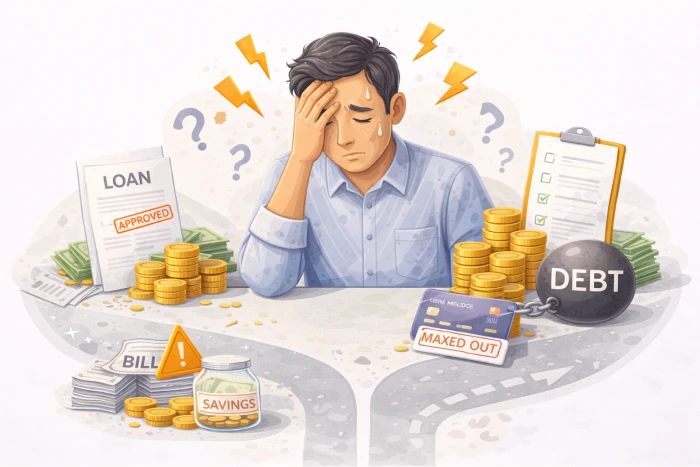
Financial stress is not just about numbers. It affects how you think, react, and make decisions. When money feels tight or EMIs pile up, even simple choices become emotionally charged.
In 2026, with rising living costs, digital credit access, and multiple EMI commitments, many Indian households experience silent financial pressure. At Saarathi.ai, we have observed that borrowers under stress often make reactive decisions such as taking high-interest loans, delaying EMI payments, or avoiding financial planning altogether.
Understanding how financial stress affects decision making can help you break the cycle and move toward rational, data-driven choices.
What Is Financial Stress?
Financial stress occurs when:
Expenses exceed income
EMIs feel overwhelming
Savings are low
Debt keeps increasing
Income is uncertain
Policy advisories and consumer awareness initiatives from the Reserve Bank of India emphasize responsible borrowing. However, stress often builds before borrowers realize the warning signs.
Financial stress is both psychological and practical. It reduces clarity and increases impulsiveness.
The Science: How Stress Changes Your Brain
When you feel financially pressured, your brain shifts into survival mode.
This leads to:
Short-term thinking
Risky quick-fix decisions
Avoidance behavior
Emotional spending
Over-borrowing
Stress narrows focus. Instead of thinking about long-term financial goals, you focus only on immediate relief.
For example, instead of comparing interest rates calmly, you may accept the first loan approval available.
7 Ways Financial Stress Affects Decision Making
1. Short-Term Over Long-Term Thinking
Under stress, people prefer immediate relief even if long-term cost is higher.
Example:
Taking a personal loan at 18 percent interest to solve a short-term liquidity issue instead of restructuring existing debt.
This increases the total interest burden.
2. Increased Impulsive Borrowing
Easy digital approvals make borrowing quick. Financial news reports in the Economic Times frequently discuss rising unsecured credit growth.
When stressed, instant approval feels like relief. But emotional borrowing can worsen the situation.
At Saarathi.ai, we encourage borrowers to simulate EMI affordability before applying rather than reacting emotionally.
3. Avoidance of Financial Tracking
Many stressed borrowers:
Avoid checking bank balances
Ignore loan statements
Delay reviewing expenses
Avoidance increases anxiety and allows debt to grow unnoticed.
Tracking numbers, even when uncomfortable, restores control.
4. Overestimating Future Income
Financial stress can lead to optimistic assumptions:
"Next year's salary will increase."
"Business will improve soon."
"Bonus will cover this."
This may justify taking larger loans today.
Industry analysis from CRISIL often shows that income volatility increases risk for borrowers with high unsecured debt.
Planning based on uncertain income increases vulnerability.
5. Emotional Spending as Relief
Ironically, stress sometimes leads to spending for comfort.
Examples:
Online shopping
Dining out more often
Festival overspending
Lifestyle upgrades
This behavior provides temporary emotional relief but worsens financial pressure.
6. Risk of Entering a Debt Trap
When stress leads to:
Borrowing to repay loans
Paying only minimum dues
Frequent refinancing
You may slowly enter a debt trap.
Without a structured repayment plan, financial stress compounds.
7. Decision Fatigue
When money worries dominate daily thoughts, mental energy reduces.
This results in:
Delayed decisions
Poor comparisons
Acceptance of unfavorable loan terms
Ignoring fine print
Stress reduces cognitive bandwidth.
Real-Life Scenario
Assume:
Income: Rs 75,000
Total EMIs: Rs 35,000
Savings: Low
Under pressure, you receive a pre-approved personal loan offer.
Emotionally, it feels like relief. Rationally, it increases EMI to Rs 50,000.
That pushes EMI-to-income ratio above safe levels.
Without analysis, stress drives a harmful decision.
How to Break the Financial Stress Cycle
1. Create a Clear EMI Snapshot
List:
Outstanding balances
Interest rates
EMI amounts
Closure dates
Clarity reduces fear.
You can monitor structured loan applications and repayment plans through Saarathi Bazaar if you use Saarathi.ai.
2. Follow the 48-Hour Rule for New Loans
If not an emergency, wait 48 hours before accepting any new credit offer.
Use that time to:
Compare rates
Calculate total cost
Evaluate affordability
You can compare personal loan offers on Saarathi.ai to see transparent cost breakdowns across lenders.
3. Cap EMI at 40 Percent of Income
Total EMIs should ideally remain below 35 to 40 percent of net income.
This creates breathing room and reduces stress.
If your ratio is higher, focus on restructuring instead of adding new loans.
4. Build Emergency Buffer Gradually
Even saving Rs 3,000 to Rs 5,000 monthly builds confidence.
Liquidity reduces stress significantly.
Financial stability is not about large savings overnight. It is about consistency.
5. Use AI-Based Decision Support
When stressed, decision clarity reduces.
Using structured digital tools can help you:
Compare interest rates objectively
Simulate EMI scenarios
Avoid multiple hard inquiries
Choose optimal tenure
At Saarathi.ai, our Recommendation Engine analyzes income, credit profile, and lender criteria to suggest safer borrowing limits instead of pushing maximum eligibility.
You can also ask eligibility questions via Saarathi AI expert chatbot before applying.
Data reduces emotional bias.
Warning Signs You Are Making Stress-Driven Decisions
Accepting first loan offer without comparison
Ignoring total interest cost
Borrowing for non-essential purchases
Avoiding financial discussions
Frequently refinancing without long-term plan
Recognizing these signs is the first step to correction.
When to Seek Support
If financial stress causes:
Sleeplessness
Constant anxiety
Repeated EMI delays
Arguments at home
It may be time to:
Consult a financial planner
Speak with lender support teams
Restructure debt early
Early action prevents long-term damage.
FAQs
1. Does financial stress really affect decision making?
Yes. Stress reduces long-term thinking and increases impulsive choices.
2. Why do stressed people take high-interest loans?
They prioritize immediate relief over total cost.
3. How can I make better loan decisions under stress?
Pause, calculate EMI affordability, compare offers, and avoid rushing.
4. What is a safe EMI-to-income ratio?
Ideally below 35 to 40 percent of net monthly income.
5. How can Saarathi.ai help reduce financial stress?
You can compare transparent loan offers, simulate EMI options, and receive AI-based recommendations aligned with your financial capacity.
Conclusion
Financial stress changes how you think. It pushes you toward quick fixes instead of sustainable solutions.
To protect your decisions:
Track your numbers clearly
Avoid impulse borrowing
Cap EMIs below 40 percent
Build emergency savings
Use data-driven tools
Money decisions should be calm, structured, and intentional.
Take control of your borrowing journey, explore smarter structured loan options, and discover personalized solutions on Saarathi.ai today.