How Compounding Works: The Secret Behind Wealth Creation?
|
Many successful investors attribute their financial growth to one powerful concept: compounding. Understanding how compounding works is often considered the secret behind long term wealth creation. In simple terms, compounding means earning returns not only on your original investment but also on the returns generated over time. This creates a snowball effect that accelerates wealth growth the longer you stay invested. In India, where more individuals are exploring mutual funds, SIPs, and long term investments, learning the power of compounding can help investors build significant wealth over time. This guide explains how compounding works, why time matters more than timing the market, and how disciplined investing can transform small contributions into large financial outcomes.
What is Compounding?
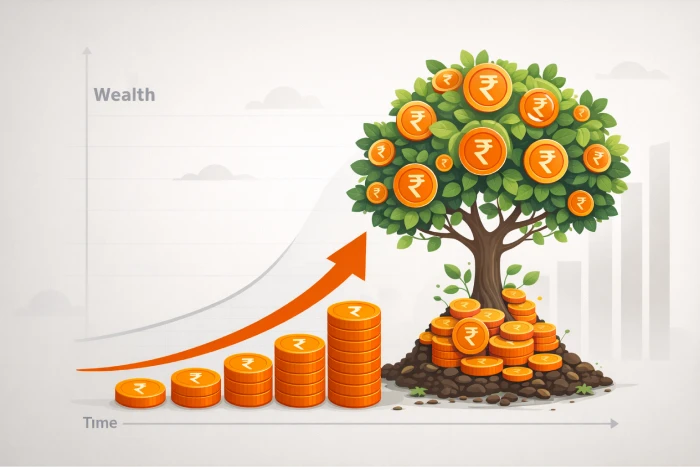
Compounding refers to the process where investment earnings generate their own earnings over time. Instead of withdrawing returns, investors reinvest them, allowing the investment to grow at an increasing rate.
For example, if you invest money and earn returns each year, those returns are added to your original investment. In the following year, returns are calculated on the new total amount.
This cycle continues repeatedly, creating exponential growth.
In simple terms:
Compounding = earning interest on interest.
Albert Einstein famously referred to compounding as the “eighth wonder of the world” because of its powerful ability to multiply wealth over time.
How Compounding Works in Real Life
Let us understand the concept with a simple example.
Suppose you invest Rs.1,00,000 in an investment that earns 10 percent annually.
Year | Investment Value |
Year 1 | Rs.1,10,000 |
Year 2 | Rs.1,21,000 |
Year 5 | Rs.1,61,051 |
Year 10 | Rs.2,59,374 |
Year 20 | Rs.6,72,750 |
Even though the annual return remains the same, the growth accelerates significantly over time because the returns are reinvested.
This is the core strength of compounding.
Why Time is the Most Important Factor in Compounding
One of the biggest drivers of compounding is time. The longer your investment remains invested, the greater the compounding effect.
Many investors underestimate how powerful time can be in wealth creation.
Consider two investors:
Investor A starts investing at age 25
Investor B starts investing at age 35
Both invest Rs.10,000 per month and earn an average annual return of 12 percent.
Investor | Investment Duration | Total Investment | Wealth Created |
Investor A | 35 years | Rs.42 lakh | Rs.6+ crore |
Investor B | 25 years | Rs.30 lakh | Rs.1.7+ crore |
Even though Investor A invested only Rs.12 lakh more, the wealth difference becomes massive due to compounding over time.
This shows why starting early is crucial.
The Role of SIP in Compounding
Systematic Investment Plans (SIPs) are one of the most effective ways to benefit from compounding.
By investing regularly, SIPs allow investors to accumulate units over time while reinvesting returns.
Benefits of SIP for compounding include:
Consistent investment discipline
Rupee cost averaging during market volatility
Long term compounding of returns
Low starting investment amounts
For example, investing Rs.5,000 per month through SIP at 12 percent annual return can grow into more than Rs.50 lakh in 25 years.
This demonstrates how small but consistent investments can grow significantly.
Key Factors That Maximize Compounding
While compounding is powerful, certain habits help maximize its benefits.
Start Investing Early
The earlier you begin investing, the longer your money compounds.
Even small investments in your 20s can outperform larger investments started later in life.
Stay Invested for the Long Term
Frequent withdrawals interrupt compounding.
Long term investments allow returns to accumulate and multiply.
Reinvest Earnings
Dividends, interest, or capital gains should ideally be reinvested rather than withdrawn.
Reinvestment fuels the compounding cycle.
Maintain Consistent Investments
Regular contributions such as monthly SIPs help build a larger base for compounding.
Compounding vs Simple Interest
Many investors confuse compounding with simple interest, but the difference is significant.
Feature | Simple Interest | Compound Interest |
Interest calculation | Only on principal | On principal + accumulated interest |
Growth pattern | Linear | Exponential |
Wealth creation | Slow | Rapid over time |
For example, Rs.1 lakh invested at 10 percent simple interest for 20 years becomes Rs.3 lakh.
But with compound interest, the same investment becomes more than Rs.6.7 lakh.
This illustrates how compounding dramatically accelerates wealth creation.
Investments That Benefit from Compounding
Several financial instruments allow investors to benefit from compounding.
Common examples include:
Mutual funds
Equity investments
Public Provident Fund (PPF)
National Pension System (NPS)
Fixed deposits with reinvested interest
Among these, equity mutual funds historically offer stronger compounding potential due to higher long term returns.
However, investors should choose instruments based on risk tolerance and investment goals.
Common Mistakes That Reduce Compounding Benefits
Even though compounding is simple, many investors unintentionally weaken its impact.
Common mistakes include:
Stopping SIP investments during market downturns
Withdrawing investments too early
Trying to frequently time the market
Investing irregularly without consistency
Choosing very short investment horizons
Successful compounding requires patience, discipline, and consistency.
Real Life Example of Compounding in India
Consider a young professional investing Rs.8,000 per month starting at age 25.
Assuming an average annual return of 12 percent, the investment could grow to nearly Rs.3 crore by age 60.
Total investment made: around Rs.33.6 lakh
Potential wealth created: around Rs.3 crore
The majority of this growth comes not from contributions but from compounded returns.
This is why long term investors often emphasize staying invested rather than constantly chasing new opportunities.
How to Use Compounding for Long Term Wealth Creation
To effectively use compounding, investors can follow a structured approach.
Step 1: Define long term financial goals such as retirement, children's education, or home ownership.
Step 2: Start investing as early as possible.
Step 3: Invest consistently through SIP or regular contributions.
Step 4: Avoid panic during market fluctuations.
Step 5: Stay invested for decades whenever possible.
Following these principles can significantly improve financial outcomes.
FAQs
What is compounding in simple terms?
Compounding is the process of earning returns on both the original investment and the returns already generated.
Why is compounding important for investors?
Compounding allows investments to grow exponentially over time, helping investors build significant wealth.
How long does compounding take to show results?
Compounding becomes more powerful over longer periods. Significant effects are usually visible after 10 to 15 years of investing.
Does SIP benefit from compounding?
Yes. SIP investments benefit from compounding because returns are reinvested and grow over time.
Can compounding work with small investments?
Yes. Even small investments can grow significantly if invested regularly and allowed to compound over many years.
Conclusion
Compounding is one of the most powerful forces in wealth creation. By reinvesting returns and staying invested for long periods, investors allow their money to grow exponentially. The earlier you begin investing, the stronger the compounding effect becomes. Small, consistent investments can eventually turn into large financial assets when given enough time. Understanding how compounding works helps investors focus on patience, discipline, and long term financial planning. When combined with regular investments and a long term perspective, compounding can transform simple savings into lasting wealth.