How Climate Policies Raise Property and Business Loan Costs?
|
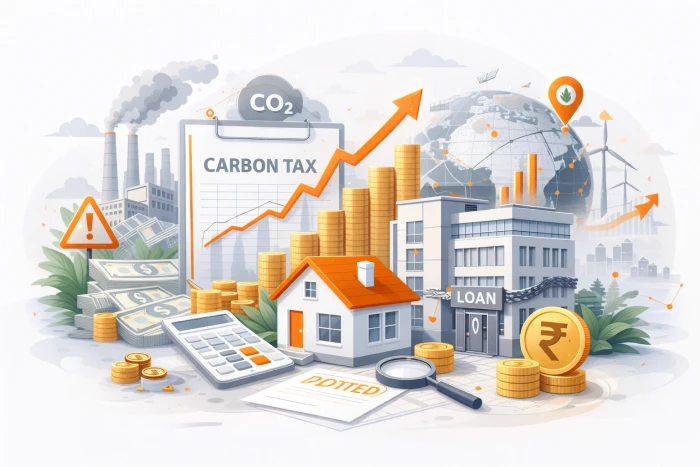
Global climate policies and carbon taxes are reshaping industries, trade flows, and investment decisions worldwide. While these measures aim to reduce emissions and fight climate change, they can also influence inflation, construction costs, and business profitability. This raises an important question for Indian borrowers: could global climate policies and carbon taxes increase property and business loan costs? The answer is yes, indirectly. Through higher input costs, stricter environmental compliance, and shifting capital allocation, climate regulation can affect lending risk assessment and interest rates. In this article, we explain the economic chain reaction and how borrowers can prepare in 2026.
What Are Global Climate Policies and Carbon Taxes?
Climate policies include:
Carbon taxes on emissions
Emission trading systems
Mandatory ESG disclosures
Renewable energy targets
Green building standards
Many developed economies are introducing carbon border adjustment mechanisms. These impose carbon related costs on imported goods produced in carbon intensive environments.
This affects export oriented industries and global supply chains.
How Carbon Policies Increase Costs in India
1. Higher Raw Material Prices
Industries such as:
Steel
Cement
Power generation
Chemicals
are carbon intensive.
If global carbon taxes increase production costs:
Construction material prices rise
Infrastructure project costs increase
Manufacturing margins shrink
Higher construction costs directly impact property prices.
2. Compliance and Green Upgrades
Developers and businesses may need to invest in:
Energy efficient machinery
Renewable energy installations
Carbon reporting systems
Green certifications
These upgrades require capital expenditure, which may increase borrowing needs.
Impact on Property Loan Costs
1. Rising Property Prices
If input costs rise due to carbon policies:
Developers may increase selling prices
Loan ticket sizes may increase
EMI burden grows
Higher property value means higher loan principal.
2. Inflationary Pressure
If energy and transportation costs increase:
Inflation may rise
The Reserve Bank of India may tighten monetary policy
Repo rate hikes increase floating home loan EMIs.
3. Green Premium Financing
Some lenders may offer preferential rates for certified green buildings. However, conventional properties may not benefit from such incentives.
You can compare home loan offers on Saarathi.ai to evaluate lender specific pricing and green financing options.
Impact on Business Loan Costs
1. Higher Operating Costs
MSMEs in carbon intensive sectors may face:
Higher electricity tariffs
Export levies
Increased compliance expenses
This may reduce profit margins and affect credit risk assessment.
2. Stricter Lending Criteria
Banks and NBFCs increasingly evaluate ESG risk in corporate lending.
During risk assessment, lenders may consider:
Environmental compliance record
Carbon exposure
Transition readiness
Higher perceived risk can lead to higher interest spreads.
You can compare business loan offers on Saarathi.ai to identify lenders offering competitive rates for your sector profile.
Role of Global Capital Markets
Global investors are reallocating funds toward green assets.
If climate policies tighten globally:
Green bonds may attract lower yields
High carbon sectors may face higher borrowing costs
The Reserve Bank of India and Indian regulators are also encouraging sustainable finance frameworks.
Rating agencies such as CRISIL have highlighted growing ESG considerations in credit ratings.
Over time, access to cheaper capital may depend partly on environmental performance.
Will Loan EMIs Increase Immediately?
Not necessarily.
Impact depends on:
Extent of inflation caused by carbon pricing
RBI’s policy response
Domestic energy transition pace
If inflation remains controlled, repo rates may stay stable despite global climate measures.
However, sectors with high carbon exposure may face localized credit tightening.
Opportunities in the Transition
Climate policy shifts also create opportunities.
For Property Buyers
Energy efficient homes may have lower operating costs
Green financing schemes may offer incentives
Solar installations can reduce electricity bills
For Businesses
Renewable energy adoption reduces long term fuel risk
ESG compliant companies may access lower cost capital
Borrowers who adapt early may secure better financing terms.
What Borrowers Should Do
1. Evaluate Energy Efficiency
For property purchase, consider green certified projects.
2. Monitor Inflation Trends
Energy driven inflation can influence repo rate decisions by the Reserve Bank of India.
3. Maintain Strong Credit Score
Higher credit scores reduce risk premium even in volatile sectors.
4. Keep EMI Ratio Conservative
Maintain EMIs below 40 percent of income.
5. Compare Lenders Carefully
Different lenders assess sector risk differently.
You can ask eligibility questions via Saarathi AI expert before applying to understand approval probability.
You can also track your application in Saarathi Bazaar and stay informed throughout the process.
FAQs
Can carbon taxes increase home loan EMIs?
Indirectly yes, if they raise construction costs and inflation, leading to repo rate hikes.
Are green buildings cheaper to finance?
Some lenders offer preferential rates for certified sustainable projects.
Will business loans become harder to get?
Carbon intensive sectors may face stricter assessment, but transition ready firms may benefit.
Does RBI consider climate risk in policy?
Yes, climate risk is increasingly part of financial stability discussions.
Should I delay property purchase due to climate policies?
Focus on affordability and energy efficiency rather than speculation on policy timing.
Conclusion
Global climate policies and carbon taxes are reshaping economic structures. While they aim to reduce emissions, they can indirectly increase property and business loan costs through higher input prices, compliance expenses, and inflationary pressure.
However, the green transition also creates financing opportunities for energy efficient homes and sustainable businesses.
For borrowers, disciplined planning, strong credit health, and transparent lender comparison are key.
Discover personalized loan options on Saarathi.ai today and finance your property or business confidently in a changing climate policy landscape.