Global Currency Wars and Your Personal Loan Costs
|
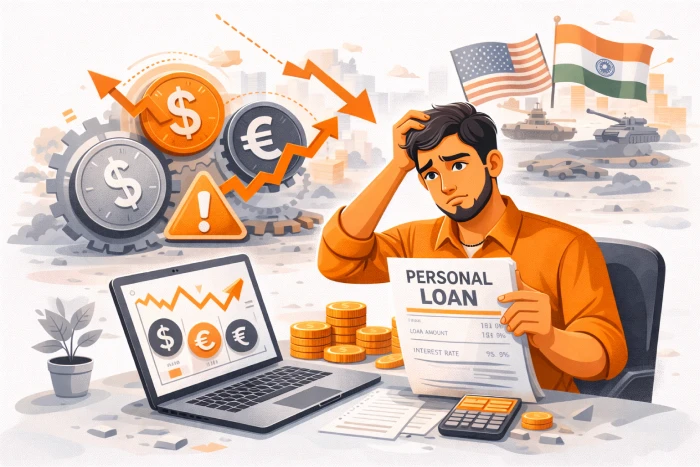
Currency wars occur when countries deliberately weaken their currencies to boost exports and protect domestic growth. In a volatile global economy, competitive devaluations can create ripple effects across emerging markets. For Indian borrowers, this raises an important question: how could global currency wars indirectly raise your personal loan costs? While currency policies may seem distant from your EMI, they can influence inflation, bond yields, lender funding costs, and risk premiums. In this article, we explain the economic chain reaction and what it means for personal loan borrowers in 2026.
What Is a Currency War?
A currency war typically involves:
Central banks cutting interest rates aggressively
Large scale liquidity injections
Direct or indirect currency intervention
Competitive devaluation to support exports
When multiple economies weaken their currencies simultaneously, exchange rate volatility increases.
As often reported by Economic Times, sharp currency moves can impact capital flows and inflation in emerging markets like India.
How Currency Wars Affect India
India does not deliberately engage in competitive devaluation, but it is influenced by global flows.
If major economies weaken their currencies:
The US dollar may strengthen
Capital may move toward safe assets
Emerging market currencies, including the rupee, may face pressure
The Reserve Bank of India may intervene to manage excessive volatility, but it does not fix exchange rates permanently.
The Inflation Channel
If the rupee weakens due to global currency tensions:
Crude oil imports become expensive
Fuel prices may rise
Transportation costs increase
Food inflation accelerates
This pushes up headline inflation.
If inflation remains above comfort levels, the Reserve Bank of India may avoid cutting rates or even consider tightening.
Higher policy rates eventually impact personal loan pricing.
The Bond Yield Channel
Currency volatility often leads to:
Foreign investor outflows
Selling of Indian government bonds
Rising domestic bond yields
When bond yields rise:
Banks and NBFCs face higher funding costs
Risk premiums increase
Loan pricing adjusts upward
Personal loans, being unsecured, are more sensitive to risk premium changes.
You can compare personal loan offers on Saarathi.ai to evaluate how different lenders price loans during volatile cycles.
Why Personal Loans Are More Vulnerable
Personal loans are unsecured, meaning:
No collateral backing
Higher default risk
Greater sensitivity to economic stress
During global uncertainty:
Lenders increase minimum credit score thresholds
Interest spreads widen
Approval criteria become stricter
If currency wars trigger global slowdown or volatility, unsecured loan rates may rise faster than home loan rates.
The Risk Premium Effect
Even if repo rates remain stable:
Lenders may add higher spreads
Risk based pricing may increase
For example:
A borrower with 720 credit score may see higher interest compared to a 780 score borrower
Processing scrutiny may increase
At Saarathi.ai, we have observed that during periods of global volatility, borrowers with strong credit profiles secure better spreads despite macro uncertainty.
Real World Scenario
Suppose:
Major economies weaken currencies
Dollar strengthens
Rupee depreciates from 82 to 90
Oil prices rise
Consequences:
Inflation rises
RBI maintains tight stance
Bond yields stay elevated
NBFC funding cost increases
Personal loan interest rates inch up
Even without a repo hike, effective borrowing costs may increase.
Impact on Existing vs New Borrowers
Existing Personal Loan Borrowers
Most personal loans are fixed rate.
Your EMI remains unchanged
New borrowing may become costlier
New Borrowers
Higher interest rates possible
Stricter eligibility checks
Lower sanctioned amount
You can compare personal loan offers on Saarathi.ai before applying to secure competitive rates.
What Borrowers Should Do
1. Strengthen Credit Score
Maintain a score above 750 to reduce risk premium.
2. Avoid Multiple Unsecured Loans
High unsecured exposure increases rejection risk during volatility.
3. Build Emergency Fund
Maintain 6 months of expenses and EMIs.
4. Monitor Inflation and Currency Trends
Sharp rupee depreciation often signals inflation pressure.
5. Pre Check Eligibility
You can ask eligibility questions via Saarathi AI expert before formal application to avoid unnecessary credit inquiries.
6. Track Application Transparently
Use Saarathi Bazaar to track your application in Saarathi Bazaar and stay informed during processing.
Could Rates Fall Despite Currency Wars?
If global slowdown outweighs inflation pressure:
Central banks may cut rates
Liquidity may increase
However, currency volatility often delays aggressive rate cuts.
The Reserve Bank of India balances inflation, growth, and currency stability simultaneously.
FAQs
Do currency wars directly increase personal loan rates?
Not directly, but they can raise inflation and funding costs, which push rates higher.
Are home loans less affected?
Home loans are secured and often linked to repo, so impact may be slower compared to personal loans.
Should I delay taking a personal loan?
If global volatility is high and not urgent, compare options carefully before proceeding.
Does rupee depreciation always increase rates?
Only if it leads to sustained inflation or capital outflows.
How can I get the lowest rate during volatility?
Maintain a high credit score and compare multiple lenders before finalizing.
Conclusion
Global currency wars may seem distant, but they can indirectly raise personal loan costs in India through inflation pressure, bond yield movements, and higher risk premiums. Unsecured loans are particularly sensitive during volatile cycles.
Instead of reacting to headlines, focus on strengthening your financial profile and comparing lenders strategically.
Discover personalized personal loan options on Saarathi.ai today and secure competitive rates even in a volatile global currency environment.