Fixed vs Floating Interest Rates: Which Should You Pick?
|
Choosing between a fixed and floating interest rate is one of the most important decisions when taking a loan. It directly impacts your EMI, total interest paid, and financial stability. While fixed rates offer predictability, floating rates can help you benefit from falling interest rates. But which one should you pick in 2026? The answer depends on your risk appetite, market conditions, and financial goals. In this guide, we break down both options in simple terms and help you make the right choice using smarter tools like Saarathi.ai.
What Is a Fixed Interest Rate
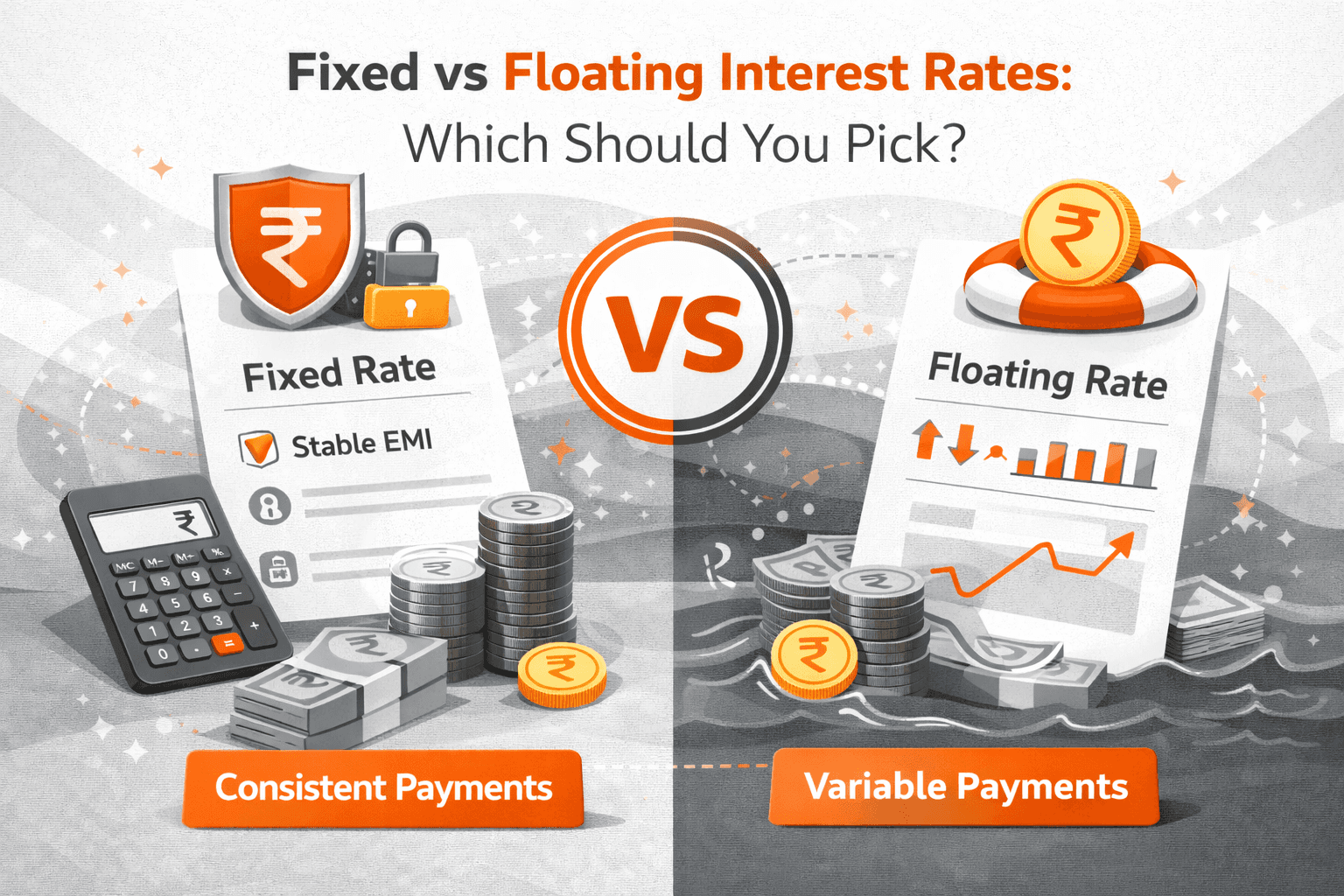
A fixed interest rate remains constant throughout the loan tenure.
This means:
EMI stays the same
Interest rate does not change
Predictable repayment
What Is a Floating Interest Rate
A floating interest rate changes over time based on market conditions.
It is usually linked to:
RBI repo rate
Lender’s benchmark rate
This means:
EMI may increase or decrease
Interest cost can vary
At Saarathi.ai, we have observed that many borrowers choose without fully understanding these differences, leading to avoidable costs.
Key Differences: Fixed vs Floating
Fixed Interest Rate
Stable EMI
No impact from market changes
Easier financial planning
Usually slightly higher initial rate
Floating Interest Rate
Variable EMI
Benefits when rates fall
Risk when rates rise
Usually lower starting rate
Which One Is Cheaper in 2026
In a Falling Interest Rate Scenario
Floating rates are cheaper because:
Rates reduce over time
EMI or tenure decreases
In a Rising Interest Rate Scenario
Fixed rates are better because:
EMI remains stable
No increase in cost
When You Should Choose Fixed Interest Rate
Need for Stability
Choose fixed if:
You want predictable EMI
You prefer financial certainty
Tight Monthly Budget
No risk of EMI increase
Better for fixed income households
Rising Interest Rate Environment
Protects against future rate hikes
When You Should Choose Floating Interest Rate
Expecting Rate Cuts
Choose floating if:
Market rates are likely to fall
Long-Term Loans
Home loans benefit more from floating rates
Higher Risk Appetite
Comfortable with EMI fluctuations
Real Cost Example
Loan Amount: ₹10 lakh
Tenure: 5 years
Fixed Rate
Interest: 13 percent
EMI: Stable
Total cost predictable
Floating Rate
Starts at 11 percent
EMI may increase or decrease
Total cost uncertain
Over time:
Floating can be cheaper or more expensive depending on rate movement
Hybrid Approach: Best of Both Worlds
Some lenders offer:
Fixed rate for initial years
Floating rate later
Benefits:
Stability at start
Flexibility later
You can compare personal loan offers on Saarathi.ai to explore such options.
Factors to Consider Before Choosing
Your Income Stability
Stable income → Floating possible
Fixed income → Fixed better
Loan Tenure
Short tenure → Fixed preferred
Long tenure → Floating beneficial
Market Trends
Rising rates → Fixed
Falling rates → Floating
Risk Tolerance
Low risk → Fixed
High risk → Floating
How to Decide Smartly
Step 1: Assess Your Budget
Ensure EMI is manageable even if rates increase.
Step 2: Understand Market Direction
Keep track of:
RBI repo rate
Economic trends
Step 3: Compare Loan Offers
Do not rely on one lender.
You can compare personal loan offers on Saarathi.ai to find the best option.
Step 4: Read Loan Terms
Check:
Rate reset frequency
Conversion charges
Prepayment terms
You can ask eligibility questions via Saarathi AI expert before applying.
How Saarathi.ai Helps You Choose Better
AI-Based Recommendation Engine
Suggest the best loan type based on your profile.
Transparent Comparison
Compare fixed and floating rate options easily.
Saarathi Bazaar Dashboard
Track your application in Saarathi Bazaar and compare offers.
Paperless Process
Apply quickly with faster approvals.
Real Insight from Saarathi.ai
At Saarathi.ai, we have observed that borrowers with stable income and long-term loans often benefit from floating rates, while those seeking certainty prefer fixed rates despite slightly higher cost.
Common Mistakes to Avoid
Choosing based only on initial rate
Ignoring future rate changes
Not checking reset terms
Overestimating risk tolerance
Not comparing multiple lenders
Impact of Lending Trends in 2026
Recent insights from CRISIL and Economic Times show:
Increased adoption of floating rates
RBI rate cycles influencing borrowing decisions
Growth of hybrid loan products
This gives borrowers more flexibility in choosing loan structures.
FAQs
Which is better: fixed or floating interest rate?
Depends on your risk appetite and market conditions.
Is the fixed rate always higher?
Usually slightly higher than floating rates.
Can floating rate increase EMI?
Yes, if interest rates rise.
Can I switch between fixed and floating?
Yes, but charges may apply.
Which is safer?
Fixed rate is safer due to stability.
Can Saarathi.ai help me choose?
Yes, it provides comparisons and personalized recommendations.
Conclusion
Choosing between fixed and floating interest rates is not about right or wrong, it is about what suits your financial situation. Fixed rates offer stability, while floating rates provide flexibility and potential savings.
The key is to understand your needs, assess risks, and make an informed decision.
Discover personalized loan options on Saarathi.ai today and choose the interest rate that aligns perfectly with your financial goals.