Can Checking My CIBIL Score Frequently Reduce It?
|
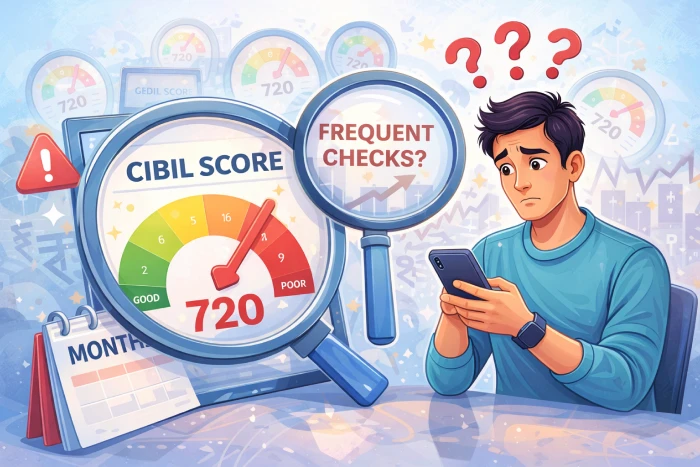
Many borrowers worry that checking their CIBIL score frequently might reduce it. This fear often stops people from monitoring their credit health regularly. The truth is simple and reassuring. Checking your own CIBIL score does not reduce it. In fact, regular monitoring is a smart financial habit. However, confusion arises because of different types of credit inquiries that can impact your score. In this guide, we explain how CIBIL inquiries work, when your score can be affected, and how to manage your credit profile effectively using tools like Saarathi.ai.
Understanding Credit Inquiries
Whenever your credit report is accessed, it is recorded as an inquiry. These inquiries are of two types:
Soft Inquiry
A soft inquiry happens when:
You check your own CIBIL score
A lender checks your profile for pre-approved offers
Background checks are done without a loan application
Impact:
No effect on your credit score
Checking your score through official platforms or apps is completely safe.
Hard Inquiry
A hard inquiry occurs when:
You apply for a loan
You apply for a credit card
A lender evaluates your application
Impact:
Small, temporary drop in your score (usually 5 to 10 points)
At Saarathi.ai, we have observed that multiple hard inquiries within a short time can significantly reduce approval chances.
Why Checking Your CIBIL Score Does Not Reduce It
Your own credit check is considered a soft inquiry because:
It does not indicate borrowing behavior
It is only for awareness
It does not signal risk to lenders
Credit bureaus encourage borrowers to check their scores regularly to stay informed and avoid surprises.
When Your CIBIL Score Actually Gets Affected
Multiple Loan Applications
Applying for loans across different lenders within a short period leads to multiple hard inquiries.
This signals:
Credit hunger
Higher risk
Rejected Applications
Frequent rejections combined with hard inquiries can lower your score further.
High Credit Utilization
Even without inquiries, high usage of credit cards impacts your score.
Missed Payments
Late or missed payments remain the biggest factor affecting your score.
How Often Should You Check Your CIBIL Score
Best practice:
Once every month for active borrowers
Once every 2 to 3 months for general monitoring
Regular checks help you:
Identify errors early
Track improvement
Prepare before applying for loans
You can ask eligibility questions via Saarathi AI expert to understand your readiness before applying.
Smart Way to Apply Without Hurting Your Score
Check Eligibility Before Applying
Instead of applying blindly:
Use AI-based platforms
Get pre-qualified matches
You can compare personal loan offers on Saarathi.ai to reduce unnecessary hard inquiries.
Apply Within a Short Window
If you are rate shopping:
Apply within a short period (usually 14 to 30 days)
Credit bureaus may treat multiple inquiries as one
Avoid Repeated Applications
Do not reapply immediately after rejection.
Wait and improve your profile first.
Benefits of Regular Credit Monitoring
Detect Errors Early
You can spot:
Incorrect late payments
Unknown accounts
Duplicate entries
As per Reserve Bank of India guidelines, you can raise disputes for inaccuracies.
Improve Financial Planning
Knowing your score helps you:
Plan loan applications
Negotiate better interest rates
Choose the right lender
Stay Credit Ready
At Saarathi.ai, we have observed that borrowers who track their credit regularly are more likely to get faster approvals and better loan offers.
How Saarathi.ai Helps You Protect Your Credit Score
AI-Based Eligibility Checks
Understand your chances before applying and avoid unnecessary inquiries.
Smart Lender Matching
Our Recommendation Engine connects you with lenders that fit your profile, reducing rejection risk.
Saarathi Bazaar Dashboard
Track your application in Saarathi Bazaar and manage multiple offers in one place.
Paperless and Transparent Process
Apply digitally with full visibility and faster approvals.
Common Myths About CIBIL Score Checks
Myth 1: Checking your score reduces it
Fact: It does not. It is a soft inquiry.
Myth 2: Every inquiry affects your score
Fact: Only hard inquiries impact your score.
Myth 3: Checking too often is risky
Fact: Frequent self-checks are safe and recommended.
Myth 4: Loan rejection does not affect score
Fact: Rejection itself does not, but the hard inquiry does.
FAQs
Can I check my CIBIL score daily?
Yes, but checking monthly is usually sufficient.
How many hard inquiries are too many?
More than 3 to 4 in a short period can impact your score negatively.
How long do hard inquiries affect my score?
They typically impact your score for a few months and stay on your report for up to 2 years.
Does a pre-approved loan check affect my score?
No, it is usually a soft inquiry.
Is it safe to check scores on multiple platforms?
Yes, as long as they use soft inquiries.
Can Saarathi.ai help me avoid score drops?
Yes, by matching you with the right lenders and reducing unnecessary applications.
Conclusion
Checking your CIBIL score frequently does not reduce it. In fact, it is one of the smartest financial habits you can build. The real impact comes from hard inquiries, missed payments, and high credit utilization.
By understanding how credit inquiries work and using the right tools, you can protect and improve your credit profile.
Discover personalized loan options on Saarathi.ai today and make smarter borrowing decisions without harming your CIBIL score.