Are Indian NBFC Stocks Risky If Global Liquidity Tightens?
|
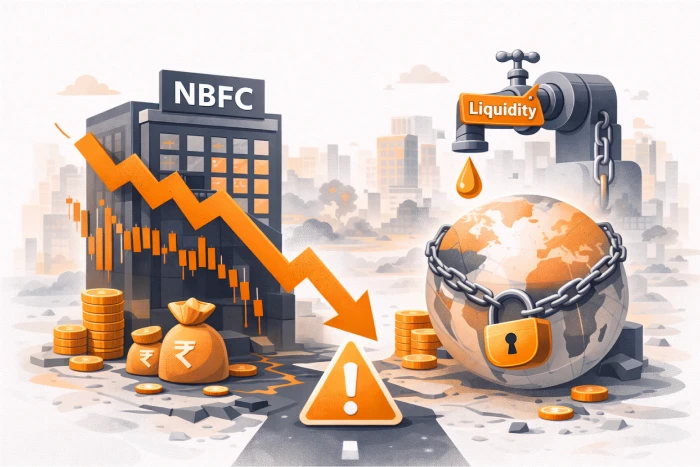
When global liquidity tightens due to US rate hikes, rising bond yields, or geopolitical uncertainty, emerging markets often feel the pressure. For investors, this raises a sharp question: are Indian NBFC stocks risky if global liquidity tightens? Non Banking Financial Companies play a critical role in India’s credit ecosystem, especially in retail loans, MSME finance, and consumer lending. However, they depend significantly on market borrowings. In this article, we examine how global liquidity cycles affect NBFC stocks, what risks investors should monitor, and how it indirectly impacts borrowers in 2026.
What Does Global Liquidity Tightening Mean?
Global liquidity tightens when:
Major central banks raise interest rates
Quantitative tightening reduces money supply
Bond yields rise sharply
Investors pull money from risk assets
When liquidity shrinks, capital becomes more expensive and risk appetite declines.
As frequently reported by Economic Times, rising US Treasury yields often trigger capital outflows from emerging markets.
Why NBFCs Are Sensitive to Liquidity Cycles
Unlike banks, NBFCs do not have large low cost CASA deposit bases. They rely on:
Bank borrowings
Market debt
Bonds and commercial paper
Securitization
If global liquidity tightens:
Bond yields rise
Borrowing costs increase
Refinancing becomes expensive
This directly affects margins.
The Reserve Bank of India regulates NBFCs and monitors liquidity risks, especially for large systemically important entities.
Key Risks for NBFC Stocks
1. Rising Cost of Funds
If NBFCs borrow at higher rates but cannot pass on cost fully to borrowers:
Net interest margins shrink
Profitability declines
Stock valuations compress
2. Asset Quality Stress
During global slowdowns:
MSMEs may face demand contraction
Retail borrowers may face income instability
Unsecured loan delinquencies may rise
If non performing assets increase, NBFC earnings may suffer.
3. Liquidity Risk
Short term refinancing pressure can create stock price volatility, even if long term fundamentals remain intact.
Are All NBFC Stocks Equally Risky?
No.
Risk depends on:
Capital adequacy ratio
Liquidity coverage
Asset quality
Diversification of funding sources
Retail vs corporate loan mix
Rating agencies such as CRISIL regularly assess capital buffers and liquidity strength across NBFCs.
Large diversified NBFCs with strong retail franchises may be more resilient than small concentrated lenders.
RBI’s Role in Managing Systemic Risk
The Reserve Bank of India has strengthened oversight of NBFCs through:
Scale based regulation
Liquidity coverage ratio norms
Stress testing frameworks
Enhanced disclosure requirements
After past liquidity events, regulation has become stricter.
This reduces systemic collapse risk but does not eliminate market volatility.
How Does This Affect Borrowers?
If global liquidity tightens:
1. Loan Interest Rates May Rise
NBFCs may increase lending rates to protect margins.
Borrowers may see:
Higher personal loan rates
Slightly higher business loan pricing
Selective tightening in high risk segments
You can compare personal loan offers on Saarathi.ai to identify lenders offering competitive pricing even in volatile cycles.
2. Stricter Eligibility Norms
NBFCs may:
Increase minimum credit score requirements
Reduce loan amounts
Tighten documentation checks
You can compare home loan offers on Saarathi.ai to evaluate which lenders maintain flexible eligibility standards.
3. Slower Disbursals in Risky Segments
High risk unsecured or microfinance segments may face cautious underwriting.
Investor Perspective: Short Term vs Long Term
Short Term
Stock prices may correct sharply during liquidity tightening
Valuation multiples may compress
Volatility increases
Long Term
If India’s domestic credit growth remains strong:
Quality NBFCs may recover
Retail demand may sustain growth
Digital lending efficiency may improve margins
India’s structural credit penetration remains lower compared to developed markets, offering long term growth potential.
Indicators Investors Should Track
Bond yields movement
RBI repo rate direction
NBFC cost of funds trend
Gross NPA ratios
Liquidity coverage ratios
As covered by Economic Times, funding cost trends often signal earnings pressure early.
Borrower Strategy in Tight Liquidity Phases
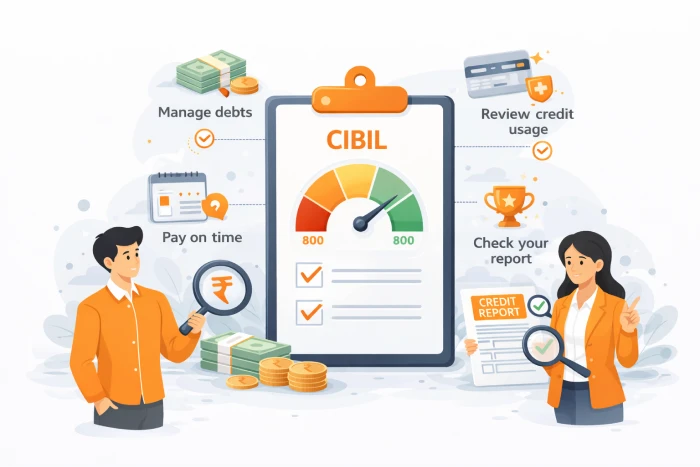
Maintain credit score above 750
Keep EMI below 40 percent of income
Avoid multiple unsecured loans
Compare lenders before applying
You can ask eligibility questions via Saarathi AI expert before formal application to reduce rejection risk.
You can also track your application in Saarathi Bazaar and monitor approvals transparently.
Are NBFC Stocks High Risk in 2026?
They are sensitive to global liquidity cycles, but not uniformly high risk.
Well capitalized NBFCs with diversified retail portfolios and strong governance are better positioned than smaller over leveraged entities.
For borrowers, the bigger concern is not stock prices but funding cost transmission.
FAQs
Do global rate hikes affect NBFC stocks more than banks?
Yes, because NBFCs rely more on market borrowings and are sensitive to bond yield movements.
Will NBFC loan rates increase if liquidity tightens?
Likely yes, especially for unsecured loans.
Is there systemic risk like 2008?
Regulation and capital buffers are stronger today, reducing systemic collapse probability.
Should borrowers avoid NBFC loans?
Not necessarily. Compare rates and eligibility carefully.
How can I secure the best rate during tight liquidity?
Maintain a strong credit profile and compare multiple lenders before finalizing.
Conclusion
Indian NBFC stocks can face volatility if global liquidity tightens, mainly due to higher funding costs and potential asset quality pressure. However, stronger regulation, improved capital buffers, and diversified retail portfolios offer resilience.
For borrowers, liquidity tightening may translate into higher spreads and stricter approvals, but disciplined financial planning and smart comparison can help secure competitive terms.
Discover personalized loan options on Saarathi.ai today and navigate changing liquidity cycles with confidence.