What Is EMI and How Is It Calculated?
|
If you have ever taken a home loan, personal loan, car loan, or business loan, you have probably heard the term EMI. But what exactly is EMI, and how is it calculated?
EMI directly impacts your monthly budget, savings, and financial stability. Even a small difference in interest rate or tenure can significantly change your EMI and total repayment amount.
At Saarathi.ai, we have observed that many borrowers focus only on loan approval and overlook EMI planning. This often leads to financial stress later. In this guide, we explain EMI in simple terms, how it is calculated, and how you can optimize it before applying for a loan.
What Is EMI?
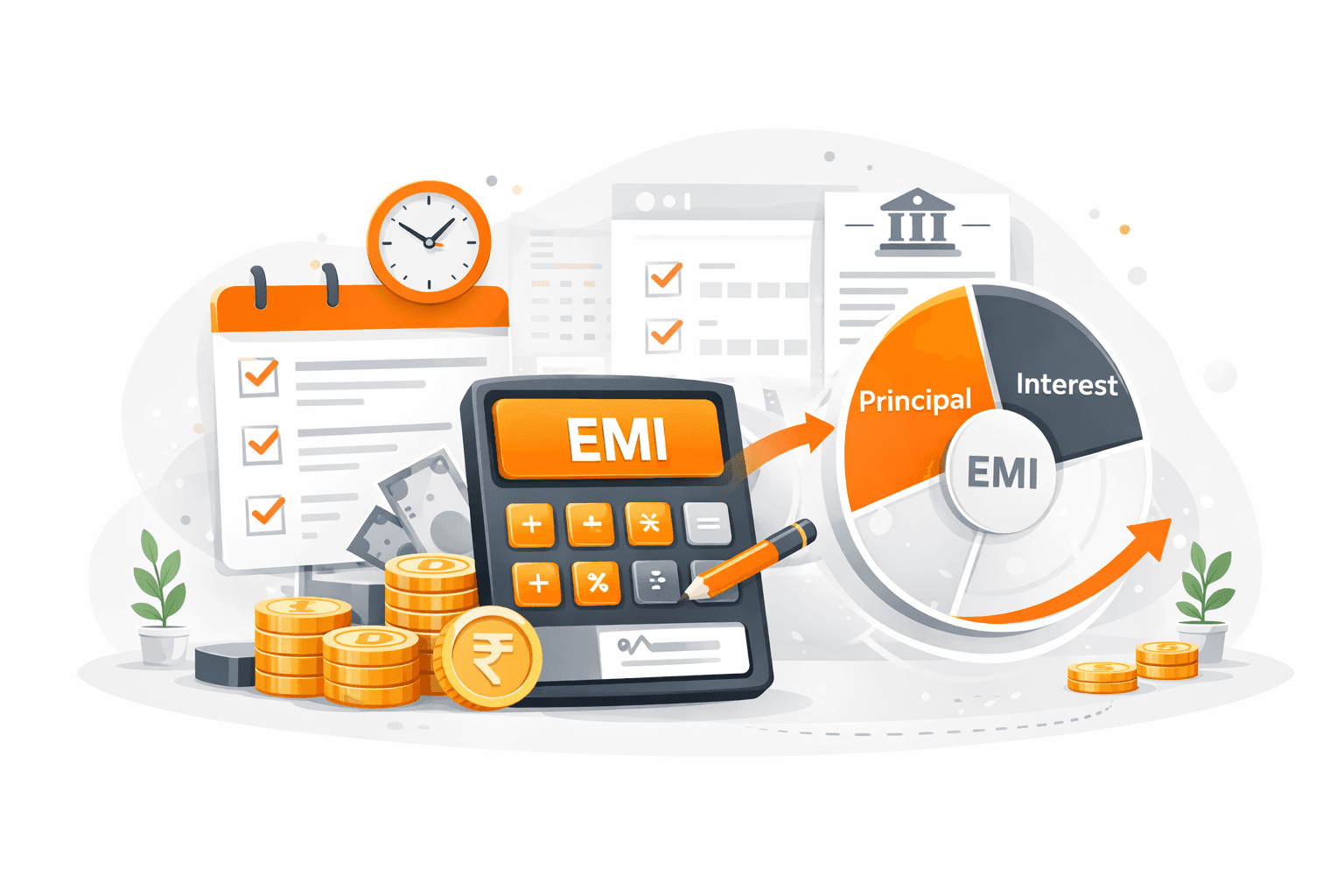
EMI stands for Equated Monthly Instalment. It is the fixed amount you pay every month to repay your loan.
Each EMI consists of two components:
Principal amount - The original loan amount
Interest amount - The cost charged by the lender
Over time, the interest portion reduces while the principal portion increases. This is called amortisation.
Lenders regulated by the Reserve Bank of India follow structured repayment guidelines to ensure transparency in loan contracts.
How Is EMI Calculated?
EMI is calculated using a standard mathematical formula:
EMI = [P x R x (1+R)^N] / [(1+R)^N - 1]
Where:
P = Loan amount
R = Monthly interest rate
N = Loan tenure in months
Do not worry about the formula complexity. What matters is understanding the factors that influence EMI.
Key Factors That Affect Your EMI
1. Loan Amount
Higher loan amount means higher EMI.
Example:
Rs 5 lakh loan will have lower EMI than Rs 10 lakh loan at the same interest rate and tenure.
2. Interest Rate
Even a 0.5 percent difference can impact EMI significantly.
Interest rates depend on:
Credit score
Income profile
Employer category
Existing loans
Lenders assess credit history from TransUnion CIBIL before offering rates.
3. Loan Tenure
Longer tenure reduces monthly EMI but increases total interest paid.
Shorter tenure increases EMI but reduces overall interest cost.
Balancing EMI affordability and total repayment is key.
Example: EMI Calculation in Practice
Let us assume:
Loan Amount: Rs 10 lakh
Interest Rate: 10 percent per year
Tenure: 5 years
Your EMI would be approximately Rs 21,247 per month.
If the tenure increases to 7 years, EMI reduces, but total interest paid increases.
At Saarathi.ai, our AI-based recommendation engine helps borrowers choose the right tenure based on income stability and financial goals.
EMI Breakdown Over Time
In the initial months:
Interest portion is higher
Principal repayment is lower
In later months:
Principal portion increases
Interest reduces
This is why prepaying early in the tenure saves more interest.
Types of EMI Structures in India
1. Fixed Interest EMI
Interest rate remains constant throughout the tenure. EMI stays unchanged.
2. Floating Interest EMI
Interest rate changes based on market conditions.
As per RBI guidelines, many home loans in India are linked to external benchmarks.
3. Step-Up EMI
EMI increases gradually over time. Suitable for salaried individuals expecting salary growth.
4. Pre-EMI
Common in under-construction home loans. You pay only interest until full disbursement.
How to Reduce Your EMI
1. Improve Your Credit Score
A higher credit score can fetch lower interest rates.
Regular monitoring of your credit profile from TransUnion CIBIL helps secure better offers.
2. Increase Loan Tenure
This lowers EMI but increases total interest paid.
3. Make Partial Prepayments
Reducing principal lowers future interest burden.
4. Compare Lenders Before Applying
Interest rates vary across lenders.
Instead of applying blindly, you can compare personal loan offers on Saarathi.ai and view customized EMI options instantly.
EMI vs Total Loan Cost
Many borrowers focus only on EMI affordability.
But remember:
Lower EMI + Longer Tenure = Higher Total Interest
Higher EMI + Shorter Tenure = Lower Total Interest
Financial coverage in The Economic Times often highlights how borrowers underestimate total repayment costs.
Always check the total payable amount before signing.
What Happens If You Miss an EMI?
Missing EMIs can lead to:
Late payment charges
Penalty interest
Lower CIBIL score
Negative impact on future loan approvals
Consistent repayment strengthens your creditworthiness.
How Saarathi.ai Helps You Plan EMIs Smartly
Saarathi.ai is an AI-powered digital lending marketplace connecting borrowers with 110+ banks and NBFCs.
With Saarathi.ai, you can:
View personalised EMI calculations instantly
Get AI-driven recommendations through Saarathi Recommendation Engine
Ask eligibility questions via Saarathi AI expert
Track applications in Saarathi Bazaar dashboard
Experience a 100 percent paperless process
Instead of guessing your EMI, you can make informed decisions backed by AI insights.
Common EMI Mistakes to Avoid
Choosing longest tenure without calculating total interest
Ignoring processing fees
Over-borrowing beyond repayment capacity
Not maintaining emergency savings
Responsible borrowing keeps EMIs stress-free.
FAQs
1. What is a good EMI to income ratio?
Ideally, total EMIs should not exceed 40 to 50 percent of your monthly income.
2. Can EMI change during loan tenure?
Yes, if you have a floating interest rate loan.
3. Is EMI calculated on reducing balance?
Yes. Most loans in India follow reducing balance method.
4. Can I change my EMI amount later?
Some lenders allow restructuring, subject to conditions.
5. Does higher EMI improve credit score?
Not directly. Timely repayment improves your score.
Conclusion
Understanding what EMI is and how it is calculated helps you borrow wisely. Remember:
EMI depends on loan amount, interest rate, and tenure
Lower EMI may mean higher total interest
Improving credit score can reduce EMI burden
Strategic comparison saves money
Before applying, calculate carefully and choose smartly.
Discover personalized loan options on Saarathi.ai today and plan your EMIs with AI-powered precision.