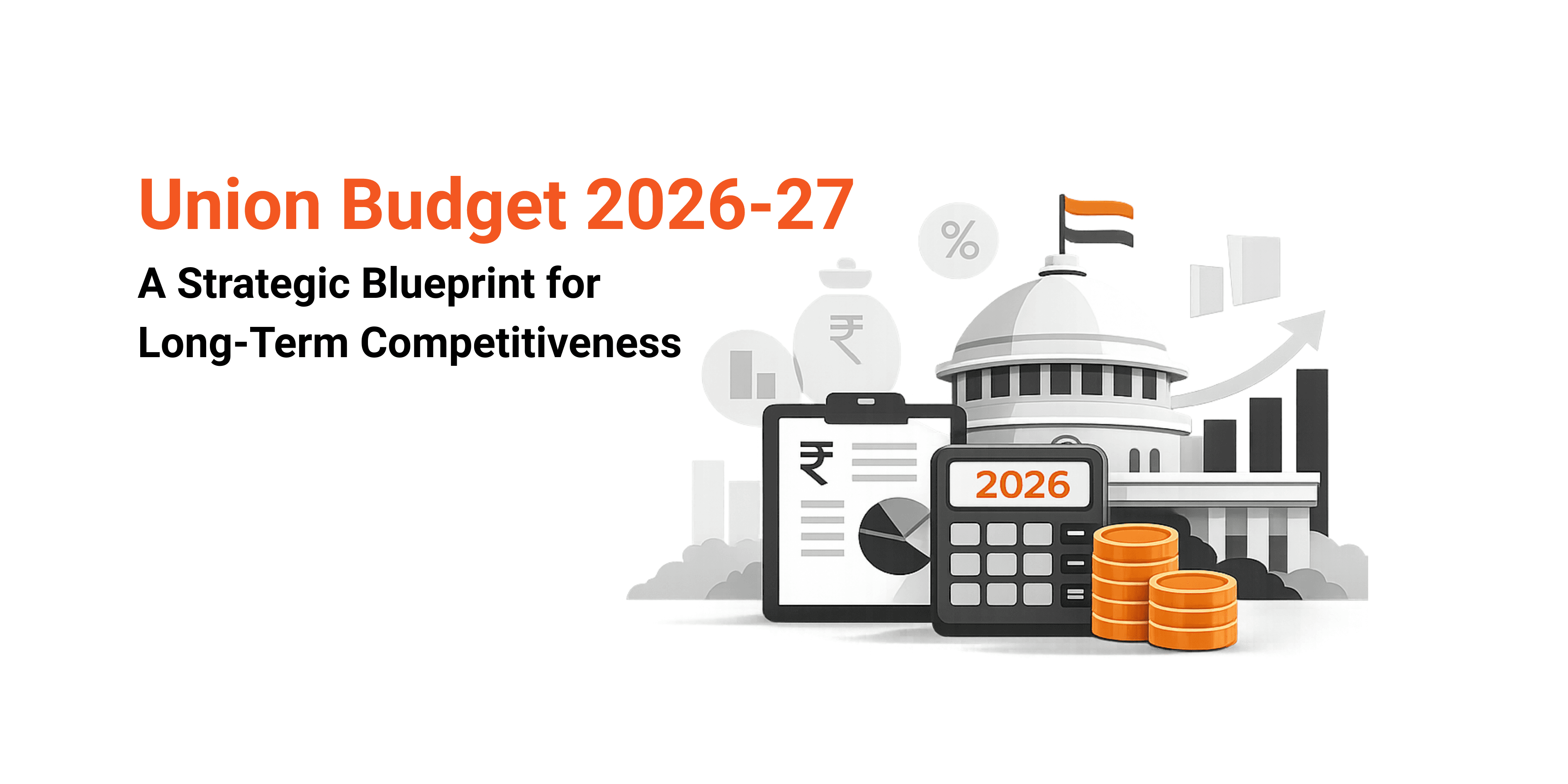
Union Budget 2026-27: A Strategic Long-Term Blueprint
Ravi Choudhary
Ravi Choudhary
|
Feb 2, 2026
Feb 2, 2026
Presented on 1 February 2026 by the Finance Minister, the Union Budget 2026-27 continues the government’s gradual transition toward investment-led growth while maintaining fiscal discipline and facilitating structural reforms. It reframes India’s economic narrative around capital expansion, capability building, and financial stability, even as it navigates an increasingly complex global landscape.
This analysis synthesises the official budget data with real-time market reactions and offers insights designed for stakeholders in business, finance, agriculture, and regional economies.
1. Macroeconomic Architecture: Balancing Growth and Fiscal Prudence
The Budget assumes a nominal GDP growth of around 10 percent and real growth of roughly 6.8 – 7.2 percent in 2026-27. This reflects confidence in strong underlying demand despite global headwinds. According to the budget estimates:
Total expenditure is set at ₹53.5 lakh crore.
Capital expenditure is increased to ₹12.2 lakh crore, the highest in at least a decade, at around 4.4 percent of GDP.
Fiscal deficit is reduced slightly to 4.3 percent of GDP.
Debt-to-GDP ratio is projected to fall to 55.6 percent, down from the previous year.
While the announced capital expenditure of ₹12.2 lakh crore reinforces the government’s commitment to infrastructure-led growth, the more consequential variable is execution.
In recent years, actual capex utilisation has often been back-loaded toward the second half of the fiscal year, with variations across ministries and states. Land acquisition delays, state-level fiscal constraints, and capacity limitations among executing agencies continue to pose challenges.
As a result, the effectiveness of the capex push will depend less on budgeted allocations and more on project readiness, inter-governmental coordination, and speed of disbursement. Markets are likely to track quarterly spending data closely to assess whether the announced outlay translates into on-ground activity.
This mix of higher public investment with a marginally lower fiscal gap indicates a shift from pure stabilisation to strategic fiscal expansion, suggesting that India is accepting a modest deficit to catalyse growth without compromising long-term financial health.
2. Tax Policy: Continuity With Targeted Market Signals
A defining feature of Budget 2026–27 is tax continuity rather than tax expansion. Personal income tax slabs and headline rates remain unchanged, signalling policy stability at a time when fiscal headroom is constrained by high capital expenditure commitments and global uncertainty.
From a fiscal standpoint, any further broad-based tax rationalisation was not realistically feasible in this Budget cycle. With capital expenditure at record levels and the fiscal deficit already finely balanced, meaningful rate cuts or slab expansions would have risked either widening the deficit or diluting the investment-led growth strategy.
Instead, the government has chosen a calibrated approach to preserve revenue predictability, improve compliance efficiency, and send selective policy signals without undermining the tax base.
A key example is the increase in Securities Transaction Tax on derivatives, which aims to curb excessive speculative activity while enhancing revenue buoyancy without impacting the wider taxpayer base.
Looking ahead, the direction of tax policy over the next few Budgets is likely to shift from rationalisation to consolidation. Rather than introducing fresh rate changes, the government is expected to gradually harmonise and consolidate the old and new tax regimes, reduce duplication and complexity across exemptions and deductions, and encourage voluntary migration toward a simpler, lower-litigation framework.
In effect, Budget 2026 suggests that the era of frequent slab tinkering is ending, and the focus is moving toward structural simplification, administrative efficiency, and regime convergence.
This approach aligns with the government’s broader fiscal philosophy: protect the revenue base today, simplify the system tomorrow, and fund growth through investment rather than tax giveaways.
3. Sector Priorities: Where Money Is Being Directed
Infrastructure, Logistics and Connectivity
The significant increase in capital spending is intended to drive infrastructure-led growth. Roads, freight corridors, waterways and port networks received renewed focus, and related stocks such as L&T and Adani Ports reacted positively with gains.
This sustained investment not only creates jobs but also reduces transaction costs across industries and geographic corridors.
Manufacturing and Strategic Value Chains
The Budget increases support for manufacturing sectors, including semiconductors, rare minerals, and advanced technology production. The emphasis on scaling up manufacturing beyond low-value segments signals a push toward complex production ecosystems.
Technology, MSMEs, and Human Capital
Budget allocations include incentives for digital infrastructure, small business growth funds, and vocational expansion. This aligns with the government’s aim to spur innovation and deepen skill penetration, especially in semi-urban and rural regions.
4. Targeted Incentives: Tax Holidays and MSME Capital Support
Alongside tax stability for individuals, the Budget deploys targeted incentives rather than broad giveaways. These include tax holidays for select strategic sectors and a ₹10,000 crore growth fund for MSMEs.
The design choice is deliberate. Instead of diffusing fiscal resources across the economy, the government has chosen to concentrate incentives where employment creation and formalisation multipliers are highest. MSMEs account for a disproportionate share of jobs and credit demand, yet remain capital-constrained. Equity-linked and growth-oriented funding can help bridge this structural gap more effectively than incremental interest subventions.
However, the real impact of these measures will depend on the speed of deployment, eligibility clarity, and last-mile access. Historically, similar funds have faced delays due to risk aversion and procedural bottlenecks. Execution, not allocation, will determine outcomes.
5. Market Reaction: Short-Term Shock, Long-Term Realignment
Budget day saw sharp volatility in Indian markets, which is worth understanding from both economic and behavioural perspectives.
Initial Downturn
The markets experienced one of the largest intra-day Budget day slips in recent years:
Benchmark indices dropped nearly 1.8 – 2 percent after the STT hike on derivatives triggered fears of lower liquidity and higher trading costs.
Brokers and exchange stocks saw reinforced sell-offs as their business models are partly driven by high-volume trading.
The lack of specific foreign investor incentives also contributed to risk-off sentiment.
Rebound and Sector Rotation
Following the shock, markets began to stabilise and rally back:
Infrastructure and heavy industry stocks led the rebound, reflecting renewed focus on tangible growth drivers.
Commentary from analysts suggested that investors began to separate short-term tax noise from longer-term growth signals, leading to renewed confidence.
The overall pattern illustrates a classic market reaction where short-term policy changes trigger volatility, but fundamentals reassert themselves once initial uncertainty subsides.
6. What Makes This Budget Strategic
Going beyond headlines, here are analytical insights into how Budget 2026 reshapes the economic landscape:
A. Capital Investment as a Structural Growth Lever
The sustained and higher share of public capex, now consistently above 4 percent of GDP, is a deliberate shift toward physical capital accumulation, not just cyclical stimulus. This can boost long-run productivity if executed efficiently.
B. Market Discipline and Speculation Control
The STT hike is a bold market-discipline move that targets speculative derivatives trading without broad tax changes. It aims to reduce excess short-term trading and push capital towards real economy participation.
C. Fiscal Trajectory in a Global Context
Even as India increases spending, it also sets a declining debt path target to around 50 percent of GDP by 2031. This signals to credit rating agencies and global investors that fiscal expansion is strategic and time-bound.
D. Regional and Sectoral Spread
Allocations for transport connectivity, MSMEs, and digital infrastructure suggest an intent to reduce inter-regional disparities and integrate economies like Haryana’s rural and manufacturing sectors into broader supply chains.
7. What This Means for Different Stakeholders
Households and Wage Earners
Stable personal taxes provide planning clarity. Indirect measures, like better infrastructure, can reduce living costs over time.
Agriculture and Rural Economies
Although MSP and income support mechanisms were not radically changed, technology tools and rural infrastructure upgrades strengthen productivity and access.
Small Businesses
MSME funds and compliance simplifications could lower cost barriers and broaden access to capital.
Investors and Markets
Short-term volatility highlights the importance of factoring policy risks into trading strategies. Longer-term gains are likely tied to sectors with direct linkage to capex.
8. Conclusion: Budget 2026 as a Growth-Economy Blueprint
The Union Budget 2026-27 is more than a fiscal statement; it is a strategic document aimed at expanding India’s growth frontier while maintaining financial discipline. Its emphasis on capital allocation, infrastructure, sectoral capability building, and measured market signals positions the economy for resilient long-term expansion.
The mixed but eventually stabilising market reaction underscores investors’ need to distinguish between short-term cost signals and medium-term fundamentals. For businesses, entrepreneurs, and regional stakeholders alike, the Budget provides a roadmap anchored in growth with responsibility.
Presented on 1 February 2026 by the Finance Minister, the Union Budget 2026-27 continues the government’s gradual transition toward investment-led growth while maintaining fiscal discipline and facilitating structural reforms. It reframes India’s economic narrative around capital expansion, capability building, and financial stability, even as it navigates an increasingly complex global landscape.
This analysis synthesises the official budget data with real-time market reactions and offers insights designed for stakeholders in business, finance, agriculture, and regional economies.
1. Macroeconomic Architecture: Balancing Growth and Fiscal Prudence
The Budget assumes a nominal GDP growth of around 10 percent and real growth of roughly 6.8 – 7.2 percent in 2026-27. This reflects confidence in strong underlying demand despite global headwinds. According to the budget estimates:
Total expenditure is set at ₹53.5 lakh crore.
Capital expenditure is increased to ₹12.2 lakh crore, the highest in at least a decade, at around 4.4 percent of GDP.
Fiscal deficit is reduced slightly to 4.3 percent of GDP.
Debt-to-GDP ratio is projected to fall to 55.6 percent, down from the previous year.
While the announced capital expenditure of ₹12.2 lakh crore reinforces the government’s commitment to infrastructure-led growth, the more consequential variable is execution.
In recent years, actual capex utilisation has often been back-loaded toward the second half of the fiscal year, with variations across ministries and states. Land acquisition delays, state-level fiscal constraints, and capacity limitations among executing agencies continue to pose challenges.
As a result, the effectiveness of the capex push will depend less on budgeted allocations and more on project readiness, inter-governmental coordination, and speed of disbursement. Markets are likely to track quarterly spending data closely to assess whether the announced outlay translates into on-ground activity.
This mix of higher public investment with a marginally lower fiscal gap indicates a shift from pure stabilisation to strategic fiscal expansion, suggesting that India is accepting a modest deficit to catalyse growth without compromising long-term financial health.
2. Tax Policy: Continuity With Targeted Market Signals
A defining feature of Budget 2026–27 is tax continuity rather than tax expansion. Personal income tax slabs and headline rates remain unchanged, signalling policy stability at a time when fiscal headroom is constrained by high capital expenditure commitments and global uncertainty.
From a fiscal standpoint, any further broad-based tax rationalisation was not realistically feasible in this Budget cycle. With capital expenditure at record levels and the fiscal deficit already finely balanced, meaningful rate cuts or slab expansions would have risked either widening the deficit or diluting the investment-led growth strategy.
Instead, the government has chosen a calibrated approach to preserve revenue predictability, improve compliance efficiency, and send selective policy signals without undermining the tax base.
A key example is the increase in Securities Transaction Tax on derivatives, which aims to curb excessive speculative activity while enhancing revenue buoyancy without impacting the wider taxpayer base.
Looking ahead, the direction of tax policy over the next few Budgets is likely to shift from rationalisation to consolidation. Rather than introducing fresh rate changes, the government is expected to gradually harmonise and consolidate the old and new tax regimes, reduce duplication and complexity across exemptions and deductions, and encourage voluntary migration toward a simpler, lower-litigation framework.
In effect, Budget 2026 suggests that the era of frequent slab tinkering is ending, and the focus is moving toward structural simplification, administrative efficiency, and regime convergence.
This approach aligns with the government’s broader fiscal philosophy: protect the revenue base today, simplify the system tomorrow, and fund growth through investment rather than tax giveaways.
3. Sector Priorities: Where Money Is Being Directed
Infrastructure, Logistics and Connectivity
The significant increase in capital spending is intended to drive infrastructure-led growth. Roads, freight corridors, waterways and port networks received renewed focus, and related stocks such as L&T and Adani Ports reacted positively with gains.
This sustained investment not only creates jobs but also reduces transaction costs across industries and geographic corridors.
Manufacturing and Strategic Value Chains
The Budget increases support for manufacturing sectors, including semiconductors, rare minerals, and advanced technology production. The emphasis on scaling up manufacturing beyond low-value segments signals a push toward complex production ecosystems.
Technology, MSMEs, and Human Capital
Budget allocations include incentives for digital infrastructure, small business growth funds, and vocational expansion. This aligns with the government’s aim to spur innovation and deepen skill penetration, especially in semi-urban and rural regions.
4. Targeted Incentives: Tax Holidays and MSME Capital Support
Alongside tax stability for individuals, the Budget deploys targeted incentives rather than broad giveaways. These include tax holidays for select strategic sectors and a ₹10,000 crore growth fund for MSMEs.
The design choice is deliberate. Instead of diffusing fiscal resources across the economy, the government has chosen to concentrate incentives where employment creation and formalisation multipliers are highest. MSMEs account for a disproportionate share of jobs and credit demand, yet remain capital-constrained. Equity-linked and growth-oriented funding can help bridge this structural gap more effectively than incremental interest subventions.
However, the real impact of these measures will depend on the speed of deployment, eligibility clarity, and last-mile access. Historically, similar funds have faced delays due to risk aversion and procedural bottlenecks. Execution, not allocation, will determine outcomes.
5. Market Reaction: Short-Term Shock, Long-Term Realignment
Budget day saw sharp volatility in Indian markets, which is worth understanding from both economic and behavioural perspectives.
Initial Downturn
The markets experienced one of the largest intra-day Budget day slips in recent years:
Benchmark indices dropped nearly 1.8 – 2 percent after the STT hike on derivatives triggered fears of lower liquidity and higher trading costs.
Brokers and exchange stocks saw reinforced sell-offs as their business models are partly driven by high-volume trading.
The lack of specific foreign investor incentives also contributed to risk-off sentiment.
Rebound and Sector Rotation
Following the shock, markets began to stabilise and rally back:
Infrastructure and heavy industry stocks led the rebound, reflecting renewed focus on tangible growth drivers.
Commentary from analysts suggested that investors began to separate short-term tax noise from longer-term growth signals, leading to renewed confidence.
The overall pattern illustrates a classic market reaction where short-term policy changes trigger volatility, but fundamentals reassert themselves once initial uncertainty subsides.
6. What Makes This Budget Strategic
Going beyond headlines, here are analytical insights into how Budget 2026 reshapes the economic landscape:
A. Capital Investment as a Structural Growth Lever
The sustained and higher share of public capex, now consistently above 4 percent of GDP, is a deliberate shift toward physical capital accumulation, not just cyclical stimulus. This can boost long-run productivity if executed efficiently.
B. Market Discipline and Speculation Control
The STT hike is a bold market-discipline move that targets speculative derivatives trading without broad tax changes. It aims to reduce excess short-term trading and push capital towards real economy participation.
C. Fiscal Trajectory in a Global Context
Even as India increases spending, it also sets a declining debt path target to around 50 percent of GDP by 2031. This signals to credit rating agencies and global investors that fiscal expansion is strategic and time-bound.
D. Regional and Sectoral Spread
Allocations for transport connectivity, MSMEs, and digital infrastructure suggest an intent to reduce inter-regional disparities and integrate economies like Haryana’s rural and manufacturing sectors into broader supply chains.
7. What This Means for Different Stakeholders
Households and Wage Earners
Stable personal taxes provide planning clarity. Indirect measures, like better infrastructure, can reduce living costs over time.
Agriculture and Rural Economies
Although MSP and income support mechanisms were not radically changed, technology tools and rural infrastructure upgrades strengthen productivity and access.
Small Businesses
MSME funds and compliance simplifications could lower cost barriers and broaden access to capital.
Investors and Markets
Short-term volatility highlights the importance of factoring policy risks into trading strategies. Longer-term gains are likely tied to sectors with direct linkage to capex.
8. Conclusion: Budget 2026 as a Growth-Economy Blueprint
The Union Budget 2026-27 is more than a fiscal statement; it is a strategic document aimed at expanding India’s growth frontier while maintaining financial discipline. Its emphasis on capital allocation, infrastructure, sectoral capability building, and measured market signals positions the economy for resilient long-term expansion.
The mixed but eventually stabilising market reaction underscores investors’ need to distinguish between short-term cost signals and medium-term fundamentals. For businesses, entrepreneurs, and regional stakeholders alike, the Budget provides a roadmap anchored in growth with responsibility.
Discover the
Best Bank Loan Offer
Discover the
Best Bank Loan Offer
Say goodbye to endless bank visits and uncertainty!
With our smart loan matchmaking, you can instantly discover the right lenders and compare multiple offers - quickly and seamlessly. Built with 300+years of combined industry experience, our platform ensures efficiency, accuracy, and higher conversions.
Experience the future of lending.
Say goodbye to endless bank visits and uncertainty!
With our smart loan matchmaking, you can instantly discover the right lenders and compare multiple offers - quickly and seamlessly. Built with 300+years of combined industry experience, our platform ensures efficiency, accuracy, and higher conversions.
Experience the future of lending.
Download the Saarathi Bazaar App
Download the Saarathi Bazaar App