What is a CIBIL Score and Why Is It Important?
|
Your CIBIL Score is one of the most important numbers in your financial life. Whether you are applying for a personal loan, home loan, business loan, or even a credit card, lenders first check this three-digit score before approving your application. In simple terms, a CIBIL Score shows how responsibly you have handled credit in the past.
At Saarathi.ai, we have observed that borrowers with higher credit scores not only get faster approvals but also enjoy lower interest rates and better loan terms. In today’s AI-driven digital lending ecosystem, your CIBIL Score can be the difference between instant approval and rejection. Let us understand what it means and why it is so important in India.
What Is a CIBIL Score?
A CIBIL Score is a three-digit numeric summary of your credit history, ranging from 300 to 900. It is issued by TransUnion CIBIL, India’s first and leading credit information company.
The higher your score, the better your creditworthiness.
Here is a quick breakdown:
750 - 900: Excellent - High approval chances
700 - 749: Good - Most loans approved
650 - 699: Fair - Limited lender options
Below 650: Risky - High rejection probability
Your CIBIL Score is calculated based on data shared by banks and NBFCs with credit bureaus.
How Is CIBIL Score Calculated?
According to guidelines from the Reserve Bank of India, lenders must report credit data regularly to credit bureaus. Your score is then calculated using the following factors:
1. Payment History - 35% Weightage
This is the most important factor. Late EMIs or missed credit card payments can reduce your score significantly.
2. Credit Utilisation Ratio - 30%
If you use more than 30% to 40% of your credit limit regularly, lenders may see you as credit-hungry.
3. Credit Mix - 10%
A healthy mix of secured loans such as home loans and unsecured loans such as personal loans improves your profile.
4. Credit History Length - 15%
Older credit accounts with good repayment records strengthen your score.
5. New Credit Enquiries - 10%
Too many loan applications in a short period can reduce your score.
At Saarathi.ai, our AI-powered eligibility check helps you avoid unnecessary hard enquiries that may impact your credit score.
Why Is CIBIL Score Important?
1. Faster Loan Approvals
Banks and NBFCs rely heavily on your credit score to make instant decisions. With AI-based underwriting becoming common in India, a strong score often leads to near-instant approvals.
You can compare personal loan offers on Saarathi.ai to see options matched to your credit profile without affecting your score.
2. Lower Interest Rates
A difference of even 50 to 100 points in your CIBIL Score can reduce your interest rate significantly. Over a long tenure, this can save lakhs in interest.
For example:
9.5% vs 11% on a Rs 20 lakh home loan for 20 years can create a huge EMI difference.
3. Higher Loan Amount Eligibility
Lenders feel more confident approving higher loan amounts when your repayment history is strong.
Using the ask eligibility questions via Saarathi AI feature, you can understand how much loan you qualify for before applying.
4. Better Negotiation Power
Borrowers with 800+ scores often get:
Processing fee waivers
Pre-approved offers
Flexible repayment options
5. Approval for Credit Cards and Overdrafts
Your CIBIL Score impacts more than loans. It also affects:
Credit card approvals
Loan against property
Business credit lines
According to financial coverage in The Economic Times, lenders are increasingly tightening underwriting norms, making credit scores even more critical in 2026.
Minimum CIBIL Score Required for Different Loans
Loan Type | Ideal CIBIL Score | Notes |
Personal Loan | 750+ | Unsecured, higher risk |
Home Loan | 700+ | Secured, longer tenure |
Business Loan | 700+ | Income stability matters |
Loan Against Property | 650+ | Backed by collateral |
You can track your application in Saarathi Bazaar to see real-time lender responses after applying.
What Happens If Your CIBIL Score Is Low?
A low score does not mean you will never get a loan. However, you may face:
Higher interest rates
Lower approved amounts
Additional documentation
Guarantor requirement
At Saarathi.ai, we have helped many borrowers secure approvals even with moderate credit scores by matching them with suitable lenders from our network of 110+ banks and NBFCs.
How to Improve Your CIBIL Score Quickly
Improving your score requires discipline and strategy.
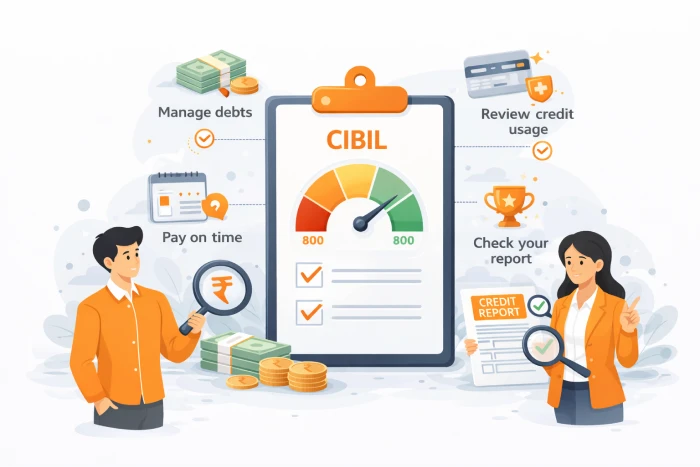
1. Pay EMIs and Credit Cards on Time
Set auto-debit reminders.
2. Reduce Credit Utilisation
Keep usage below 30% of your limit.
3. Avoid Multiple Loan Applications
Use platforms like Saarathi.ai to compare loan options before submitting applications.
4. Check Your Credit Report for Errors
Dispute inaccuracies immediately.
5. Maintain Old Accounts
Do not close your oldest credit card unless necessary.
Difference Between CIBIL Score and Credit Report
Many people confuse the two.
CIBIL Score: 3-digit summary number
Credit Report: Detailed history of all loans, EMIs, credit cards, and enquiries
Both are generated by TransUnion CIBIL, but lenders primarily look at the score first.
How Saarathi.ai Helps You Leverage Your CIBIL Score
In today’s digital lending landscape, transparency and speed matter. Saarathi.ai bridges the gap between borrowers and 110+ lenders using AI-driven intelligence.
With Saarathi.ai, you can:
Compare multiple loan offers in one place
Get AI-based recommendations via Saarathi Recommendation Engine
Ask instant eligibility questions through Saarathi AI expert
Track real-time status on Saarathi Bazaar dashboard
Experience a 100% paperless journey
Instead of applying blindly to multiple banks and harming your score, you can discover personalised loan matches based on your profile.
Common Myths About CIBIL Score
Myth 1: Checking My Score Reduces It
Fact: Self-checks are soft enquiries and do not affect your score.
Myth 2: Salary Alone Determines Approval
Fact: Even high-income individuals get rejected with poor credit history.
Myth 3: Closing a Loan Immediately Improves Score
Fact: Long, consistent repayment history builds stronger creditworthiness.
FAQs
1. What is a good CIBIL Score in India?
A score above 750 is generally considered good for most loans.
2. How often is CIBIL Score updated?
It is updated monthly when lenders report your repayment data.
3. Can I get a personal loan with 650 CIBIL Score?
Yes, but interest rates may be higher. Comparing lenders on Saarathi.ai improves your chances.
4. Does checking CIBIL Score reduce points?
No, checking your own score does not impact it.
5. How long does it take to improve CIBIL Score?
With disciplined repayments, noticeable improvements can occur within 3 to 6 months.
Conclusion
Your CIBIL Score is the foundation of your financial credibility in India. A strong score gives you:
Faster approvals
Lower interest rates
Higher loan eligibility
Better financial flexibility
Instead of guessing your chances, take control of your borrowing journey. Discover personalized loan options on Saarathi.ai today and unlock smarter, AI-powered approvals.