ITR Filing Mistakes That Can Hurt Your Loan Approval in 2026
|
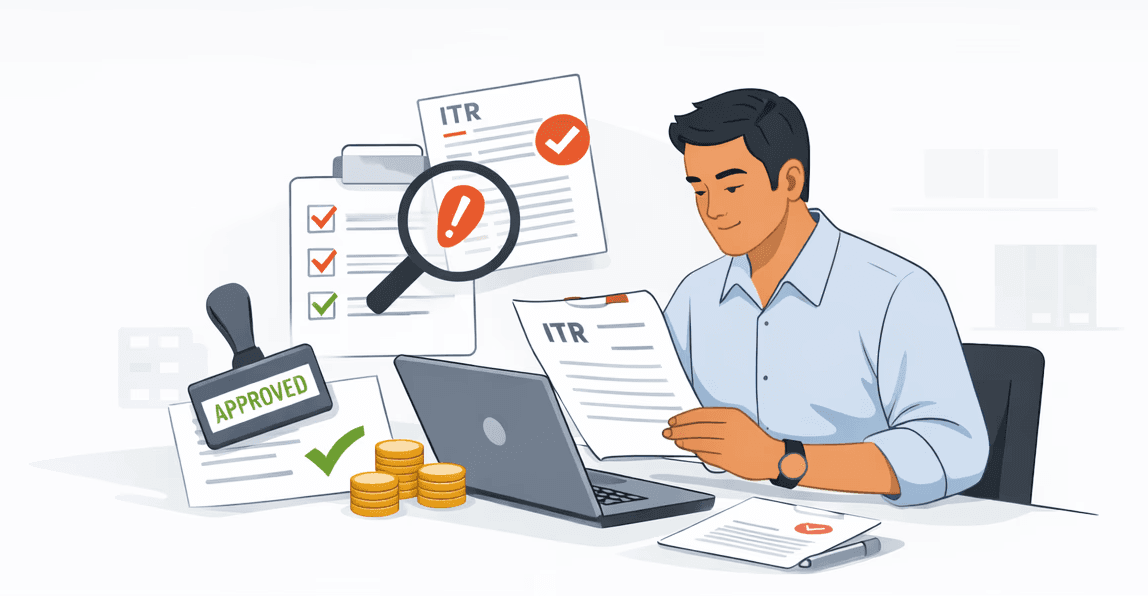
If you are planning to apply for a home loan, personal loan, or business loan in 2026, your Income Tax Return (ITR) can directly impact your approval chances. Many borrowers believe filing ITR is just a compliance formality. But lenders see it as proof of income stability, financial discipline, and repayment capacity.
At Saarathi.ai, we have observed that several loan rejections happen not because of low income, but because of ITR filing mistakes, inconsistencies, or under-reporting. Even small errors can reduce your eligible loan amount or delay approvals.
In this guide, we explain the most common ITR filing mistakes that can hurt your loan approval in 2026 and how to avoid them.
Why ITR Matters for Loan Approval in 2026
In 2026, lenders are stricter due to updated risk norms and tighter underwriting processes. As per guidelines and supervision from Reserve Bank of India, banks and NBFCs must carefully assess borrower risk, especially for unsecured loans.
Your ITR helps lenders:
Verify declared income
Assess income consistency over years
Calculate FOIR (Fixed Obligation to Income Ratio)
Evaluate tax compliance behavior
Cross-check bank statements and GST data
If your ITR has errors, mismatches, or red flags, lenders may:
Reduce your eligible loan amount
Increase interest rate
Delay approval
Reject your application
This is especially critical for self-employed professionals, freelancers, MSME owners, and consultants.
1. Under-Reporting Income to Save Tax
This is the most common mistake.
Many applicants show lower income to reduce tax liability. While this may save tax in the short term, it significantly reduces your loan eligibility.
How it hurts you:
Lower declared income = Lower eligible loan amount
Banks calculate EMI capacity based on net taxable income
You may qualify for much less than expected
Example:
If your actual annual income is Rs 12 lakh but you declare Rs 7 lakh, lenders will only consider Rs 7 lakh while calculating eligibility.
At Saarathi.ai, we often see borrowers surprised when they receive a lower sanction amount. The reason is usually under-reported income in ITR.
2. Mismatch Between ITR and Bank Statements
Lenders cross-check:
ITR income
Form 26AS
AIS
Bank deposits
If your bank statements show higher cash deposits than declared income, it creates suspicion.
Red flags lenders notice:
Large unexplained deposits
High cash transactions
Business turnover mismatch
GST vs ITR inconsistencies
Such mismatches can trigger additional verification or rejection.
3. Filing ITR Late or Missing Multiple Years
For self-employed borrowers, lenders usually require:
Last 2 to 3 years of ITR
Consistent income growth
If you:
Filed ITR late
Skipped one financial year
Filed returns only before applying for loan
It signals financial instability.
Many lenders view last-minute filing before loan application as risk behavior.
4. Frequent Revised Returns Without Clear Justification
Revising ITR is allowed. However, frequent revisions close to a loan application may raise concerns.
Lenders may ask:
Why was income revised?
Was earlier filing incorrect?
Is income being inflated for eligibility?
Unclear revisions may delay approval.
5. Showing Losses or Extremely Low Profit (Self-Employed)
Business owners sometimes declare:
High expenses
Depreciation-heavy books
Minimal net profit
While this reduces tax, lenders evaluate net profit as repayment capacity.
If your ITR shows:
Low profit margin
Consecutive losses
Sharp profit decline
Your loan may be reduced or rejected.
6. Incorrect ITR Form Selection
Using the wrong ITR form can create classification issues.
For example:
Salaried filing ITR-3 instead of ITR-1
Business income not properly disclosed
This may not directly cause rejection, but it can delay underwriting and increase scrutiny.
7. Not Declaring Existing Loans
Your ITR should align with:
Existing EMIs
Interest paid
Loan deductions
If lenders find obligations through credit bureau that are not reflected properly, your credibility drops.
Credit bureaus like TransUnion CIBIL provide detailed obligation history to lenders. Any mismatch can raise questions.
8. Ignoring AIS and Form 26AS Reconciliation
The Annual Information Statement tracks:
Interest income
Securities transactions
High-value transactions
If your ITR does not reconcile with AIS or Form 26AS, lenders may assume incomplete disclosure.
This can lead to:
Extended verification
Additional document requests
Processing delays
9. Switching Tax Regime Without Understanding Impact
With the new tax regime updates in recent Budgets, many taxpayers switch regimes without evaluating implications.
Switching regimes can:
Change your declared deductions
Affect net taxable income
Impact loan eligibility calculations
Always understand how regime changes affect loan affordability assessment.
10. Filing ITR Only for Loan Purpose
Some borrowers file 2 to 3 years of backdated ITR just before applying.
Banks can detect:
Fresh filings
Low tax payment history
Sudden income spikes
This may appear as an attempt to artificially boost eligibility.
Consistency matters more than sudden improvement.
How to File ITR Smartly If You Plan to Take a Loan in 2026
Here’s what we recommend at Saarathi.ai:
Maintain consistent income declaration
Avoid unnecessary income suppression
Reconcile AIS, GST, and bank statements
Keep 2 to 3 years of clean filing history
Plan tax strategy with loan eligibility in mind
If you are unsure how your ITR affects eligibility, you can:
Compare loan options instantly on Saarathi.ai
Use the Saarathi AI expert to check eligibility doubts
Track multiple offers transparently in Saarathi Bazaar dashboard
This helps you avoid rejection before formally applying.
How Saarathi.ai Helps You Avoid ITR-Related Loan Rejections
Many borrowers apply blindly and face rejection. Rejection affects credit score and future approval chances.
Saarathi.ai connects you with 110+ lenders and uses its AI-driven recommendation engine to:
Match you with lenders suited to your income profile
Identify documentation gaps early
Reduce unnecessary credit inquiries
Improve approval probability
Instead of applying everywhere, you apply smarter.
FAQs
1. How many years of ITR are required for a home loan?
Most lenders require 2 to 3 years of ITR for self-employed applicants. Salaried individuals usually provide Form 16 and recent ITR.
2. Can low declared income reduce my loan amount?
Yes. Loan eligibility is calculated based on declared taxable income.
3. Does late ITR filing affect loan approval?
It can, especially if multiple years are filed late or only before applying for a loan.
4. Can I revise ITR to increase loan eligibility?
You can revise within allowed timelines, but frequent or suspicious revisions may delay approval.
5. Is ITR required for personal loans?
For salaried individuals, it may not always be mandatory. For self-employed applicants, it is usually required.
Conclusion
Your ITR is not just a tax document. It is your financial credibility report.
Before applying for a loan in 2026, remember:
Under-reporting income reduces eligibility
Mismatch creates red flags
Consistency improves approval chances
Clean tax history builds lender confidence
If you are planning a loan, don’t leave approval to chance.
Discover personalized loan options on Saarathi.ai today and check your eligibility without impacting your credit score.