How Do Banks Decide Loan Eligibility?
|
Ever wondered why one person gets instant loan approval while another faces rejection, even with a similar salary? The answer lies in loan eligibility assessment.
Banks and NBFCs follow structured risk evaluation models before approving personal loans, home loans, or business loans. They assess your income, credit score, existing EMIs, job stability, and more.
At Saarathi.ai, we have observed that many borrowers assume eligibility depends only on salary. In reality, lenders evaluate multiple factors to determine your repayment capacity and creditworthiness. In this guide, we break down exactly how banks decide loan eligibility in India.
What Is Loan Eligibility?
Loan eligibility refers to the maximum loan amount and terms a lender is willing to offer you based on your financial profile.
Lenders regulated by the Reserve Bank of India must follow responsible lending guidelines and assess repayment capacity carefully.
Eligibility determines:
Loan amount approved
Interest rate offered
Loan tenure
Need for guarantor or collateral
Key Factors Banks Use to Decide Loan Eligibility
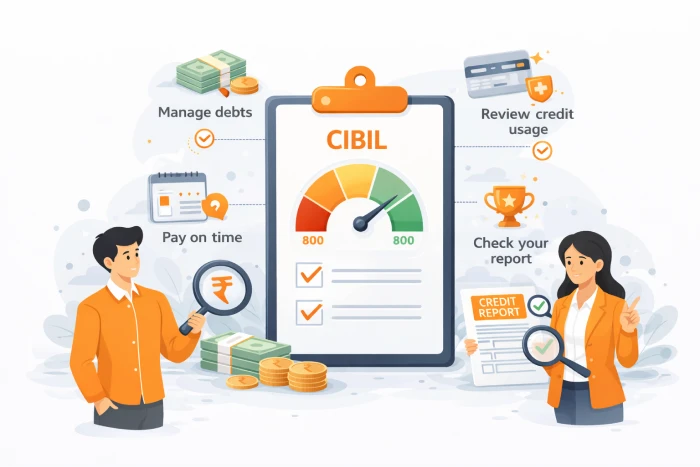
1. Credit Score and Credit History
Your credit score is one of the first filters.
Banks check your credit report from TransUnion CIBIL to review:
CIBIL score
Past repayment behaviour
Missed EMIs
Loan settlements
Credit card utilisation
Generally:
750+ score improves approval chances
Below 650 may reduce eligibility
At Saarathi.ai, we have seen that even a 50-point improvement can significantly change loan offers.
2. Monthly Income
Income indicates repayment capacity.
For salaried applicants, banks check:
Salary slips
Bank statements
Employer category
For self-employed applicants:
ITR filings
Profit and loss statements
GST returns
Higher income usually means higher loan eligibility, but it is not the only factor.
3. Debt-to-Income Ratio
Banks calculate how much of your income is already committed to EMIs.
Ideally:
Total EMIs should not exceed 40 to 50 percent of monthly income
If your income is Rs 60,000 and existing EMIs are Rs 30,000, eligibility may be restricted.
4. Employment Stability
Banks prefer:
Salaried individuals with at least 1 to 2 years of work experience
Self-employed individuals with stable business history of 2 to 3 years
Frequent job changes may impact eligibility.
5. Age of Applicant
Age determines the repayment window.
For example:
Personal loans typically require age between 21 and 60
Home loans may extend up to retirement age
Younger borrowers may get longer tenure options.
6. Type of Loan
Eligibility differs by loan type:
Personal loans are unsecured and require stronger credit profile
Home loans are secured, so eligibility may be higher
Business loans depend on cash flow
Each loan category has different risk parameters.
7. Loan Tenure Chosen
Longer tenure reduces EMI and increases eligibility.
However, it increases total interest paid.
Choosing the right tenure is a balance between affordability and cost.
8. Employer Profile or Business Category
Banks classify employers into:
Government
PSU
MNC
Private limited
Small enterprises
Applicants working in reputed organisations may receive better eligibility.
How Technology and AI Are Changing Eligibility Decisions
Modern lenders use:
AI-based underwriting models
Automated income analysis
Digital document verification
Financial coverage by The Economic Times highlights how digital lending platforms are reducing manual bias in eligibility decisions.
At Saarathi.ai, our AI-powered Recommendation Engine analyses your profile and matches you with lenders most likely to approve your loan. This reduces unnecessary rejections and credit enquiries.
How Banks Calculate Maximum Loan Amount
For salaried individuals, a common method is:
Eligible EMI = 40 to 50 percent of net monthly income
Then EMI is converted into loan amount based on interest rate and tenure.
Example:
If your net monthly income is Rs 80,000
Maximum EMI allowed may be around Rs 35,000
Based on interest rate and tenure, the bank calculates the loan amount.
This is why two people with same salary may get different loan offers depending on:
Credit score
Existing EMIs
Tenure preference
Common Reasons for Loan Rejection
Low CIBIL score
High credit card utilisation
Multiple recent loan enquiries
Incomplete documentation
Unstable income
High existing EMIs
Many borrowers apply to multiple banks after rejection, which further impacts credit score.
Instead, you can compare personal loan offers on Saarathi.ai and view suitable lenders before submitting formal applications.
How to Improve Loan Eligibility
1. Improve Credit Score
Pay EMIs on time and reduce credit card utilisation.
2. Reduce Existing EMIs
Close small loans before applying for new ones.
3. Increase Loan Tenure
Longer tenure reduces EMI and improves eligibility.
4. Add Co-Applicant
Especially useful for home loans.
5. Maintain Clean Banking History
Avoid cheque bounces and irregular salary credits.
Does Checking Eligibility Affect Credit Score?
Hard enquiries from lenders can affect your score.
However, using platforms that provide smart matching reduces unnecessary enquiries.
At Saarathi.ai, you can ask eligibility questions via Saarathi AI experts and explore options strategically.
How Saarathi.ai Simplifies Loan Eligibility Check
Saarathi.ai is an AI-powered digital lending marketplace connecting borrowers with 110+ banks and NBFCs.
With Saarathi.ai, you can:
Check eligibility instantly
Compare multiple lender offers in one place
Get AI-driven personalised recommendations
Track applications in Saarathi Bazaar dashboard
Experience a 100 percent paperless process
Instead of guessing your approval chances, you get clarity upfront.
Quick Summary: What Banks Check
Factor | Why It Matters |
Credit Score | Shows repayment discipline |
Income | Determines repayment capacity |
Existing EMIs | Indicates financial burden |
Employment Stability | Reflects income reliability |
Age | Affects loan tenure |
Loan Type | Determines risk level |
FAQs
1. What is the minimum CIBIL score required for loan eligibility?
Usually 700+, but 750+ improves approval chances significantly.
2. Can I get a loan with low income?
Yes, but the eligibility amount may be lower.
3. Does salary alone determine eligibility?
No. Credit history and existing EMIs are equally important.
4. How can I increase my loan eligibility quickly?
Reduce debt, improve credit score, and choose longer tenure.
5. Does checking loan eligibility affect credit score?
Only if a hard enquiry is made. Smart comparison reduces unnecessary checks.
Conclusion
Banks decide loan eligibility based on multiple financial factors, not just salary.
Remember:
Credit score plays a major role
Debt-to-income ratio impacts approval
Stable income improves eligibility
Strategic comparison prevents rejection
Before applying, understand where you stand.
Discover personalized loan options on Saarathi.ai today and check your eligibility with AI-powered precision and transparency.