Fixed vs Floating Interest Rate: What’s the Difference?
|
When taking a home loan, personal loan, or business loan, one of the most important decisions you make is choosing between a fixed interest rate and a floating interest rate.
This choice directly affects your EMI, total interest paid, and financial flexibility over the loan tenure. With changing repo rates and evolving lending norms in India, understanding this difference has become more important than ever.
At Saarathi.ai, we have observed that many borrowers select an interest type without fully understanding how it impacts long-term repayment. In this guide, we break down fixed vs floating interest rates in simple terms so you can make an informed decision in 2026.
What Is a Fixed Interest Rate?
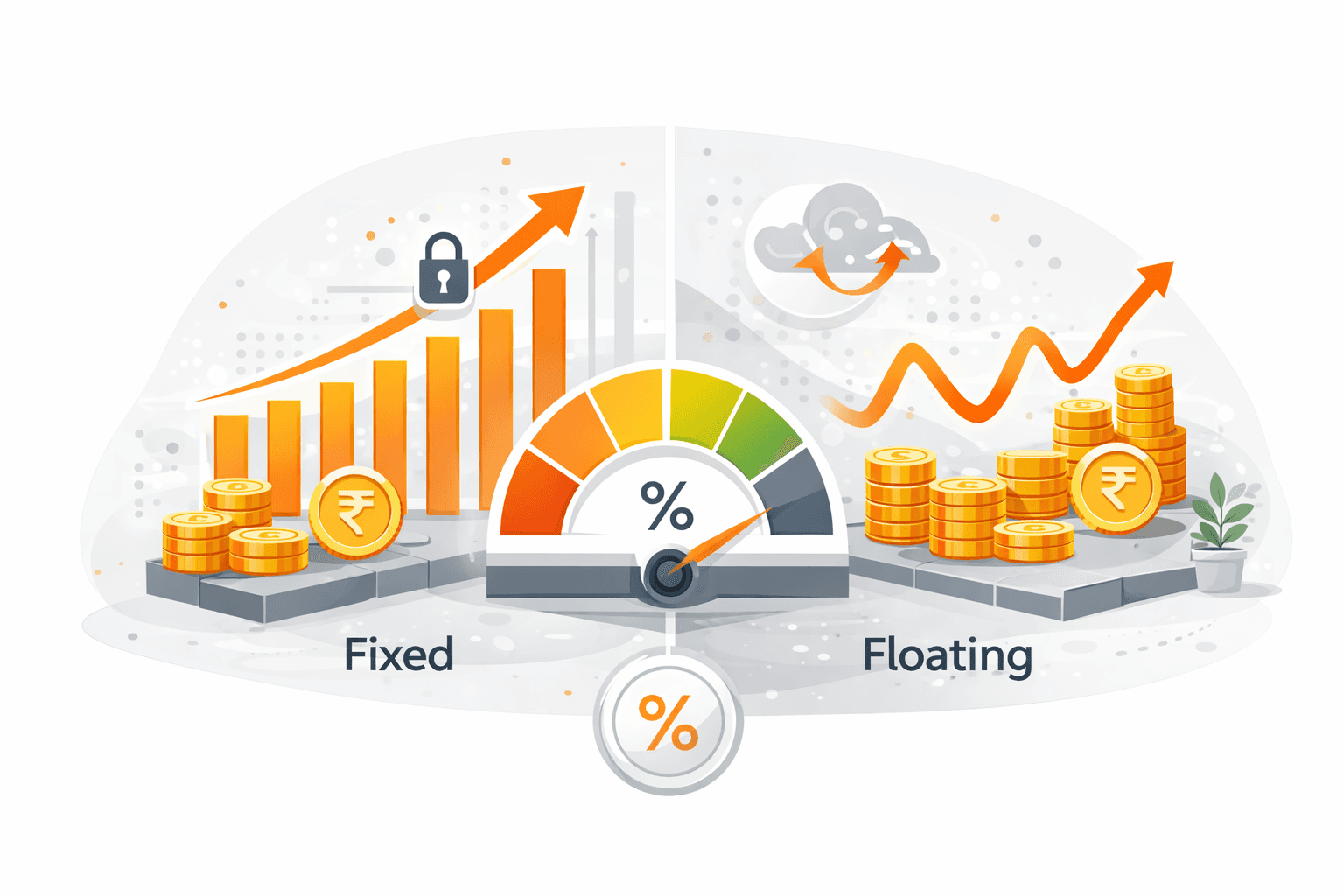
A fixed interest rate remains constant throughout the loan tenure or for a defined initial period.
This means:
Your EMI stays the same
Your interest rate does not change with market fluctuations
Your repayment schedule remains predictable
Lenders regulated by the Reserve Bank of India must clearly disclose whether the rate is fixed or floating in loan agreements.
Advantages of Fixed Interest Rate
Predictable EMI
Easier budgeting
Protection against rising interest rates
Disadvantages of Fixed Interest Rate
Usually higher than floating rates
Limited benefit if market rates fall
Possible prepayment charges
Fixed rates are common in personal loans where tenure is shorter.
What Is a Floating Interest Rate?
A floating interest rate changes based on market conditions. It is typically linked to an external benchmark such as the repo rate set by the Reserve Bank of India.
If the repo rate:
Increases → Your interest rate may rise
Decreases → Your interest rate may fall
As per RBI guidelines, most new home loans in India are linked to external benchmark rates.
Advantages of Floating Interest Rate
Usually lower starting rate
Benefit when rates fall
Often lower foreclosure penalties
Disadvantages of Floating Interest Rate
EMI may increase unexpectedly
Budget planning becomes harder
Total repayment may increase if rates rise
How Repo Rate Affects Floating Loans
The repo rate is the rate at which RBI lends money to banks.
When RBI increases repo rate:
Banks increase lending rates
Floating loan EMIs may rise
When RBI reduces repo rate:
Floating loan rates may reduce
Financial updates frequently covered by The Economic Times highlight how repo rate changes directly impact home loan borrowers.
Example: Fixed vs Floating Comparison
Assume you take a Rs 20 lakh home loan for 20 years.
Fixed Rate at 9.5 percent
EMI remains constant
No change regardless of market movement
Floating Rate starting at 9 percent
EMI lower initially
If rates rise to 10 percent, EMI increases
If rates drop to 8.5 percent, EMI reduces
The difference over 20 years can amount to lakhs.
At Saarathi.ai, our AI-powered recommendation engine compares both scenarios so borrowers can see potential long-term impact before choosing.
Which Option Is Better for Personal Loans?
Most personal loans in India come with fixed interest rates because:
Tenure is short
Risk for lenders is higher
EMI predictability is important
You can compare personal loan offers on Saarathi.ai to see interest type and tenure options across lenders.
Which Option Is Better for Home Loans?
Floating rates are more common in home loans because:
Tenure is long
Market rates fluctuate over time
RBI repo rate linkage ensures transparency
However, borrowers who prefer stability may choose fixed rates.
Factors to Consider Before Choosing
1. Interest Rate Trend
If rates are expected to rise, fixed rate may protect you.
If rates are expected to fall, floating rate may benefit you.
2. Loan Tenure
Short tenure: Fixed may work well
Long tenure: Floating may offer flexibility
3. Risk Appetite
If you prefer predictable budgeting, a fixed rate is safer.
If you can handle EMI fluctuations, floating may reduce long-term cost.
4. Prepayment Plans
Floating loans often have lower or zero foreclosure charges for individuals.
5. Credit Profile
Lenders assess your credit history through TransUnion CIBIL before offering rates. A higher score may fetch better pricing in both options.
Can You Switch Between Fixed and Floating?
Some lenders allow switching between rate types for a fee.
Options include:
Conversion charges
Balance transfer to another lender
Refinancing
Always calculate total cost before switching.
How EMI Changes in Floating Loans
When rates rise, lenders may:
Increase EMI
Extend tenure
Or adjust both
Understanding this clause in your loan agreement is important.
Quick Comparison Table
Feature | Fixed Rate | Floating Rate |
EMI Stability | Stable | Variable |
Initial Rate | Slightly Higher | Usually Lower |
Market Impact | No effect | Directly affected |
Budget Planning | Easy | Uncertain |
Benefit in Falling Rates | No | Yes |
How Saarathi.ai Helps You Choose Smartly
Saarathi.ai is an AI-powered digital lending marketplace connecting borrowers with 110+ banks and NBFCs.
With Saarathi.ai, you can:
Compare fixed and floating rate offers instantly
Get personalised recommendations via Saarathi Recommendation Engine
Ask eligibility questions through Saarathi AI expert
Track applications in Saarathi Bazaar dashboard
Complete the process 100 percent digitally
Instead of guessing which rate type is better, you can see data-backed comparisons in one place.
Common Mistakes to Avoid
Choosing fixed without checking rate premium
Selecting floating without understanding repo linkage
Ignoring total repayment comparison
Not reviewing foreclosure terms
Careful evaluation saves money over the long term.
FAQs
1. Is fixed interest rate safer than floating?
Yes, in terms of EMI predictability. But it may cost more if rates fall.
2. Can the floating rate become lower than fixed?
Yes, especially if RBI reduces repo rate.
3. Are personal loans fixed or floating?
Most personal loans in India have fixed interest rates.
4. Does switching interest type affect credit score?
No, but balance transfer involves new credit enquiry.
5. Which is better in 2026?
It depends on interest rate trends, loan tenure, and your risk comfort.
Conclusion
Understanding the difference between fixed and floating interest rates helps you borrow confidently.
Remember:
Fixed rates offer stability and predictable EMIs
Floating rates offer flexibility and benefit from falling rates
Loan tenure and market conditions matter
Compare total cost, not just EMI
Before finalising your loan, evaluate both options carefully.
Discover personalized loan options on Saarathi.ai today and choose the right interest rate with AI-powered clarity.