Budget 2026 Tax Changes: Will It affect your Loan Eligibility this year?
|
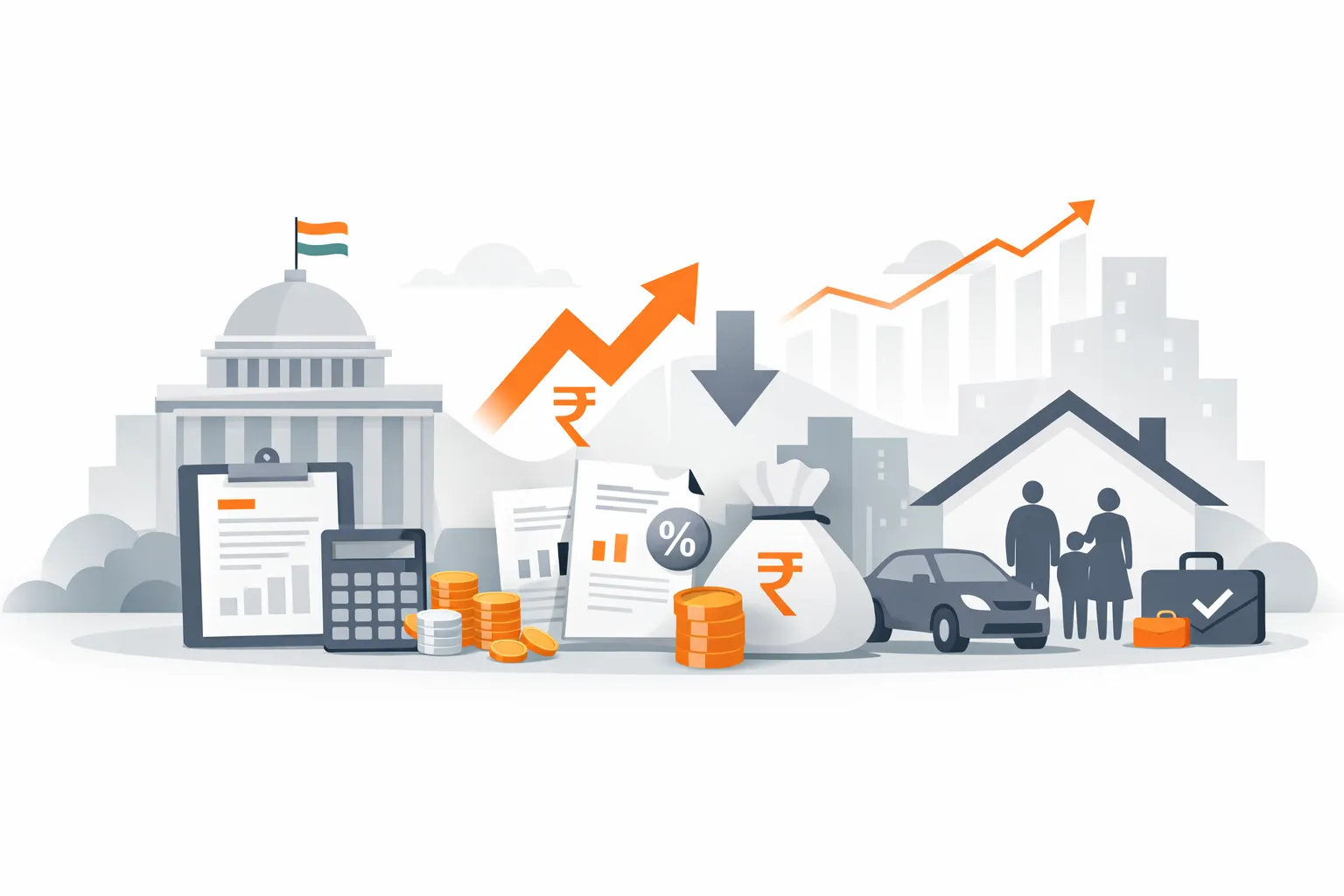
Every year, the Union Budget brings tax changes that affect your take-home salary and business income. But here is the real question: Will Budget 2026 tax changes affect your loan eligibility this year?
The short answer is yes. Tax slabs, rebates, and deductions directly influence your net income. And lenders calculate loan eligibility based on your net income, not just gross earnings.
At Saarathi.ai, we have observed that many borrowers overlook how budget announcements impact their borrowing capacity. A small tax tweak can increase or reduce your eligible loan amount significantly. Let us understand how.
What Changed in Budget 2026?
Budget 2026 introduced adjustments in:
Income tax slabs under the new regime
Standard deduction limits
Compliance and reporting requirements
Incentives for MSMEs and startups
These changes influence how much disposable income remains after tax.
The reforms were presented under the guidance of the Ministry of Finance and align with fiscal goals monitored by the Reserve Bank of India.
Now let us see how this connects to loan approval.
How Tax Changes Impact Loan Eligibility
Lenders assess three primary factors:
Net monthly income
Existing EMIs
Stability of income
If tax rates change, your net income changes. That directly affects your EMI capacity.
Example
Suppose:
Gross annual salary: Rs 15 lakh
Tax reduction under new slab: Rs 40,000
Increase in monthly take-home: Approx Rs 3,300
This additional disposable income can increase your loan eligibility by several lakhs depending on tenure and interest rate.
You can instantly check your updated eligibility using Saarathi AI before applying.
Impact on Salaried Borrowers
For salaried individuals, lenders calculate eligibility based on:
Net take-home salary
Form 16
ITR (for higher ticket loans)
If Budget 2026 reduced your tax liability:
Your debt-to-income ratio improves
EMI capacity increases
Chances of approval improve
However, if deductions were limited under certain regimes, your net income might decrease, affecting eligibility.
At Saarathi.ai, we have observed that borrowers switching between old and new tax regimes sometimes miscalculate their actual take-home income during loan application.
Impact on Self-Employed Borrowers
For business owners and professionals, tax changes affect:
Net profit after tax
Cash flow visibility
ITR reporting
If compliance requirements tightened, lenders may scrutinize documentation more closely.
Insights from CRISIL indicate that lenders increasingly rely on verified tax data to assess risk in unsecured lending.
If your declared income increases due to revised limits or incentives, your loan eligibility may improve in the next assessment cycle.
Budget 2026 and Home Loan Demand
Tax benefits related to housing often influence borrowing decisions.
If deductions under Section 80C or housing interest provisions were modified, it can:
Change affordability perception
Increase demand for home loans
Influence lender competition
You can compare updated home loan offers directly on Saarathi.ai and see which lenders are adjusting eligibility norms.
Budget 2026 and Business Loans
If MSME incentives or tax relief measures were introduced:
Business cash flow improves
Profit margins stabilize
Lender confidence increases
However, if compliance norms tightened, documentation requirements may increase.
Through Saarathi Bazaar, you can track documentation and approval status transparently.
Indirect Effects on Loan Eligibility
Tax changes also impact:
1. Inflation and Interest Rates
Fiscal policy influences monetary policy. The Reserve Bank of India may adjust repo rates based on budget direction.
If interest rates rise:
EMI increases
Loan eligibility decreases
If rates fall:
Borrowing capacity improves
2. Credit Demand and Lending Norms
Budget announcements often increase loan demand.
When demand rises sharply:
Lenders may tighten underwriting
Documentation scrutiny increases
Applying strategically becomes important.
Should You Apply Before or After Budget Changes?
It depends.
Apply immediately if:
Your take-home income improved
Tax outgo reduced
Your eligibility increased
Wait and reassess if:
New compliance rules affect your documentation
Income reporting changes are pending
You need to file updated ITR
At Saarathi.ai, we recommend checking eligibility digitally first instead of applying blindly.
How to Calculate Your Updated Eligibility
Follow these steps:
Calculate revised net monthly income
Subtract existing EMIs
Keep EMI-to-income ratio within 40-50 percent
Factor in current interest rates
You can do this instantly through Saarathi AI and receive lender-matched options.
Common Mistakes Borrowers Make After Budget
Assuming gross salary equals eligibility
Ignoring regime switch impact
Applying without updated documentation
Not recalculating EMI capacity
Applying to multiple lenders without comparison
Smart borrowers compare offers before submitting documents.
FAQs
1. Do tax slab changes immediately affect loan eligibility?
Yes, if they change your net take-home income.
2. Does Budget impact interest rates directly?
Not directly, but it influences monetary policy decisions by the RBI.
3. Should I switch tax regimes before applying for a loan?
Choose the regime that improves your net income and long-term tax planning.
4. Will higher deductions increase eligibility?
Yes, if they reduce tax and increase disposable income.
5. Do lenders consider budget incentives for MSMEs?
Yes, especially when assessing business stability and cash flow.
Conclusion
Budget 2026 tax changes can directly and indirectly impact your loan eligibility.
Here are the key takeaways:
Net income determines EMI capacity
Tax reductions can increase eligibility
Compliance changes may increase scrutiny
Interest rate shifts influence borrowing power
Strategic application improves approval chances
Before applying, discover personalized loan options on Saarathi.ai today. Check your updated eligibility instantly, compare multiple lenders, and apply with confidence.