Low CIBIL Score? Rebuild It Faster in 2026
|
A low CIBIL score can feel like a financial roadblock. Loan rejections, higher interest rates, and limited credit options often follow. In India, most banks and NBFCs prefer a CIBIL score of 750 and above for smooth approvals. But if your score has dropped due to missed EMIs, high credit utilization, or past defaults, do not panic. Credit repair is possible with the right strategy and discipline. At Saarathi.ai, we have observed that borrowers who take structured steps can see noticeable improvement within 6 to 12 months. This guide explains how to rebuild your CIBIL score faster and regain control of your financial future.
What Is Considered a Low CIBIL Score?
CIBIL scores range between 300 and 900.
750 and above - Excellent
700 to 749 - Good
650 to 699 - Average
Below 650 - Risk category
If your score is below 700, lenders may:
Reject your loan
Offer smaller loan amounts
Charge higher interest rates
Understanding your current score is the first step.
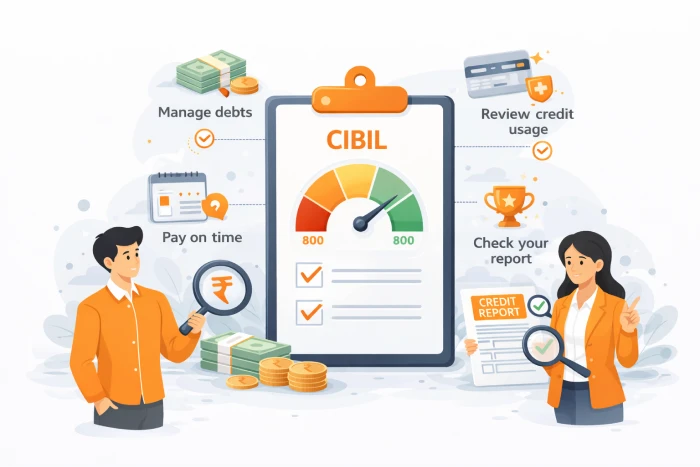
Step 1: Check Your Credit Report for Errors
Many borrowers are surprised to find mistakes in their credit report.
Common errors include:
Closed loans still marked active
Incorrect outstanding balances
Duplicate accounts
Wrong personal details
Loans that do not belong to you
Dispute incorrect entries immediately with the credit bureau. Even small corrections can improve your score.
Step 2: Clear Overdue Payments First
Payment history has the biggest impact on your CIBIL score.
If you have:
Missed EMIs
Credit card overdue
Delayed payments
Prioritize clearing these immediately.
Once cleared:
Ensure lender updates the status as settled or closed
Avoid further delays
Consistent repayment builds trust with lenders.
Step 3: Reduce Credit Utilization Ratio
Credit utilization refers to how much of your available credit limit you are using.
Healthy level: Below 30 percent.
Example:
Credit limit: Rs 1 lakh
Outstanding balance: Rs 80,000
Utilization: 80 percent
High utilization signals risk.
Try to:
Pay down outstanding balances
Avoid maxing out credit cards
Spread spending across cards if needed
Lower utilization can improve your score within a few billing cycles.
Step 4: Avoid Multiple Loan Applications
Every loan application triggers a hard inquiry.
Too many inquiries in a short time:
Reduce your score
Signal financial distress
Instead of applying randomly, you can compare personal loan offers on Saarathi.ai to match with suitable lenders intelligently.
This reduces unnecessary rejections and protects your score.
Step 5: Use Secured Credit Products
If your score is very low, consider:
Secured credit card against fixed deposit
Small secured loan
These products are easier to obtain and help rebuild payment history.
Make timely payments consistently.
Step 6: Maintain Old Credit Accounts
Length of credit history matters.
Do not close old credit cards if:
They have no annual fee
They help maintain low utilization
Longer history improves stability perception.
Step 7: Convert Outstanding to Structured EMI
If you are struggling with large credit card dues, converting them into structured EMIs may help:
Reduce default risk
Improve repayment pattern
Prevent further damage
Structured repayment shows discipline over time.
Step 8: Set Up Auto-Debit for All EMIs
One missed EMI can drop your score significantly.
Enable:
Auto-debit mandates
SMS reminders
Calendar alerts
Consistency is the key to rebuilding.
How Long Does It Take to Improve CIBIL Score?
Timeline depends on severity of damage.
Minor late payments: 3 to 6 months
High utilization issues: 2 to 4 months after reduction
Major defaults or settlements: 12 months or longer
At Saarathi.ai, we have observed that steady repayment behavior produces visible improvement within 6 months for most borrowers.
Common Mistakes That Delay Recovery
Avoid these errors:
Settling loan without full repayment
Closing all credit lines
Ignoring small overdue amounts
Applying to multiple loan apps
Taking new high-interest short-term loans
Short-term fixes often create long-term problems.
Real Scenario Example
Borrower had:
CIBIL score 620
Credit card overdue Rs 50,000
Two missed EMIs
Action taken:
Cleared overdue
Reduced credit utilization below 25 percent
Avoided new applications
Maintained 6 months clean repayment
Result:
Score improved to around 700 within 8 months.
Patience and discipline matter.
Can You Get a Loan With Low CIBIL Score?
Yes, but with conditions.
Some lenders evaluate:
Income stability
Bank transaction patterns
Employer profile
Debt-to-income ratio
However, interest rates may be higher.
Before applying, you can ask eligibility questions via Saarathi AI to understand your chances without damaging your score further.
For long-term goals like buying property, you can compare home loan offers on Saarathi.ai once your score improves to secure better rates.
Does Loan Settlement Affect CIBIL?
Yes.
Loan settlement is reported as “settled” rather than “closed”.
This signals partial repayment and negatively impacts creditworthiness.
If possible, aim for full closure instead of settlement.
Smart Habits for Long-Term Credit Health
Keep EMI ratio below 40 percent of income
Build emergency fund
Avoid impulsive BNPL usage
Monitor credit report every few months
Plan borrowing strategically
Financial discipline builds stronger credit profile.
Emotional Side of Low Credit Score
Loan rejections can feel discouraging.
Remember:
Credit score reflects past behavior, not future potential
Improvement is fully possible
Lenders value consistent positive trend
Small disciplined actions compound over time.
FAQs
1. Can I increase my CIBIL score in 30 days?
Significant improvement takes time, but reducing credit utilization may show minor gains quickly.
2. Does checking my own credit score reduce it?
No. Self-checks are soft inquiries and do not affect score.
3. Is loan settlement better than default?
Yes, but full repayment is better for long-term credit health.
4. How often is CIBIL score updated?
Usually monthly, depending on lender reporting cycle.
5. Should I close unused credit cards?
Not necessarily. Keeping them open may help maintain credit history length.
Conclusion
A low CIBIL score is not permanent.
Key Takeaways:
Check and correct errors immediately.
Clear overdue payments first.
Reduce credit utilization below 30 percent.
Avoid multiple loan applications.
Maintain consistent repayment discipline.
Rebuilding credit takes patience, but the results are worth it. Discover smart, transparent loan options on Saarathi.ai today and move toward stronger financial health with confidence.