Co-Lending Models in India: What Borrowers Must Know
|
Co-lending models are reshaping India’s digital lending ecosystem. In 2026, many loans are no longer funded by a single bank or NBFC alone. Instead, banks and fintech platforms partner to jointly offer loans to borrowers. This structure improves credit access, speeds up approvals, and expands financial inclusion. However, borrowers often feel confused. Who is the actual lender? Who sets the interest rate? Who handles repayment or complaints? At Saarathi.ai, we have observed that clarity around co-lending builds trust and improves borrower confidence. This guide explains how co-lending works, what RBI regulations say, and what you must verify before accepting a loan.
What Is a Co-Lending Model?
A co-lending model is a partnership where:
A bank and an NBFC or fintech jointly fund a loan
Risk is shared between entities
Loan servicing may be handled by one partner
Typically, the bank provides a larger share of the loan amount, while the fintech or NBFC manages sourcing, underwriting support, and servicing.
This structure combines:
Bank capital strength
Fintech technology
Faster processing
Wider borrower reach
Why Co-Lending Is Growing in India
Several reasons drive this growth:
1. Financial Inclusion
Banks can reach underserved borrowers through fintech distribution networks.
2. AI-Based Underwriting
Fintech platforms use AI to assess alternative data, helping gig workers and MSMEs.
3. Faster Disbursal
Digital platforms reduce manual paperwork.
4. Regulatory Support
RBI has formalized co-lending guidelines to promote structured partnerships.
At Saarathi.ai, we have observed increased approvals for self-employed borrowers under structured co-lending arrangements.
How Does Co-Lending Work?
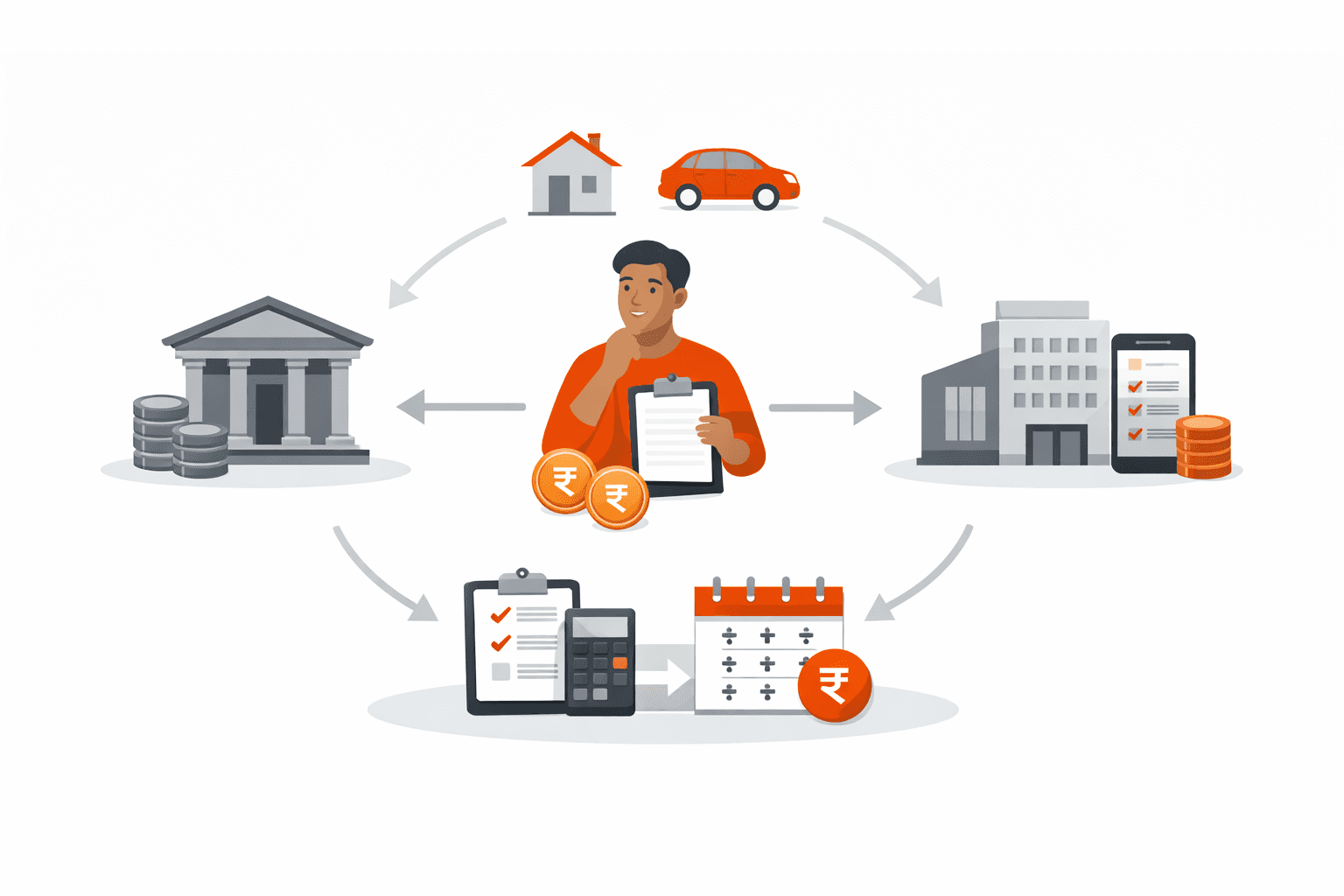
Here is a simplified structure:
Borrower applies via fintech platform
Credit assessment is conducted
Loan is jointly funded by bank and NBFC
EMI is paid to designated servicing partner
Risk and returns are shared
Even though two entities fund the loan, the borrower experiences a single unified process.
Who Is the Actual Lender?
This is the most common question.
In a co-lending model:
Both bank and NBFC are lenders
Loan agreement must clearly mention all funding entities
RBI requires transparent disclosure
Always check:
Name of regulated bank
Name of NBFC partner
Interest rate breakdown
Processing charges
On trusted marketplaces like Saarathi.ai, lender details are displayed transparently before you proceed.
Interest Rates in Co-Lending
Interest rates depend on:
Borrower risk profile
Loan type
Tenure
Bank and NBFC cost of funds
Sometimes co-lending reduces rates because banks have lower cost of capital. In other cases, pricing reflects shared risk.
You should compare total repayment amount rather than focusing only on monthly EMI.
You can compare personal loan offers on Saarathi.ai to see transparent interest comparisons across multiple lenders.
Benefits of Co-Lending for Borrowers
1. Better Access to Credit
Borrowers in semi-urban and rural areas benefit from fintech reach.
2. Faster Processing
Digital onboarding reduces approval time.
3. Competitive Pricing
Shared funding may reduce interest burden.
4. Inclusion of Non-Traditional Profiles
Freelancers and small business owners get improved evaluation through AI analysis.
Risks and Concerns
Despite advantages, borrowers must remain cautious.
1. Confusion Over Responsibility
Who handles grievance redressal?
Who reports to credit bureau?
The loan agreement should clarify this.
2. Data Sharing Between Partners
Ensure proper consent and privacy compliance.
3. Collection Practices
Recovery must follow RBI fair practice code.
4. Complexity in Loan Statements
EMI servicing partner should provide clear repayment schedule.
At Saarathi.ai, we emphasize transparency and provide borrowers visibility through Saarathi Bazaar dashboard where you can track application status and lender details in one place.
RBI Guidelines on Co-Lending
RBI has laid down key principles:
Formal agreement between bank and NBFC
Clear risk-sharing arrangement
Transparent borrower communication
Proper loan documentation
Reporting to credit bureaus
Borrowers must receive a single comprehensive loan agreement that explains terms clearly.
Co-Lending vs Traditional Lending
Factor | Co-Lending | Traditional Lending
Funding Source | Bank plus NBFC | Single lender
Speed | Faster due to fintech tech | Moderate
Risk Sharing | Shared | Single entity
Borrower Experience | Unified digital | Varies
Access for New Borrowers | Higher | Limited in some cases
For planned long-term borrowing like property purchase, you can compare home loan offers on Saarathi.ai to evaluate both traditional and co-lending options.
Real Borrower Example
Consider a small business owner with moderate CIBIL score but strong GST records.
Traditional bank underwriting may hesitate due to score threshold.
In co-lending:
Fintech analyzes cash flow digitally
Bank funds majority portion
Risk is distributed
Approval chances improve
This demonstrates how technology and capital combine to expand access.
Does Co-Lending Affect Your Credit Score?
Yes.
Repayment behavior is reported to credit bureaus.
Timely EMI improves score
Delays reduce score
Multiple parallel loans increase exposure
Borrowers should monitor credit health carefully.
Before applying, you can ask eligibility questions via Saarathi AI to avoid unnecessary hard inquiries.
Is Co-Lending Safe?
Yes, when:
Both partners are RBI-registered
Terms are clearly disclosed
Data privacy norms are followed
Recovery practices comply with regulations
Always verify regulated entity names in the loan agreement.
Future of Co-Lending in India
In 2026 and beyond, co-lending may evolve with:
Account Aggregator integration
Real-time underwriting
Dynamic risk-based pricing
Deeper MSME penetration
Embedded finance partnerships
The model supports India’s financial inclusion goals while maintaining regulatory oversight.
When Should You Consider Co-Lending?
Good fit for:
MSMEs
Self-employed professionals
Gig workers
Borrowers in Tier 2 and Tier 3 cities
Applicants with moderate CIBIL but strong cash flow
Not ideal for:
Borrowers who prefer traditional branch-based interaction
Complex structured loans requiring customized negotiation
FAQs
1. Is co-lending legal in India?
Yes. RBI has formalized guidelines for bank and NBFC partnerships.
2. Who do I contact for complaints?
Loan agreement specifies servicing partner and grievance officer details.
3. Can co-lending reduce interest rates?
Sometimes, due to bank participation. Compare total cost before deciding.
4. Does co-lending mean higher risk?
No. Risk is shared between institutions, not transferred to borrower.
5. Will EMI be paid to two lenders?
No. Borrower typically pays a single EMI to designated servicing partner.
Conclusion
Co-lending models are strengthening India’s digital lending ecosystem.
Key Takeaways:
Banks and fintechs jointly fund loans.
RBI ensures transparency and compliance.
AI improves access for non-traditional borrowers.
Always verify lender details in agreement.
Comparing options ensures better pricing and clarity.
Before choosing any co-lending offer, compare transparently and understand your terms. Discover personalized loan options on Saarathi.ai today and track your application securely in one unified dashboard.