AI Credit Scoring or CIBIL: What Works Best?
|
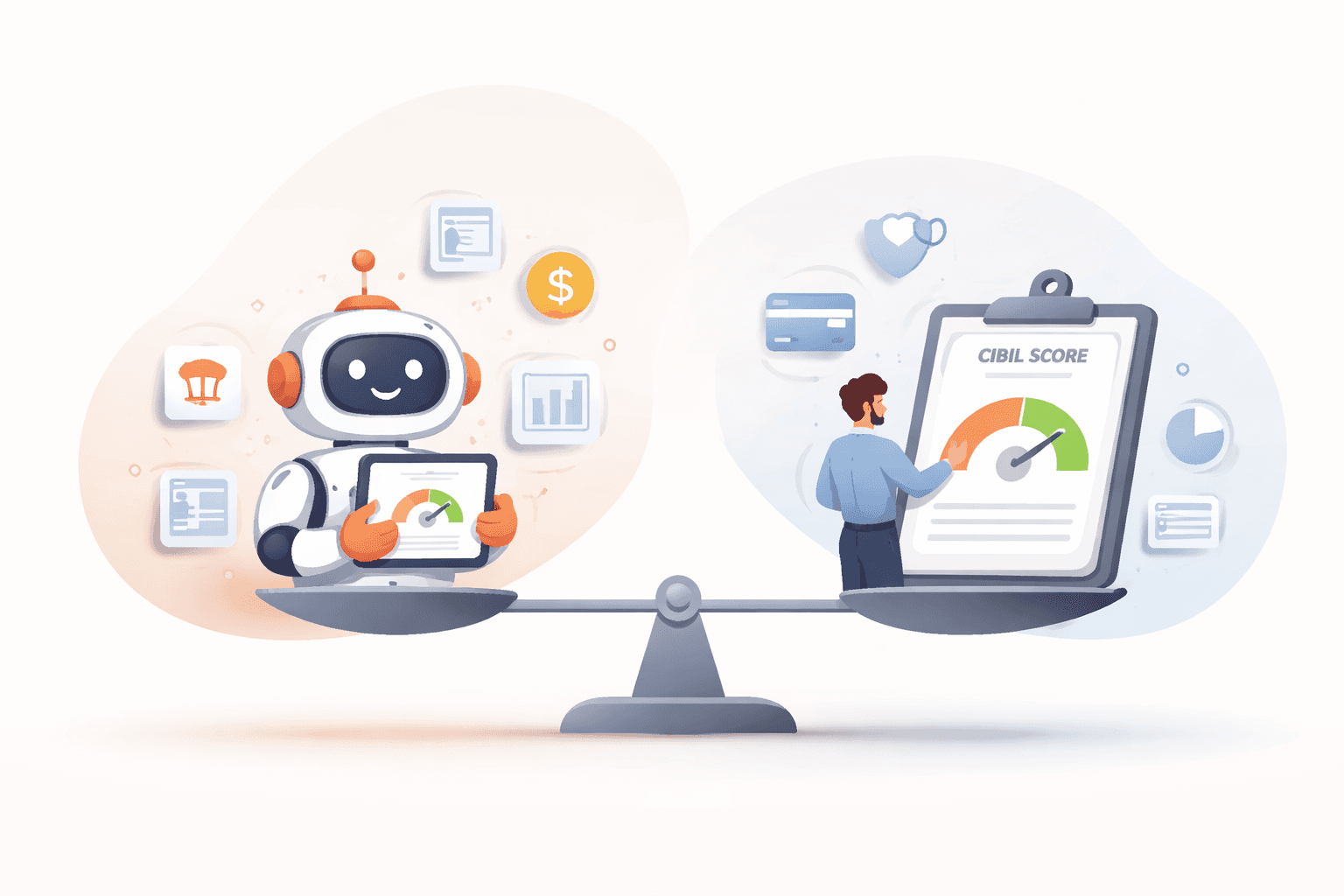
Are AI-driven credit scores better than traditional CIBIL scores? The short answer is: it depends on your financial profile. In 2026, lenders are increasingly using AI-based credit assessment models alongside traditional CIBIL scores to evaluate loan eligibility. While CIBIL scores remain the backbone of Indian lending decisions, AI-driven models use alternative data and predictive analytics to assess borrowers more holistically. For many first-time borrowers, gig workers, and self-employed professionals, AI scoring can unlock opportunities that traditional scoring may miss. At Saarathi.ai, we have observed a rising number of borrowers getting approvals through AI-supported underwriting even when their CIBIL score is moderate or thin. Let us break down how both systems work and which one may benefit you more.
What Is a Traditional CIBIL Score?
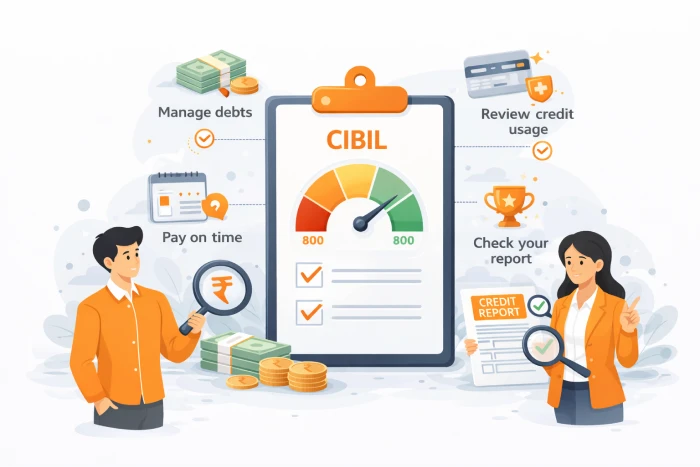
A CIBIL score is a three-digit number ranging from 300 to 900 that reflects your creditworthiness. It is generated by TransUnion CIBIL based on your credit history.
How CIBIL Score Is Calculated
Your CIBIL score is based on:
Repayment history
Credit utilization ratio
Length of credit history
Credit mix
Recent credit inquiries
Banks and NBFCs typically prefer a score of 750 or above for smoother approvals, especially for home loans and large-ticket loans.
Strengths of CIBIL Scoring
Standardized across lenders
Regulated by RBI guidelines
Widely accepted in India
Easy to understand benchmark
Limitations of CIBIL Scoring
Does not consider alternative income patterns
Penalizes new-to-credit borrowers
Limited flexibility for gig workers and freelancers
Reflects past behavior, not future earning potential
Many borrowers with stable incomes but limited credit history struggle because they are considered “thin file” customers.
What Are AI-Driven Credit Scores?
AI-driven credit scores use machine learning models and alternative data to assess credit risk. Instead of relying only on bureau data, these systems analyze broader financial behavior.
Data Points Used in AI Scoring
AI models may evaluate:
Bank transaction patterns
Cash flow consistency
GST filings for business owners
Digital payment behavior
Utility bill payments
Employment stability
Spending behavior trends
These models aim to predict repayment probability rather than just reviewing historical defaults.
At Saarathi.ai, our Saarathi Recommendation Engine uses intelligent matching to connect borrowers with lenders whose underwriting models suit their profile. This increases approval probability without unnecessary rejections.
Key Differences: AI Credit Score vs CIBIL Score
Below is a simple comparison to understand how both systems differ.
Parameter | CIBIL Score | AI-Driven Score
Data Source | Credit bureau data | Bureau + alternative data
Focus | Past credit behavior | Predictive future risk
Best For | Salaried with credit history | Gig workers, MSMEs, new borrowers
Flexibility | Limited | Highly adaptive
Transparency | Standardized | Model-based, varies by lender
Are AI Scores More Accurate?
AI models can be more accurate in specific cases, especially when:
The borrower has irregular income but strong cash flow
There is limited formal credit history
The borrower runs a small business with steady GST returns
According to industry insights published in leading financial publications like Economic Times and RBI digital lending discussions, alternative data is increasingly used to expand credit inclusion.
However, accuracy depends on model quality. AI systems can sometimes misinterpret spending patterns or seasonal income.
The Risk of Algorithmic Bias
One common doubt people have is whether AI scoring is fair. Since AI models learn from historical data, they can inherit biases if not designed properly.
Regulators and lenders are focusing on:
Transparent underwriting policies
Fair lending practices
Regular model audits
Traditional CIBIL scoring, though rigid, is standardized. AI models must maintain explainability to ensure borrowers understand approval or rejection reasons.
At Saarathi.ai, we emphasize transparent loan matching so that borrowers are not left guessing why they were declined.
Can AI Replace CIBIL Scores Completely?
Not yet.
In India, CIBIL and other credit bureau scores remain central to lending decisions. RBI guidelines still require lenders to consider bureau data.
However, AI is increasingly being used as:
A supplementary assessment tool
A risk calibration layer
A decision accelerator
In many cases, lenders combine both systems. A strong CIBIL score with positive AI-based cash flow analysis can result in better interest rates.
When AI Scoring Helps More Than CIBIL
1. First-Time Borrowers
If you have never taken a loan or credit card, your CIBIL score may not exist. AI models can assess your banking transactions and income patterns.
2. Self-Employed Professionals
Doctors, CAs, consultants, and freelancers often have fluctuating income. AI models analyze average cash flow rather than fixed salary slips.
3. MSME Owners
Business owners with strong GST filings and digital payments history may qualify even if their personal CIBIL score is average.
4. Rebuilding Credit
Borrowers recovering from past defaults can benefit if recent financial behavior shows improvement.
When CIBIL Score Matters More
1. Large Home Loans
Banks still heavily rely on bureau scores for home loans above Rs 30 lakh.
2. Low Interest Negotiation
A CIBIL score above 780 often helps negotiate lower interest rates.
3. Premium Credit Cards
High-end financial products still prioritize traditional scoring.
If you are planning to apply for a home loan, it is wise to check eligibility through tools like compare home loan offers on Saarathi.ai before applying.
Common Doubts About AI Credit Scoring
Is My Data Safe?
Reputable platforms follow RBI digital lending guidelines. Always ensure the lender is registered and transparent about data usage.
On Saarathi.ai, borrowers can review lender details and track offers securely inside Saarathi Bazaar dashboard without sharing data repeatedly.
Will AI Check My Social Media?
Legitimate lenders focus on financial data, not personal social content. Unauthorized data scraping is not allowed under regulatory frameworks.
Does AI Approve Loans Instantly?
AI speeds up decisioning but does not guarantee approval. Final approval depends on lender risk policy.
Interest Rates: Who Gets Better Deals?
A common misconception is that AI-based approval means higher interest rates. That is not necessarily true.
Interest rates depend on:
Risk category
Loan type
Lender policy
Income stability
AI may help borderline applicants qualify, but strong credit profiles continue to get the lowest rates.
Using compare personal loan offers on Saarathi.ai, borrowers can see multiple options transparently rather than accepting the first offer.
How Saarathi.ai Uses AI Responsibly
At Saarathi.ai, we blend technology with human oversight.
Here is how our process works:
Borrower enters basic details
Saarathi AI expert checks eligibility instantly
AI matches borrower with 110 plus lenders
Offers are displayed in Saarathi Bazaar
Borrower tracks application in real time
This hybrid approach ensures:
Faster approvals
Reduced rejection impact
Transparent comparisons
Paperless documentation
We have observed that borrowers with moderate CIBIL scores often get matched successfully when their banking patterns are strong.
Practical Example
Consider two borrowers:
Borrower A
CIBIL score: 790
Stable salaried income
Low credit utilization
Borrower B
CIBIL score: 690
Self-employed with consistent monthly bank credits
Strong GST compliance
Traditional underwriting favors Borrower A.
AI-assisted underwriting may still approve Borrower B with fair pricing.
This is where AI expands financial inclusion.
Should You Focus on Improving CIBIL or Banking Patterns?
The best strategy is to improve both.
Improve Your CIBIL Score By:
Paying EMIs on time
Keeping credit utilization below 30 percent
Avoiding frequent loan applications
Maintaining long credit history
Improve AI-Based Assessment By:
Maintaining steady bank balance
Avoiding frequent cheque bounces
Filing GST on time
Using digital payments consistently
If you are unsure where you stand, you can ask eligibility questions via Saarathi AI expert before formally applying.
Regulatory Outlook in India
RBI has emphasized responsible digital lending, data privacy, and transparent algorithms. AI scoring must align with:
Fair practices code
Transparent interest disclosure
Borrower consent frameworks
This ensures that innovation does not compromise consumer protection.
So, Are AI-Driven Credit Scores Better?
The honest answer is:
For salaried borrowers with strong history, CIBIL remains powerful.
For new-to-credit, gig workers, and MSMEs, AI scoring can be transformative.
The future of lending is hybrid, not either-or.
At Saarathi.ai, we believe in combining bureau strength with AI intelligence to create smarter loan journeys.
FAQs
1. Can I get a loan with low CIBIL but strong income?
Yes, some lenders use AI-based assessment to evaluate cash flow and may approve loans despite moderate scores.
2. Do AI credit models affect my official CIBIL score?
No. AI scoring is internal to lenders and does not change your bureau score.
3. Are AI-approved loans riskier?
Not necessarily. Risk depends on borrower profile and repayment capacity.
4. How can I check which lenders use AI models?
Platforms like Saarathi.ai match you intelligently without multiple hard inquiries.
5. Will AI replace credit bureaus in India?
Unlikely in the near future. AI will complement traditional bureau scoring.
Conclusion
Both AI-driven credit scores and CIBIL scores play important roles in 2026 lending decisions.
Key Takeaways:
CIBIL score reflects past credit discipline.
AI scoring evaluates broader financial behavior.
Hybrid underwriting increases approval chances.
First-time and self-employed borrowers benefit most from AI models.
Transparency and responsible lending remain critical.
If you want to see how lenders evaluate your profile using intelligent matching, discover personalized loan options on Saarathi.ai today. Get faster approvals, compare offers transparently, and track everything digitally in one place.